
Seismic Doublet (Doublet Earthquake)
- 26 Jun 2026
In News:
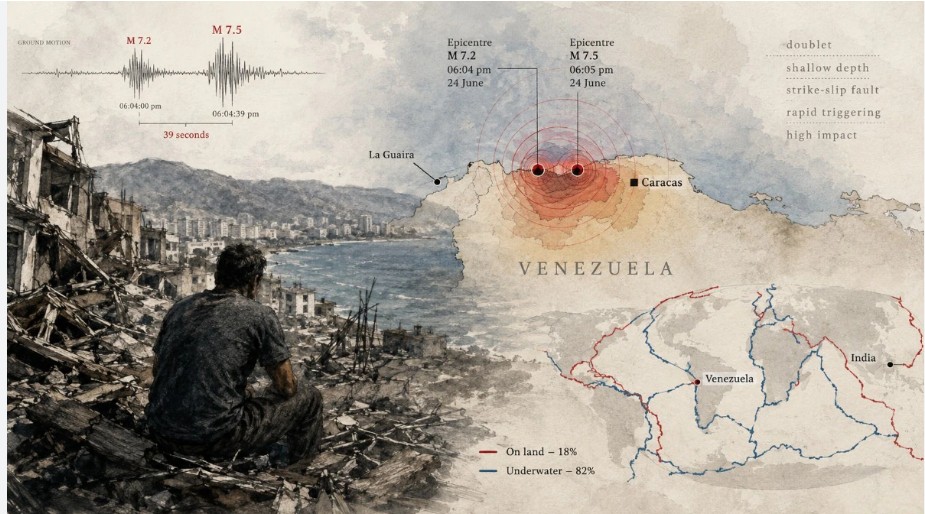
The Government of Venezuela has declared a nationwide State of Emergency after two powerful earthquakes of magnitude 7.2 and 7.5 struck off its north-central coast within a short interval. The rare seismic doublet caused extensive damage to infrastructure and significant loss of life.
What is a Seismic Doublet?
A Seismic Doublet (or Doublet Earthquake) refers to the occurrence of two earthquakes of nearly equal magnitude that strike close together in both time and location.
Unlike a typical mainshock-aftershock sequence, where the aftershocks are significantly weaker than the main earthquake, a seismic doublet involves two major earthquakes of comparable intensity. The second earthquake is not merely an aftershock but an independent large event triggered by stress transferred from the first rupture.
Mechanism
When the first earthquake occurs, it does not completely release the accumulated tectonic stress along a fault. Instead, part of this stress is rapidly transferred to a neighbouringfault segment or an asperity (a strongly locked patch of rock along a fault).
If the adjacent fault is already close to failure, the additional stress may trigger another major rupture within a short period, resulting in a seismic doublet.
Why is Venezuela Highly Earthquake-Prone?
Venezuela is situated along the active boundary between the Caribbean Plate and the South American Plate, making its northern region highly susceptible to earthquakes.
- The Caribbean Plate moves eastward relative to the South American Plate at a rate of approximately 20 mm per year.
- The movement is accommodated through a network of east-west trending strike-slip faults across northern Venezuela.
- These faults periodically accumulate stress due to friction and release it through powerful earthquakes.
Many earthquakes in Venezuela are shallow-focus earthquakes, meaning they originate close to the Earth's surface. As a result, seismic waves lose little energy before reaching the surface, leading to greater destruction.
What is a Strike-Slip Fault?
A strike-slip fault is a type of fault in which blocks of rock move horizontally past one another due to shear stress.
- The movement is predominantly lateral rather than vertical.
- It commonly occurs along transform plate boundaries.
- Sudden movement along these faults generates shallow and often destructive earthquakes.
Relevance to India
India is among the world's most earthquake-prone countries due to the ongoing convergence of the Indian Plate with the Eurasian Plate.
The collision has created the Himalayan mountain system, where enormous tectonic stress continues to accumulate, making the region vulnerable to major earthquakes.
Areas falling under Seismic Zone V (Very High Risk Zone) include:
- Himalayan States
- North-Eastern India
- Parts of Gujarat
- Andaman & Nicobar Islands
Given the presence of highly stressed fault systems, earthquake doublets cannot be ruled out in tectonically active regions, highlighting the importance of continuous seismic monitoring, earthquake-resistant infrastructure, and disaster preparedness.
In News:
The Government of Venezuela has declared a nationwide State of Emergency after two powerful earthquakes of magnitude 7.2 and 7.5 struck off its north-central coast within a short interval. The rare seismic doublet caused extensive damage to infrastructure and significant loss of life.
What is a Seismic Doublet?
A Seismic Doublet (or Doublet Earthquake) refers to the occurrence of two earthquakes of nearly equal magnitude that strike close together in both time and location.
Unlike a typical mainshock-aftershock sequence, where the aftershocks are significantly weaker than the main earthquake, a seismic doublet involves two major earthquakes of comparable intensity. The second earthquake is not merely an aftershock but an independent large event triggered by stress transferred from the first rupture.
Mechanism
When the first earthquake occurs, it does not completely release the accumulated tectonic stress along a fault. Instead, part of this stress is rapidly transferred to a neighbouringfault segment or an asperity (a strongly locked patch of rock along a fault).
If the adjacent fault is already close to failure, the additional stress may trigger another major rupture within a short period, resulting in a seismic doublet.
Why is Venezuela Highly Earthquake-Prone?
Venezuela is situated along the active boundary between the Caribbean Plate and the South American Plate, making its northern region highly susceptible to earthquakes.
- The Caribbean Plate moves eastward relative to the South American Plate at a rate of approximately 20 mm per year.
- The movement is accommodated through a network of east-west trending strike-slip faults across northern Venezuela.
- These faults periodically accumulate stress due to friction and release it through powerful earthquakes.
Many earthquakes in Venezuela are shallow-focus earthquakes, meaning they originate close to the Earth's surface. As a result, seismic waves lose little energy before reaching the surface, leading to greater destruction.
What is a Strike-Slip Fault?
A strike-slip fault is a type of fault in which blocks of rock move horizontally past one another due to shear stress.
- The movement is predominantly lateral rather than vertical.
- It commonly occurs along transform plate boundaries.
- Sudden movement along these faults generates shallow and often destructive earthquakes.
Relevance to India
India is among the world's most earthquake-prone countries due to the ongoing convergence of the Indian Plate with the Eurasian Plate.
The collision has created the Himalayan mountain system, where enormous tectonic stress continues to accumulate, making the region vulnerable to major earthquakes.
Areas falling under Seismic Zone V (Very High Risk Zone) include:
- Himalayan States
- North-Eastern India
- Parts of Gujarat
- Andaman & Nicobar Islands
Given the presence of highly stressed fault systems, earthquake doublets cannot be ruled out in tectonically active regions, highlighting the importance of continuous seismic monitoring, earthquake-resistant infrastructure, and disaster preparedness.