
Sanchi Stupa
- 29 May 2026
In News:
- India has decided to send the sacred relics of Lord Buddha's two foremost disciples—Sariputra and Maudgalyayana—from the Sanchi Stupa to Mongolia.
- The initiative aims to strengthen India's civilizational ties with Mongolia, promote Buddhist heritage, and reinforce cultural diplomacy under the shared legacy of Buddhism.
- The relics, revered by Buddhists across the world, symbolize India's role as the birthplace of Buddhism and underscore the country's efforts to preserve and globally showcase its rich cultural heritage.
Sanchi Stupa: A Symbol of India's Buddhist Heritage
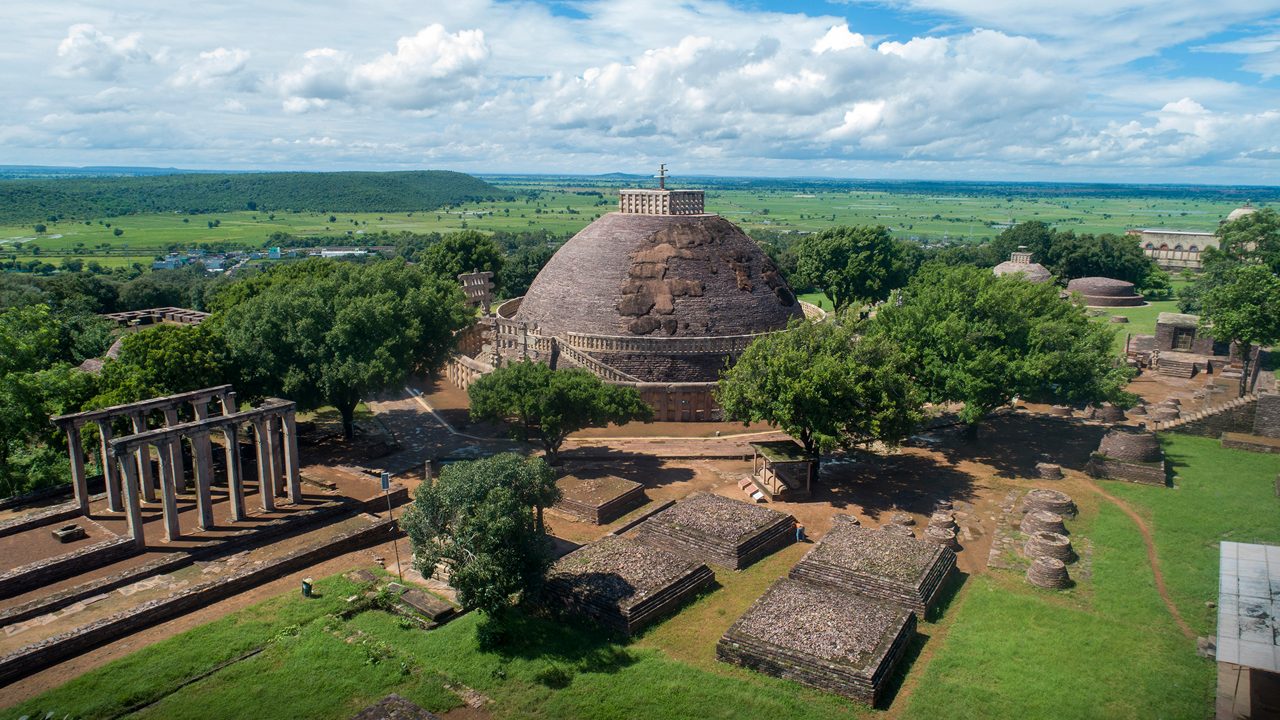
The Sanchi Stupa, located in Madhya Pradesh, is one of the oldest and best-preserved Buddhist monuments in the world. It was originally commissioned by Emperor Ashoka in the 3rd century BCE following his conversion to Buddhism after the Kalinga War.
The construction of the Great Stupa is believed to have been supervised by Ashoka's wife, Devi, who hailed from nearby Vidisha. The expansion and embellishment of the Sanchi complex in subsequent centuries received considerable patronage from the prosperous mercantile community of Vidisha, contributing to its development as a major centre of Buddhist learning and pilgrimage.
Unlike many other Buddhist monuments, Sanchi remained an important religious site for several centuries, preserving valuable evidence of the evolution of Buddhist architecture and art from the Mauryan period to the Gupta era.
Sacred Relics of Sariputra and Maudgalyayana
The Sanchi Stupa enshrines the sacred relics of Sariputra and Maudgalyayana, two of the closest and most revered disciples of Lord Buddha.
- Sariputra is regarded as the foremost disciple renowned for his profound wisdom (Prajna).
- Maudgalyayana (Mahamoggallana) is remembered for his exceptional spiritual attainments and mastery of supernatural powers.
These relics are among the most sacred objects in Buddhist tradition and attract immense reverence from Buddhist communities across Asia.
The decision to temporarily send these relics to Mongolia reflects India's commitment to promoting international Buddhist cooperation and strengthening people-to-people ties with Buddhist-majority nations.
Architectural Features of the Sanchi Stupa
The Great Stupa at Sanchi represents one of the finest examples of early Buddhist architecture.
The monument is enclosed by a massive stone railing with four elaborately carved gateways (Toranas) facing the cardinal directions. These gateways are adorned with intricate sculptures depicting scenes from the life of the Buddha, Jataka tales, symbols of Buddhism, and contemporary social life. Since the Buddha was initially represented through symbols rather than human form, the carvings prominently feature motifs such as the Bodhi Tree, empty throne, footprints, wheel (Dharmachakra), and stupa.
The structural components of the stupa carry deep symbolic significance:
- Anda (Hemispherical Dome): Represents the cosmic mound and symbolizes the universe as well as the Parinirvana of the Buddha.
- Harmika: A square railing placed above the dome representing the sacred world mountain (Mount Meru).
- Yashti: The central mast symbolizing the cosmic axis connecting heaven and earth.
- Chatras (Umbrellas): Multiple umbrella discs mounted on the mast symbolize spiritual sovereignty, protection, and the various heavenly realms (Devaloka).
Together, these architectural elements reflect Buddhist cosmology and spiritual philosophy.
Rediscovery and Conservation
Following the decline of Buddhism in India, the Sanchi complex gradually fell into neglect. It remained largely abandoned until it was rediscovered by British officer Henry Taylor in 1818.
Later, Alexander Cunningham, often regarded as the father of Indian archaeology, conducted the first systematic survey and excavations at Sanchi in 1851, laying the foundation for its scientific conservation.
Today, the monument is one of India's most important archaeological sites and has been recognized as a UNESCO World Heritage Site since 1989.