
SamagraShishu Bal SwasthyaKaryakram (SSBSK)
- 01 Jul 2026
In News:
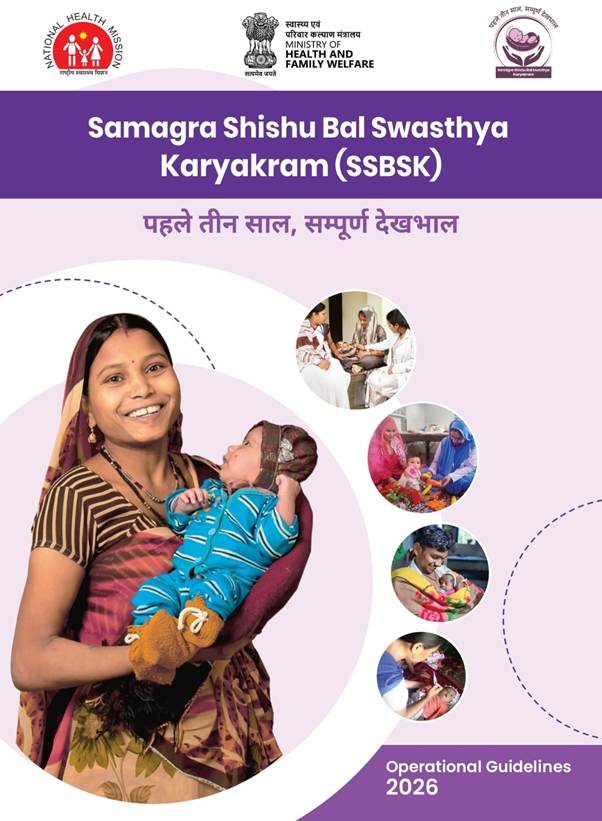
The Union Minister of Health and Family Welfare recently launched the SamagraShishu Bal SwasthyaKaryakram (SSBSK), a comprehensive national programme aimed at providing a seamless continuum of healthcare for children from birth to 36 months of age through integrated home and community-based services.
About SamagraShishu Bal SwasthyaKaryakram (SSBSK)
The SamagraShishu Bal SwasthyaKaryakram (SSBSK) is a unified national programme that seeks to provide comprehensive care during the first three years of a child's life, a period considered critical for survival, growth, and development.
The programme integrates the existing Home-Based Newborn Care (HBNC) and Home-Based Care for Young Child (HBYC) into a single, comprehensive framework, ensuring continuity of care from birth up to 36 months.
By adopting a life-cycle approach, SSBSK strengthens preventive, promotive, curative, and developmental interventions through coordinated efforts at the household, community, and health facility levels.
Key Features
A major feature of SSBSK is its risk-stratified approach, under which newborns and children identified as "at-risk"—such as those with low birth weight, prematurity, delayed initiation of breastfeeding, or other medical vulnerabilities—receive enhanced monitoring and follow-up.
Under the programme:
- At-risk newborns will receive up to nine home visits during the first 42 days of life.
- At-risk children will receive up to eight home visits until they attain 36 months of age.
The programme also strengthens community-based service delivery by introducing:
- Well-Baby Sessions during every Village Health, Sanitation and Nutrition Day (VHSND).
- A monthly ShishuShivir at Ayushman Arogya Mandirs for regular child health assessment and counselling.
Maternal Mental Health
Recognising the importance of maternal well-being in child development, SSBSK incorporates post-partum maternal mental health screening as an integral component of community-based care.
Accredited Social Health Activists (ASHAs) will conduct early screening for mental health concerns among mothers and facilitate timely referral for appropriate assessment, counselling, and treatment whenever required.
Early Childhood Development
The programme mainstreams the concept of Nurturing Care for Early Childhood Development (ECD) by promoting:
- Responsive caregiving.
- Early learning opportunities.
- Age-appropriate play.
- Parent–child interaction to support cognitive, emotional, and social development.
Technology and Digital Integration
SSBSK places significant emphasis on digital health technologies to improve monitoring, follow-up, and continuity of care.
The programme incorporates:
- Decision Support Systems (DSS).
- Child-wise digital tracking.
- Referral and alert mechanisms.
- Risk-based follow-up of vulnerable children.
These digital systems will be integrated with several existing health platforms, including:
- JANANI Portal.
- U-WIN Portal.
- MPCDSR Portal.
- RBSK 2.0 Portal.
- POSHAN Tracker.
The integration will be enabled through Ayushman Bharat Health Account (ABHA) and Baal-ABHA IDs, ensuring seamless exchange of health information across programmes.
Inclusive Strategy
Recognising the challenges of urban healthcare delivery, SSBSK incorporates tailored strategies to strengthen home-based child healthcare services in:
- Urban slums.
- Migrant settlements.
- Other underserved and vulnerable communities.
This approach seeks to ensure equitable access to healthcare irrespective of place of residence.