
Sakura Science Programme 2026
- 03 Jun 2026
In News:
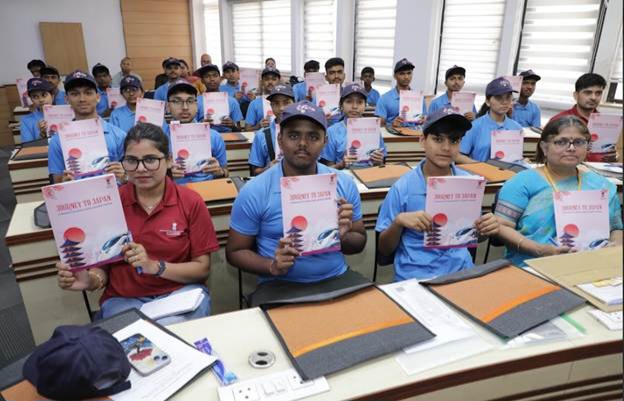
The Department of School Education & Literacy (DoSEL), Ministry of Education, recently flagged off a contingent of 56 Indian school students for a week-long visit to Japan under the Sakura Science Programme 2026. The initiative seeks to expose talented young students to Japan’s advanced scientific ecosystem, promote international academic exchange, and strengthen educational and cultural ties between India and Japan.
About the Sakura Science Programme
- The Sakura Science Programme is an international youth exchange initiative funded and implemented by the Japan Science and Technology Agency. Originally launched as the Japan-Asia Youth Exchange Program in Science, it invites promising young students from different countries to Japan for short-term educational visits focused on science, technology, innovation, and cultural understanding.
- Participating Countries (May 2026 Batch)
- The 2026 programme includes students from:India, Ghana, Nigeria, and South Africawith Japan serving as the host nation.
Objectives of the Programme
The programme aims to:
- Broaden the intellectual horizons of young learners.
- Encourage scientific curiosity and innovation.
- Provide exposure to cutting-edge science and technology.
- Promote international cooperation and people-to-people connections.
- Strengthen bilateral relations between participating countries and Japan.
- Foster appreciation of Japan’s cultural heritage and social systems.
Key Features
Experiential Scientific Learning
- Students spend approximately one week in Japan, where they gain hands-on exposure to:Advanced laboratories, Research institutions, Universities, Technology and innovation hubs
- The programme emphasizes experiential learning rather than classroom-based instruction, allowing students to directly interact with scientific infrastructure and researchers.
Merit-Based Selection
- In India, participants are selected from government schools and are primarily meritorious students who have qualified under the National Means-cum-Merit Scholarship Scheme (NMMS).
- The programme thus provides international opportunities to talented students from relatively under-resourced backgrounds.
India’s Participation
Since India joined the programme in 2016, it has developed into an important avenue of educational cooperation between India and Japan.