
SARTHAK Public Distribution System (PDS) Scheme
- 29 May 2026
In News:
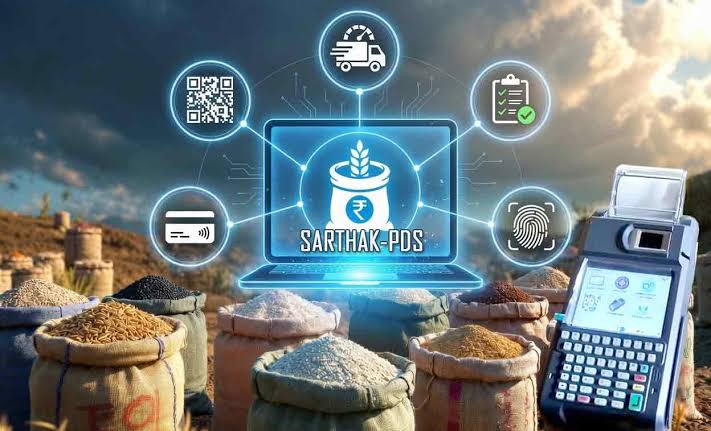
In a major step towards strengthening food security and improving the efficiency of welfare delivery, the Cabinet Committee on Economic Affairs (CCEA), chaired by the Prime Minister, has approved the SARTHAK Public Distribution System (PDS) Scheme.
The scheme seeks to modernise India's Public Distribution System by integrating technology, streamlining administrative processes, and enhancing transparency in the implementation of the National Food Security Act (NFSA), 2013.
What is SARTHAK PDS?
SARTHAK PDS stands for Scheme for Assistance in Ration Transport and Handling-Income with Automation in Public Distribution System. It has been conceived as an umbrella programme that consolidates two existing schemes into a unified framework:
- Assistance to State Agencies for Intra-State Movement of Foodgrains and Fair Price Shop (FPS) Dealers' Margin under NFSA, and
- Scheme for Modernization and Reforms through Technology in Public Distribution System (SMART-PDS).
By merging these initiatives, the government aims to create a single administrative and financial structure that supports both the physical movement of food grains and the technological transformation of the PDS ecosystem. The scheme is approved to continue until March 2031, ensuring long-term institutional support for food security reforms.
Strengthening the National Food Security Architecture
India's Public Distribution System is one of the world's largest food security programmes, serving millions of beneficiaries through an extensive network of Fair Price Shops. However, challenges such as leakages, delays, duplication of records, and monitoring inefficiencies have historically affected its effectiveness.
SARTHAK PDS seeks to address these concerns by creating a digitally integrated, transparent, and data-driven system that can facilitate efficient distribution, improve accountability, and strengthen implementation of the National Food Security Act.
Technology-Driven Transformation
A key feature of SARTHAK PDS is the extensive use of emerging technologies to modernise food grain distribution.
The scheme proposes the adoption of:
- Artificial Intelligence (AI)
- Machine Learning (ML)
- Natural Language Processing (NLP)
- Blockchain Technology
These technologies will be used to optimise supply chain management, improve beneficiary authentication, detect anomalies, minimise leakages, and enhance operational efficiency across the PDS network.
The use of AI-enabled analytics can help identify distribution gaps, forecast demand patterns, and improve decision-making, while blockchain-based systems can enhance transparency and traceability in food grain movement.
Unified Data Architecture and Real-Time Monitoring
One of the most significant reforms under SARTHAK PDS is the creation of unified databases and standardised digital architecture across states and Union Territories.
This integrated platform will enable:
- Real-time monitoring of food grain movement.
- Better coordination among stakeholders.
- Seamless data sharing across agencies.
- Improved beneficiary management.
- Enhanced transparency and accountability.
The scheme also envisages the establishment of State Command and Control Centres, which will use data-based oversight mechanisms to monitor operations and improve responsiveness.
Improved Governance and Grievance Redressal
To make the system more citizen-centric, SARTHAK PDS will incorporate AI-enabled grievance redressal mechanisms capable of processing complaints more efficiently and identifying recurring issues. This is expected to reduce delays in service delivery and improve beneficiary satisfaction.
Further, the introduction of ISO-certified process frameworks aims to strengthen transparency, operational security, quality assurance, and sustainability of PDS operations. Standardised procedures across states will help ensure uniform service delivery and reduce administrative inconsistencies.