
Reconstitution of NITI Aayog
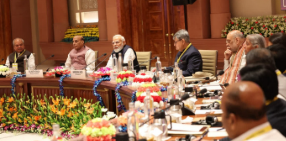
- 28 Apr 2026
In News:
The Government of India has formally reconstituted the NITI Aayog (National Institution for Transforming India), marking a strategic shift in the country's premier policy think tank. This overhaul, announced aims to infuse multidisciplinary expertise into India’s developmental roadmap, particularly in health, deep tech, and economic reforms, to align with the goal of becoming a "Viksit Bharat" by 2047.
A New Leadership for Economic and Strategic Reform
The reconstitution is led by the appointment of eminent economist and former Chief Economic Advisor Ashok Kumar Lahiri as the Vice Chairperson, succeeding Suman K. Bery. Holding the rank of a Cabinet Minister, Lahiri brings decades of experience in public policy and economic strategy to the Aayog.
The restructuring also introduces a diverse cohort of Full-Time Members, moving beyond traditional economist-heavy compositions to include experts from science, medicine, and technology:
- Rajiv Gauba: Former Cabinet Secretary (retained).
- Dr. M. Srinivas: Director of AIIMS Delhi, bringing extensive medical and public health expertise.
- Prof. Abhay Karandikar: Secretary, Department of Science and Technology, specializing in telecommunications and deep tech.
- Prof. Gobardhan Das: Renowned molecular scientist and immunologist.
- Prof. K. V. Raju: Expert in agricultural economics and rural development.
Core Philosophy: From Planning to Catalyzing
Formed on January 1, 2015, through a Cabinet resolution, NITI Aayog replaced the 65-year-old Planning Commission. This transition represented a paradigm shift in Indian governance:
- Bottom-Up Approach: Unlike the top-down "one-size-fits-all" model of the Planning Commission, NITI Aayog emphasizes that strong states make a strong nation.
- Cooperative Federalism: It serves as a primary platform to involve State Governments in the policy-making process, treating them as equal partners.
- Competitive Federalism: It encourages states to compete on developmental parameters through various indices, such as the SDG India Index and State Health Index.
Key Functions and Mandate
NITI Aayog operates as the Knowledge and Innovation Hub of the government, tasked with:
- Strategic Policy Design: Formulating long-term program frameworks while incorporating national security interests into economic strategy.
- Monitoring and Evaluation: Actively tracking the implementation of government schemes to ensure last-mile delivery.
- Ease of Living: Driving reforms to reduce the compliance burden on citizens and enhance quality of life.
- Resource Center: Acting as a repository of best practices and research on good governance.
Organizational Structure
As a non-constitutional, non-statutory, and advisory body, its structure is designed for maximum institutional flexibility:
- Chairperson: The Prime Minister of India.
- Vice Chairperson: Appointed by the PM; enjoys Cabinet Minister rank.
- Governing Council: Comprises Chief Ministers of all States and Union Territories with legislatures, and Lieutenant Governors of other UTs.
- Chief Executive Officer (CEO): An officer with the rank of Secretary to the Government of India, appointed for a fixed tenure.
- Ex-Officio Members: Maximum of four members from the Union Council of Ministers, nominated by the PM.