
Quantum Computing & Quantum Error Correction (QEC)
- 09 Jul 2026
In News:
Recent advances in Quantum Error Correction (QEC) by companies such as Google, coupled with progress under India's National Quantum Mission (NQM), have renewed global interest in quantum computing. These developments are expected to accelerate the transition from today's Noisy Intermediate-Scale Quantum (NISQ) systems to fault-tolerant quantum computers, unlocking transformative applications in cryptography, climate modelling, drug discovery and materials science.
What is Quantum Computing?
Quantum computing is an emerging field that harnesses the principles of quantum mechanics to solve computational problems that are beyond the practical capabilities of classical computers. Unlike classical computers, which process information using bits that exist either as 0 or 1, quantum computers use quantum bits (qubits). Owing to quantum phenomena such as superposition and entanglement, qubits can process multiple possibilities simultaneously, enabling exponential speed-ups for certain classes of problems.
Principles of Quantum Computing
Quantum computing relies on three fundamental principles.
- Superposition: A qubit can exist in multiple states simultaneously until it is measured, allowing parallel computation.
- Entanglement: Two or more qubits become intrinsically linked so that the state of one is correlated with the other, regardless of the distance between them.
- Interference: Quantum algorithms amplify correct computational paths while cancelling incorrect ones, improving the probability of obtaining the right solution.
Together, these principles enable massive parallelism, making quantum computers particularly powerful for optimisation, simulation and cryptographic applications.
Types of Qubits
Several physical technologies are being explored for building quantum computers.
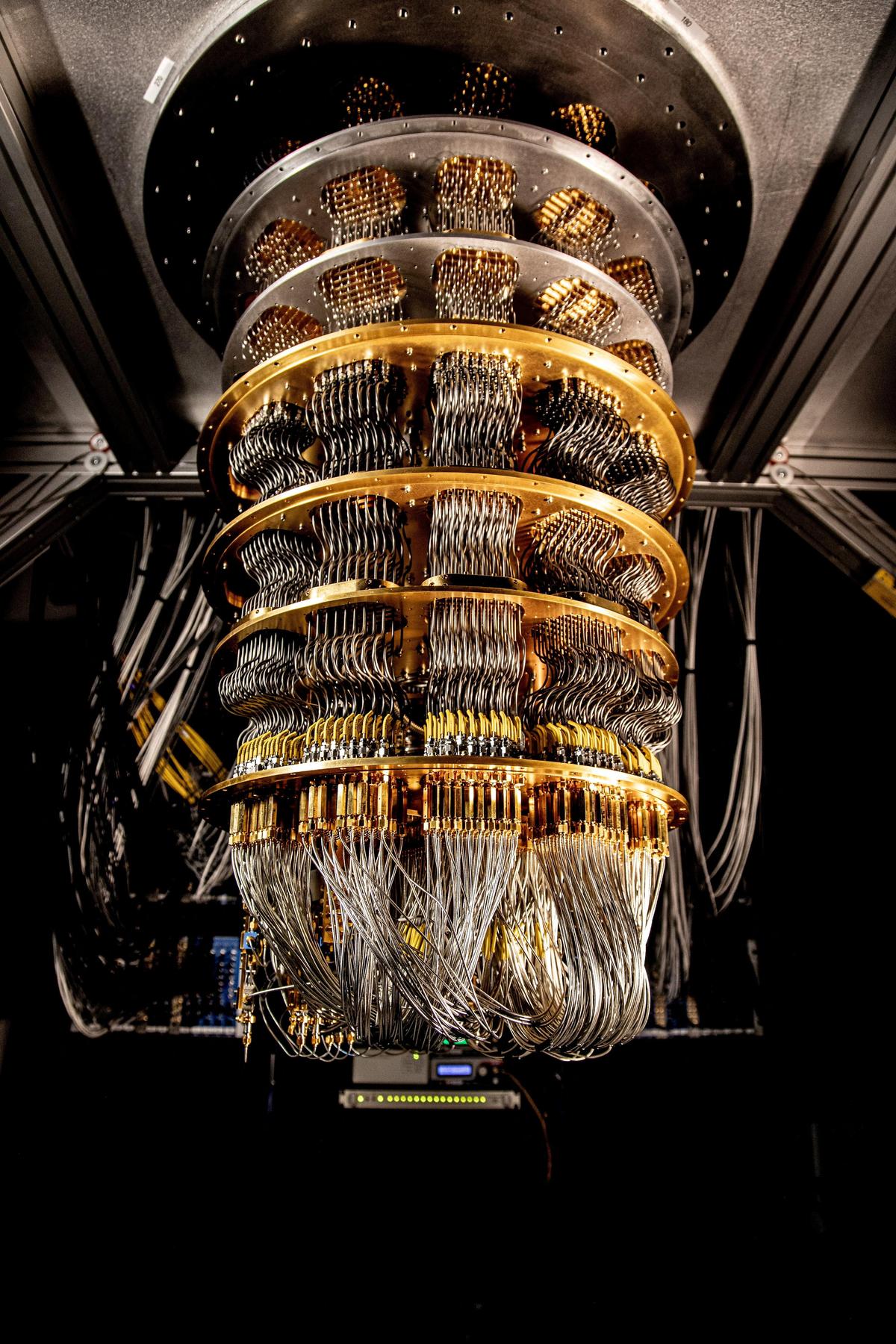
- Superconducting qubits – Based on Josephson junctions operating at temperatures close to absolute zero (used by Google's Willow processor).
- Quantum Dot qubits – Semiconductor-based qubits made from materials such as silicon or germanium.
- Trapped Ion qubits – Individual charged atoms confined using electromagnetic fields.
- Photonic qubits – Encode quantum information using photons.
- NMR qubits – Based on nuclear spins and used in the first quantum computer demonstration in 1998.
Quantum Key Distribution (QKD)
Quantum Key Distribution (QKD) is a secure communication technique that uses quantum properties of photons to exchange encryption keys. Any attempt to intercept the communication disturbs the quantum state, immediately revealing the presence of an eavesdropper. This makes QKD one of the most secure methods for transmitting cryptographic keys.
The Noise Problem in Quantum Computing
The biggest challenge in quantum computing is decoherence, where interactions with the surrounding environment—such as heat, electromagnetic radiation or vibration—destroy the fragile quantum state of qubits.
Current NISQ devices remain highly error-prone despite operating at temperatures close to absolute zero (-273°C). Their error rates remain significantly higher than those of classical computers. In addition, imperfections in lasers, microwave pulses and control systems introduce further computational errors.
Quantum Error Correction (QEC)
Quantum Error Correction (QEC) is a technique that combines multiple physical qubits to create a more reliable logical qubit capable of preserving quantum information despite individual errors.
A major breakthrough occurred when researchers demonstrated that once the error rate of physical qubits falls below a critical threshold, increasing the number of qubits actually reduces the overall error rate instead of increasing it. Google's Willow processor demonstrated this principle by successfully suppressing encoded errors, marking an important step towards practical fault-tolerant quantum computers.
India's National Quantum Mission (NQM)
The National Quantum Mission (NQM) was approved by the Government of India in April 2023 with the objective of making India a global leader in quantum technologies by 2031.
The mission seeks to develop intermediate-scale quantum computers with 50–1,000 qubits, establish a 2,000-km satellite-based quantum communication network, deploy Quantum Key Distribution (QKD) systems, advance quantum sensing and metrology, and promote indigenous development of quantum materials, devices, hardware and software.
To accelerate innovation, the mission has established four Thematic Hubs (T-Hubs) and supports quantum start-ups through innovative financing mechanisms such as Optionally Convertible Debt (OCD).
India has already achieved a significant milestone by developing an indigenous 1,000-km quantum communication network through the Department of Science and Technology (DST) in collaboration with QNu Labs, achieving half of its long-term communication target.