
Quad Foreign Ministers’ Meeting 2026
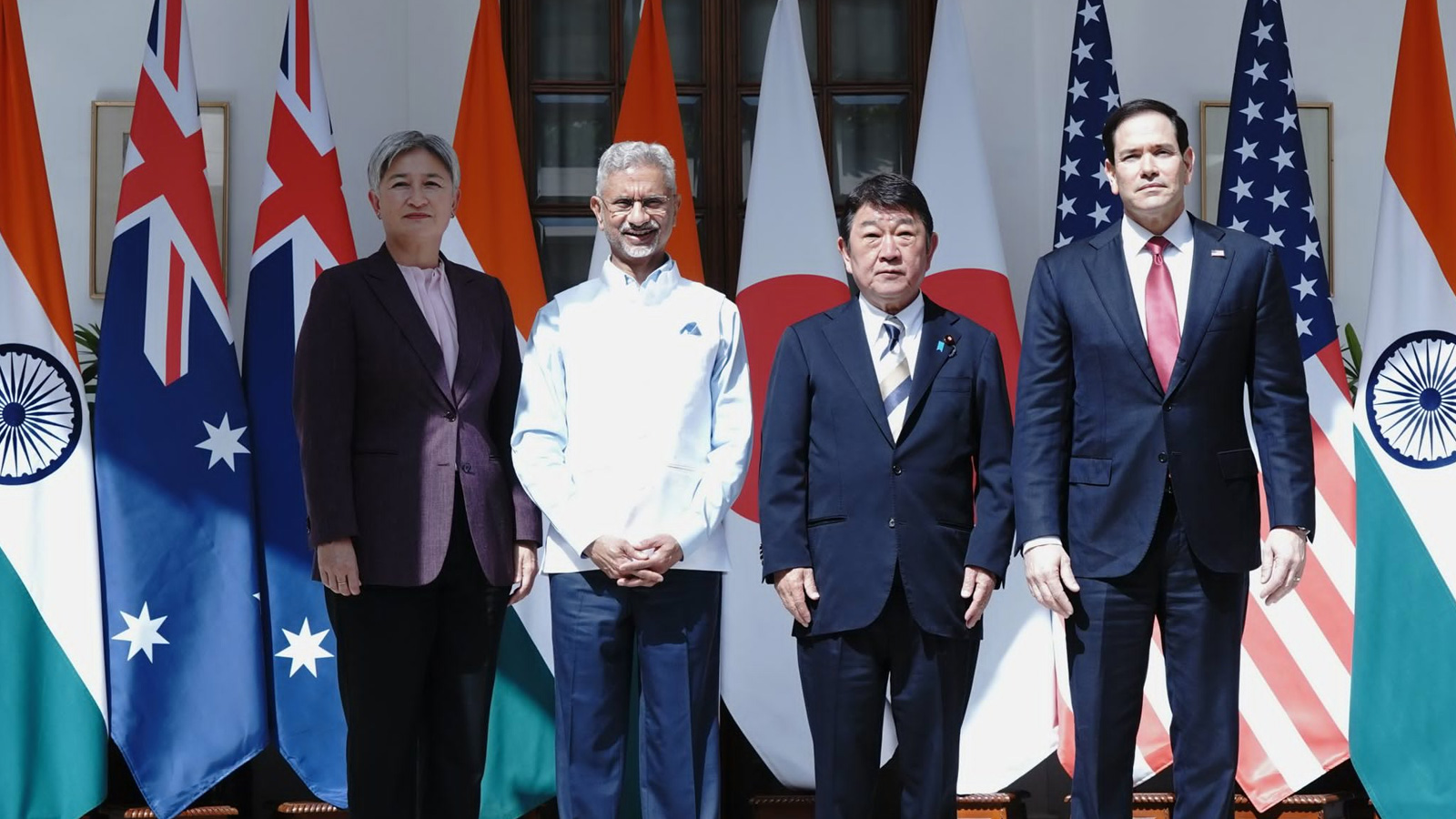
- 30 May 2026
In News:
The 11th Quad Foreign Ministers' Meeting was held in New Delhi amid growing geopolitical tensions in the South China Sea, Taiwan Strait, and Strait of Hormuz. The four Quad countries—India, the United States, Japan, and Australia—announced several new initiatives on maritime security, critical minerals, energy security, emerging technologies, and disaster response, reaffirming their commitment to a free, open, inclusive, and rules-based Indo-Pacific.
About the Quad
- The Quadrilateral Security Dialogue (Quad) is an informal strategic partnership comprising India, the United States, Japan, and Australia.
- It aims to promote a free, open, inclusive, prosperous, and resilient Indo-Pacific, based on respect for international law, freedom of navigation, territorial integrity, and peaceful resolution of disputes.
- The grouping originated as a humanitarian coordination mechanism following the 2004 Indian Ocean Tsunami, was first proposed by former Japanese Prime Minister Shinzo Abe in 2007, and was revived in 2017 in response to the changing strategic environment in the Indo-Pacific.
- At the 2021 Leaders' Summit, the Quad adopted the "Spirit of the Quad", reaffirming its commitment to democratic values, rule of law, and a region free from coercion.
- Some of its key initiatives include the Malabar Naval Exercise, Quad-at-Sea Ship Observer Mission, Indo-Pacific Partnership for Maritime Domain Awareness (IPMDA), and growing cooperation through the Quad Plus format with countries such as South Korea, New Zealand, and Vietnam.
Key Outcomes of the 11th Quad Foreign Ministers' Meeting
The meeting significantly expanded cooperation across security, economic resilience, technology, and humanitarian assistance.
Maritime and Security Cooperation
- The Quad launched the Indo-Pacific Maritime Surveillance Collaboration (IPMSC) to improve Maritime Domain Awareness (MDA) through information sharing and coordinated surveillance, with an initial focus on the Indian Ocean Region (IOR).
- It also expanded the Indo-Pacific Partnership for Maritime Domain Awareness (IPMDA) by developing a Common Operating Picture (COP) to integrate real-time maritime information across the Indo-Pacific.
- India will host the next Quad-at-Sea Ship Observer Mission, while Australia will organise the Quad Counterterrorism Tabletop Exercise (2026) focusing on state-sponsored terrorism and the misuse of Unmanned Aerial Vehicles (UAVs).
Economic Security and Supply Chain Resilience
- Recognising the strategic importance of critical minerals and secure supply chains, the Quad adopted the Quad Critical Minerals Initiative Framework to coordinate investments in mining, processing, recycling, and resilient supply chains.
- The partners also launched the Quad Initiative on Indo-Pacific Energy Security, committing over USD 25 million for technology collaboration, energy market analysis, emergency response, and resilient energy supply chains.
- Further, under the Ports of the Future Partnership, the Quad will work with Fiji to upgrade port infrastructure and committed to connecting all Pacific Island Forum countries through resilient undersea cable networks by 2026, strengthening regional digital connectivity.
Critical and Emerging Technologies
Technology cooperation emerged as another major pillar of the Quad.
The members agreed to collaborate on:
- Next-generation (6G) communication standards and Open RAN technologies.
- A Digital Identity Standards "Translation Guide" to enable cross-border interoperability.
- The AI-ENGAGE Initiative, under which over USD 6 million has been allocated for research using Artificial Intelligence, robotics, and remote sensing to improve agricultural productivity, pest management, and food security across the Indo-Pacific.
Humanitarian Assistance and Disaster Relief (HADR)
- Building on lessons from the 2025 Honolulu Tabletop Exercise, the Quad strengthened its disaster response architecture by enhancing coordination mechanisms for emergency response.
- The grouping also committed over USD 50 million to train health professionals, improve preparedness for disease outbreaks, and strengthen humanitarian assistance and disaster relief (HADR) capabilities across the Indo-Pacific.
Significance of the Quad for India
For India, the Quad has evolved into a crucial platform that complements its Act East Policy, Indo-Pacific Oceans Initiative (IPOI), and vision of SAGAR (Security and Growth for All in the Region).
It helps India:
- Counter China's growing strategic presence and the "String of Pearls" strategy in the Indian Ocean.
- Strengthen Maritime Domain Awareness through initiatives like IPMSC and IPMDA.
- Diversify critical mineral and technology supply chains under the global China 1 strategy.
- Enhance cooperation in AI, semiconductors, cyber security, telecommunications, and clean energy.
- Deepen defence interoperability while preserving India's policy of Strategic Autonomy, as the Quad is not a military alliance.