
Project Freedom
- 08 May 2026
In News:
Recently, the United States announced a temporary suspension of Project Freedom—a high-stakes military and humanitarian mission in the Persian Gulf. This pause is intended to provide space for diplomatic negotiations mediated by Pakistan, aiming for a comprehensive agreement with Iran to end the maritime blockade.
Overview of Project Freedom
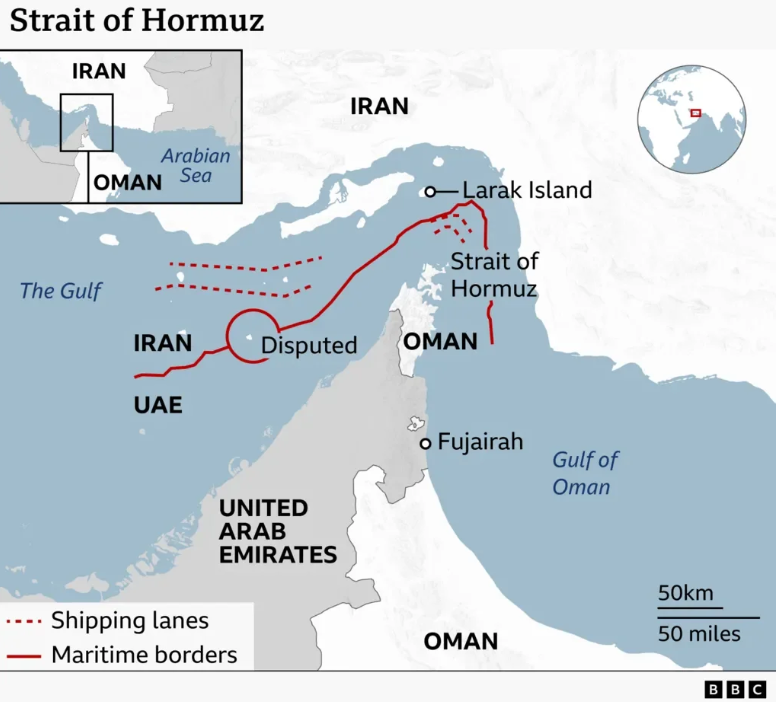
Launched in early May 2026, Project Freedom was the U.S.-led response to an Iranian blockade of the Strait of Hormuz, which had effectively paralyzed one of the world's most vital maritime arteries.
- Humanitarian Mission: The operation’s most immediate priority was the extraction of approximately 23,000 civilians hailing from 87 different nations. these individuals had been stranded aboard merchant vessels in the Persian Gulf for several weeks due to the geopolitical standoff.
- Economic Imperative: The mission aimed to restore global commercial flows. The Strait of Hormuz is a "chokepoint" of unparalleled importance, facilitating the passage of nearly 20% of the world's total oil supply.
- Strategic Overwatch: U.S. Central Command (CENTCOM) established an "Enhanced Security Area" utilizing Omani territorial waters on the southern side of the Strait. This corridor was designed to provide a safe passage for neutral vessels, shielding them from asymmetric threats such as Iranian drones, fast-attack boats, and naval mines.
Military Assets and Tactical Challenges
The mission involved a massive mobilization of "overwatch" capabilities to deter escalation while facilitating rescue operations:
- Naval Presence: The deployment was spearheaded by guided-missile destroyers, including the USS Tripoli amphibious ready group.
- Air Superiority: Over 100 aircraft, including F-16s, F-35s, and Sea Hawk helicopters, provided 24-hour aerial surveillance and defensive cover.
- Technological Edge: The mission utilized multi-domain unmanned platforms (sea and air drones) to detect subsurface threats.
- The Mine Menace: Despite the technological superiority, CENTCOM officials highlighted that traditional shipping lanes remain "extremely hazardous." The presence of Iranian-laid naval mines continues to be a primary obstacle to the full resumption of commercial traffic.
The Role of Diplomacy and Mediation
The suspension of active military maneuvers under Project Freedom marks a shift toward a "diplomacy-first" approach.
- Pakistan’s Mediation: In a rare diplomatic alignment, Pakistan has emerged as the primary mediator between Washington and Tehran. This role underscores Islamabad's strategic interest in regional stability and its unique ability to engage with both the Western bloc and its neighbor, Iran.
- The Threat of Escalation: The suspension comes amidst a backdrop of high-intensity rhetoric. While a diplomatic window has opened, the U.S. administration has simultaneously warned of "higher-level" military consequences should negotiations fail or if Iran continues to threaten global shipping.
Geopolitical Significance for India
The Hormuz crisis and the subsequent Project Freedom have direct implications for India's national interests:
- Energy Security: India imports a vast majority of its crude oil from the Gulf region. Any prolonged closure of the Strait leads to a surge in global oil prices, impacting India’s fiscal deficit and domestic inflation.
- Diaspora Safety: With thousands of Indian seafarers often employed on global merchant fleets, the humanitarian aspect of Project Freedom is of direct concern to the Ministry of External Affairs.
- Strategic Autonomy: India has traditionally maintained a balanced relationship with both Iran and the U.S., often advocating for freedom of navigation while respecting regional sovereignty.