
Piprahwa Relics
- 01 May 2026
In News:
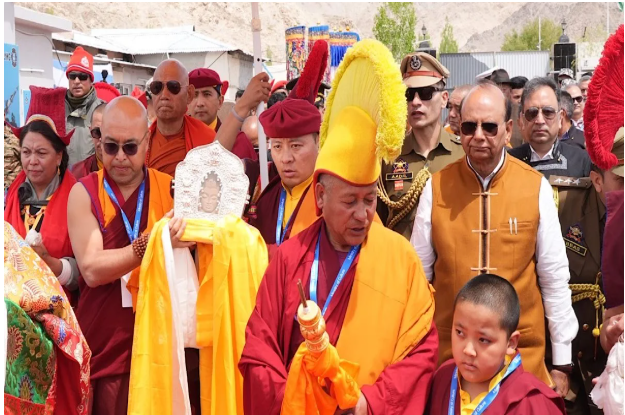
Leh recently emerged as a focal point of spiritual and historical significance as it hosted the sacred Piprahwa relics of Gautam Buddha. This landmark event, marked by the arrival of the relics in Ladakh, represents a rare confluence of faith and history. Carried via a special Indian Air Force aircraft and received with state honors, the exposition marks the first time these "AA" category antiquities have been moved from their original place of preservation for domestic exposition within India, following several high-profile international tours to nations like Thailand, Mongolia, and Vietnam.
Historical and Archaeological Context
The Piprahwa Relics are among the most authentic and significant archaeological links to the mortal remains of the Buddha. Their history is rooted in the late 19th century:
- Discovery (1898): The relics were unearthed by William Claxton Peppé, a British colonial engineer, at the Piprahwa Stupa in the Basti district of Uttar Pradesh.
- Identification of Kapilavastu: Archaeological evidence from the site associates Piprahwa with ancient Kapilavastu, the capital of the Shakya kingdom where Siddhartha Gautama spent his formative years before his Great Renunciation (Mahabhinishkramana).
- The Brahmi Inion: A critical find was a sandstone coffer containing crystal caskets. One casket bore an inion in the ancient Brahmi , explicitly linking the contents to the Shakya clan. This epigraphic evidence suggests the remains were enshrined by the Buddha’s own kinsmen around the 3rd century BC.
- Later Excavations (1971–1977): Subsequent excavations by the Archaeological Survey of India (ASI) led by K.M. Srivastava uncovered further steatite caskets containing 22 sacred bone fragments. These are currently preserved at the National Museum in New Delhi.
Legal Status and Repatriation
The trajectory of these relics reflects India’s evolving policy on heritage management and cultural diplomacy:
- The Treasure Trove Act, 1878: Under colonial law, the British Crown claimed Peppé’s original find. While some bones were presented to King Chulalongkorn of Siam (Thailand), a significant portion of the gems and ornaments remained in private hands or were moved to the Indian Museum in Kolkata.
- Antiquity Classification: In modern India, the Piprahwa relics are classified as ‘AA’ antiquities. This legal designation under the Antiquities and Art Treasures Act prohibits their sale and strictly regulates their movement, reflecting their "inestimable" value to national heritage.
- Modern Repatriation (2025-2026): In a significant victory for cultural restitution, a collection of associated gems and artifacts that had remained with the Peppé family for 127 years was repatriated to India. This was achieved through a unique public-private partnership involving the Government of India and the Godrej Industries Group, successfully preempting a planned auction in Hong Kong.
Socio-Cultural and Strategic Significance
The exposition in Ladakh transcends religious ritual, touching upon several key themes relevant to the Indian state:
- Cultural Diplomacy: The movement of these relics to various Buddhist-majority nations serves as a pillar of India’s "Act East" policy, utilizing "Soft Power" to strengthen ties with the Global South and Southeast Asia.
- Regional Integration: The ceremony in Leh, attended by the Lieutenant Governor and senior monastic leaders (including Drukpa Thuksey Rinpoche), underscores the integration of Himalayan Buddhist culture into the broader national narrative.
- The 2569th Buddha Purnima: The timing of the exposition, coinciding with Buddha Purnima, highlights the continuity of the Dhamma in the region, drawing thousands of devotees and global attention to the Dharma Center in Leh and Zanskar.
Piprahwa Relics
- 02 Aug 2025
In News:
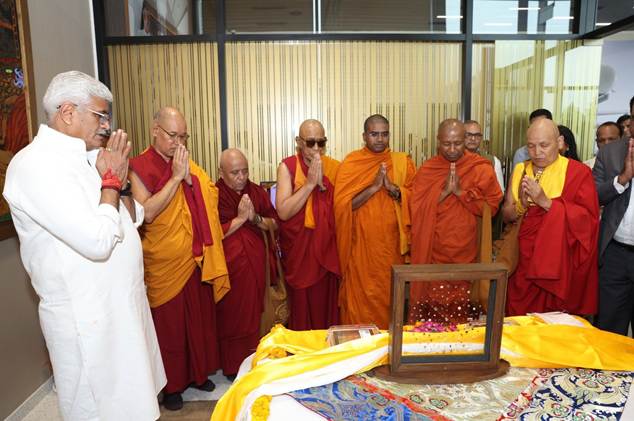
The recent return of the sacred Piprahwa relics of Lord Buddha to India marks a landmark moment in India’s cultural diplomacy, heritage preservation, and spiritual history. Orchestrated by the Ministry of Culture in partnership with the Godrej Industries Group, this event prevented the relics’ auction in Hong Kong (May 2025) and instead restored them to their rightful home. For India, the land where the Buddha attained enlightenment and preached, this repatriation is more than a matter of archaeology—it reaffirms India’s role as the civilizational custodian of global heritage.
What are the Piprahwa Relics?
- Association: Believed to be the mortal remains of Lord Buddha, enshrined by the Sakya clan (his kinsmen) in the 3rd century BCE.
- Discovery: Excavated in 1898 by William Claxton Peppé, a British civil engineer and estate manager, from a stupa at Piprahwa, Uttar Pradesh, located just south of Lumbini (Buddha’s birthplace, now in Nepal).
- Contents:
- Bone fragments of the Buddha
- Caskets: soapstone, crystal, and sandstone coffer
- Offerings: gold ornaments, gemstones, and other ritual objects
- Inscription: A Brahmi script engraving on one of the caskets confirmed the relics’ identity, noting they were deposited by the Sakya clan.
Historical Journey of the Relics
- Colonial Appropriation (1898–1899)
- Following their discovery, the British Crown claimed the artefacts under the Indian Treasure Trove Act, 1878.
- The bone and ash relics were gifted to King Chulalongkorn of Siam (Thailand), reflecting colonial practices of cultural transfer.
- The majority of the remaining relics were placed in the Indian Museum, Kolkata (1899).
- Legal Protection
- Classified as ‘AA’ antiquities under Indian law, these relics cannot be sold, exported, or removed—underscoring their sacred and national significance.
- Attempted Auction in 2025
- The relics resurfaced in Hong Kong for an intended auction.
- Through timely diplomatic and legal intervention, supported by public-private partnership with the Godrej Group, the Ministry of Culture secured their return.
Significance of the Repatriation
1. Spiritual and Cultural Significance
- Buddhism, which spread from India across Asia, regards relics of the Buddha as sacred embodiments of peace, compassion, and enlightenment.
- The return reaffirms India as the spiritual homeland of Buddhism, strengthening cultural linkages with Buddhist-majority nations like Thailand, Myanmar, Japan, and Sri Lanka.
2. Archaeological and Historical Importance
- Piprahwa is one of the earliest archaeologically verified stupa sites.
- The discovery provides rare material evidence of Buddhist practices of relic veneration, confirming textual accounts in Buddhist scriptures.
3. Diplomatic and Soft Power Dimensions
- The move highlights cultural diplomacy as a tool of India’s foreign policy.
- India positions itself as a global guardian of Buddhist heritage, enhancing ties with Southeast Asian nations where Buddhism is deeply rooted.
4. Model of Public–Private Partnership
- The collaboration between the Government of India and the Godrej Industries Group sets a precedent for safeguarding heritage.
- It reflects how corporate social responsibility (CSR) can extend beyond business to civilizational legacy.