
PaleoIndia Portal
- 03 Jul 2026
In News:
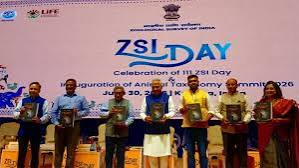
The Union Minister of Environment, Forest and Climate Change recently launched the PaleoIndia Portal, a first-of-its-kind national digital platform for documenting and preserving India's fossil heritage.
About PaleoIndia Portal
- The PaleoIndia Portal is a national digital repository developed jointly by the Zoological Survey of India (ZSI) and the National Centre for Sustainable Coastal Management (NCSCM), Chennai, using dynamic geological maps provided by the Geological Survey of India (GSI).
- The portal aims to create a comprehensive database of India's paleontological wealth by documenting fossil records from all 28 States and 8 Union Territories.
- It currently hosts information on more than 5,000 fossil specimens, covering a wide range of extinct organisms, including mammals, reptiles, birds, fishes, amphibians, molluscs, arthropods, echinoderms, foraminifera, and ichnofossils (trace fossils).
- A notable feature of the portal is its real-time data upload system, which enables researchers, field scientists, and citizen scientists to contribute fossil discoveries, thereby strengthening the documentation and conservation of India's paleontological heritage.
National Centre for Sustainable Coastal Management (NCSCM)
- The National Centre for Sustainable Coastal Management (NCSCM) is an autonomous institution established by the Ministry of Environment, Forest and Climate Change (MoEF&CC) in 2011 to support the conservation, protection, rehabilitation, and sustainable management of India's coastal ecosystems.
- Headquartered in Chennai, Tamil Nadu, the Centre provides scientific and policy support to the Union and State Governments on matters relating to Integrated Coastal Zone Management (ICZM).
- Its work includes coastal vulnerability assessments, environmental impact assessments, mapping of Ecologically Sensitive Areas (ESAs), and preparation of Integrated Coastal Zone Management plans.
- The Centre functions through six specialised research divisions covering Geospatial Sciences and GIS, Integrated Social Sciences and Economics, Coastal Environmental Impact Assessment, Conservation of Coastal and Marine Resources, Knowledge, Governance and Policy, and Futuristic Research & Integrated Island Management.