
National e-Governance Service Delivery Assessment
- 30 May 2026
In News:
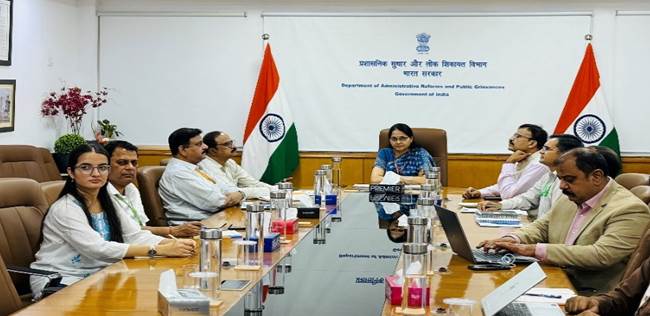
The Department of Administrative Reforms and Public Grievances (DARPG) has launched the National e-Governance Service Delivery Assessment (NeSDA) 2025 Portal to assess the quality and effectiveness of online public service delivery across States, Union Territories (UTs), and selected Central Ministries. The portal aims to strengthen digital governance by enabling standardized assessment, benchmarking, and continuous improvement in service delivery.
What is NeSDA?
- The National e-Governance Service Delivery Assessment (NeSDA) is a biennial assessment framework developed by DARPG to evaluate the maturity and effectiveness of e-governance services from a citizen-centric perspective.
- It is based on the Online Service Index (OSI) of the UN e-Government Survey, but has been adapted to India's federal governance structure.
- Rather than ranking governments solely on the number of services available online, NeSDA assesses how effectively these services are delivered, focusing on their accessibility, usability, transparency, and overall user experience.
- It also serves as a national benchmarking exercise, encouraging States, UTs, and Central Ministries to adopt best practices and bridge gaps in digital governance.
Key Features of NeSDA 2025
- NeSDA 2025 expands both the scope and depth of assessment. It evaluates State, UT, City, and Central Ministry portals, along with dedicated service portals, thereby covering the complete digital service delivery ecosystem.
- The framework assesses Government-to-Citizen (G2C) and Government-to-Business (G2B) services across major sectors such as finance, labour and employment, education, local governance, utility services, social welfare, health, agriculture, home security, environment, tourism, public grievance, and transport.
- A notable addition in NeSDA 2025 is the inclusion of services offered by the Ministry of Corporate Affairs, reflecting the increasing emphasis on digital business governance.
- To ensure uniform evaluation, the framework proposes assessment of 59 mandatory services for every State and Union Territory and 43 mandatory services for Central Ministries and Departments.
Assessment Parameters
The assessment examines the overall maturity of digital governance through multiple dimensions. It evaluates whether online services are accessible, easy to use, secure, and privacy-compliant, while also assessing end-to-end digital service delivery, integrated service delivery, status tracking, Open Government Data (OGD), e-participation, and the adoption of emerging technologies such as Artificial Intelligence. This comprehensive approach ensures that governments focus not only on digitization but also on the quality of citizens' digital experience.
Significance
NeSDA has emerged as an important instrument for promoting good governance and cooperative federalism by enabling evidence-based comparison of digital service delivery across governments.
It helps identify implementation gaps, encourages the adoption of best practices, and improves accountability through measurable performance indicators.
The launch of the NeSDA 2025 Portal will further streamline online data collection, stakeholder consultations, capacity-building programmes, and periodic reviews.
As India expands its Digital Public Infrastructure, NeSDA complements flagship initiatives such as Digital India, Ease of Living, and Minimum Government, Maximum Governance by ensuring that public services are not only digitized but are also citizen-friendly, inclusive, transparent, and efficient.