
National Panchayat Awards 2025
- 14 May 2026
In News:
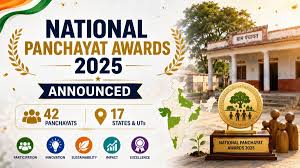
The Ministry of Panchayati Raj recently announced the winners of the National Panchayat Awards (NPA) 2025, a cornerstone initiative designed to recognize and incentivize Panchayati Raj Institutions (PRIs) that have excelled in localizing Sustainable Development Goals (SDGs).
Core Framework and Objectives
The National Panchayat Awards are conferred annually to foster a spirit of healthy competition among PRIs. The primary goal is to promote inclusive, participatory, and sustainable rural development.
- Incentivization Scheme: The awards are implemented under the Incentivization of Panchayats (IoP) scheme, which is a central component of the Rashtriya Gram Swaraj Abhiyan (RGSA)—a Centrally Sponsored Scheme.
- Alignment with Global Goals: Since the 2023 revamp, the framework has been strictly aligned with the nine themes of Localization of Sustainable Development Goals (LSDGs). This shift ensures that the assessment of a Panchayat's performance is holistic, data-driven, and transparent.
Key Award Categories and Winners
A total of 42 Panchayats were selected for the 2025 cycle from 17 States and Union Territories. The awards are broadly divided into two prestigious categories:
A. Deen Dayal Upadhyay Panchayat Satat Vikas Puraskar (DDUPSVP)
This category focuses on Gram Panchayats (GPs) that have shown exceptional performance in specific thematic areas.
- Thematic Focus: It evaluates performance across 9 LSDG themes, including Poverty-free and Enhanced Livelihoods, Healthy Panchayat, Water Sufficient Panchayat, Clean and Green Panchayat, and Women-friendly Governance.
- Selection Mechanism: Winners are determined based on their Panchayat Advancement Index (PAI) 2.0 scores.
- Scale of Recognition: 34 Gram Panchayats were selected in this category for Ranks 1, 2, and 3 across different themes.
B. Nanaji Deshmukh Sarvottam Panchayat Satat Vikas Puraskar (NDSPSVP)
Unlike the thematic focus of DDUPSVP, this award recognizes the best-performing Panchayats overall at all three tiers of the PRIs.
- Distribution: Eight Panchayats were honored, comprising three District Panchayats, two Block Panchayats, and three Gram Panchayats.
- Top Honorees:
- Best District Panchayat:Sepahijala (Tripura) secured the first rank, followed by Ganjam (Odisha) and Coimbatore (Tamil Nadu).
- Best Block Panchayat:Harippad (Kerala) stood first.
- Best Gram Panchayat: New Napam (Assam) was recognized as the top-performing village unit.
State-wise Performance Trends
The 2025 awards highlight the regional excellence in rural administration. Karnataka emerged as the leading state, securing the highest number of awards with 6 winning Panchayats. This was followed closely by Andhra Pradesh and Odisha, each securing 5 awards. Other states like Maharashtra, Tripura, and Kerala also showed strong representation across various thematic rankings.
Financial Incentives and Empowerment
To ensure that recognition translates into further development, the awards carry significant financial incentives. These funds are intended to be utilized by the winning Panchayats for furthering their developmental projects:
- Grant Range: Incentives range from ?50 lakh to ?5 crore per awardee.
- Tier-based Funding: The amount varies depending on the tier (Gram, Block, or District) and the specific category of the award. For instance, the top District Panchayat (Sepahijala) is set to receive ?5 crore, while thematic Gram Panchayat winners typically receive ?1 crore for the first rank.
Special Recognition for Emerging Challenges
In addition to the main categories, the Ministry also utilizes the National Panchayati Raj Day (April 24) to highlight specialized achievements:
- Climate Action Special Panchayat Award (CASPA): Encouraging environmental stewardship.
- Atma Nirbhar Panchayat Special Award (ANPSA): Recognizing self-reliance in local economy and infrastructure.
- Panchayat Kshamta Nirman SarvottamSansthan Puraskar: Awarded to institutions facilitating capacity building for PRIs.