
National Academic Depository (NAD)
- 10 Jul 2026
In News:
The National Academic Depository (NAD) is receiving renewed attention as India advances towards a secure, paperless and interoperable academic record management system, in line with the objectives of the National Education Policy (NEP) 2020 and Digital India.
What is the National Academic Depository (NAD)?
The National Academic Depository (NAD) is a nationwide digital framework for storing, issuing, verifying and authenticating academic credentials such as degrees, diplomas, certificates, marksheets and evaluation reports. It aims to replace paper-based academic records with authenticated digital credentials that can be securely accessed throughout a student's lifetime.
Since 2020, NAD has been implemented through DigiLocker, which serves as the operational platform for issuing, storing and sharing digital academic documents.
Need for NAD
India has one of the world's largest education ecosystems, comprising nearly 14.71 lakh schools, 1,420 universities, 53,583 colleges, 16,795 standalone institutions, and 280 research and development institutes. These institutions generate millions of academic records every year.
The traditional paper-based system is costly, time-consuming and prone to loss, damage, forgery and delays in verification. As educational reforms increasingly promote student mobility and flexible learning pathways, there is a growing need for a secure and interoperable digital repository that allows seamless access to verified academic records.
Objectives
The National Academic Depository seeks to:
- Provide lifelong digital access to authenticated academic credentials.
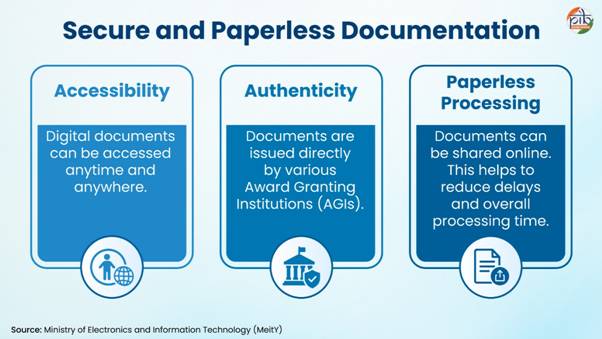
- Enable secure, paperless storage and sharing of academic records.
- Facilitate instant verification by educational institutions, employers, banks and government agencies.
- Eliminate fake certificates and reduce document forgery.
- Support credit mobility and flexible learning under NEP 2020.
Governance and Institutional Framework
The Ministry of Education is the parent ministry responsible for the National Academic Depository, while the University Grants Commission (UGC) functions as the nodal agency for its implementation through DigiLocker.
NAD operates through a coordinated digital framework in which educational institutions upload verified academic records, while students retain lifelong ownership and control over their credentials.
Digital documents issued through NAD enjoy the same legal validity as physical documents under the Information Technology Act, 2000.
Integration with National Digital Education Ecosystem
NAD has been integrated with several flagship digital initiatives to promote seamless academic mobility and verification.
These include:
- DigiLocker
- APAAR (Automated Permanent Academic Account Registry)
- Academic Bank of Credits (ABC)
- e-Sanad for attestation and apostille services
This integration enables secure storage, credit transfer, verification and international authentication of academic records.
Significance
The National Academic Depository represents a major step towards digital governance in education. It simplifies academic record management, reduces administrative burden, accelerates admissions and recruitment processes, and enhances transparency by enabling instant verification of authentic documents.
The platform also supports the implementation of Multiple Entry-Multiple Exit (MEME), the National Credit Framework (NCrF) and the Academic Bank of Credits (ABC) envisioned under the National Education Policy 2020. By promoting interoperability and lifelong learning, NAD aligns India's education system with global best practices in digital credential management.
Legal Framework
The functioning of NAD is supported by a robust legal framework:
- Information Technology Act, 2000 provides legal recognition to electronic records and digital signatures.
- Digital Locker Rules, 2016 ensure that digital documents are shared only with the explicit consent of the user.
- National e-Authentication Framework enables secure identity verification and authentication during document access and sharing.