
Mount Erebus
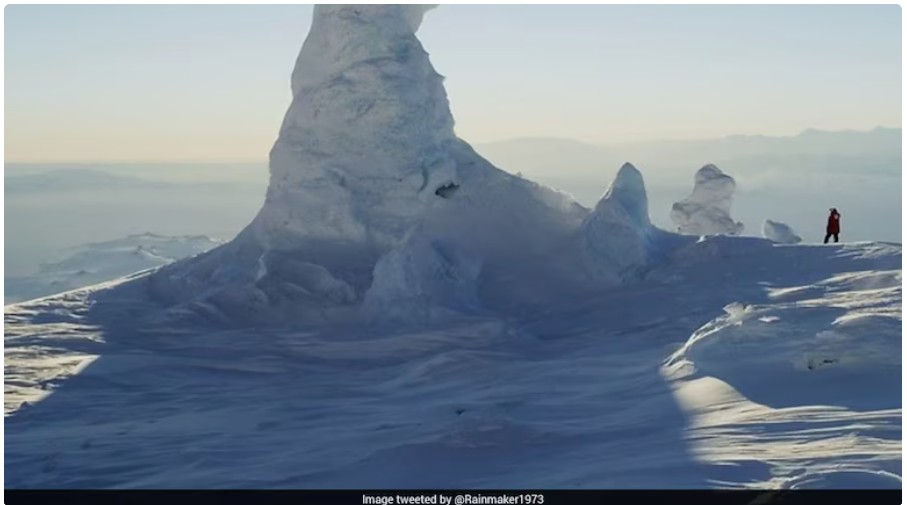
- 02 Jul 2026
In News:
Mount Erebus, the world's southernmost active volcano, has recently drawn attention for its unique geological features. Besides possessing a permanent lava lake, it is the only known volcano that emits microscopic crystals of pure gold into the atmosphere during volcanic activity.
About Mount Erebus
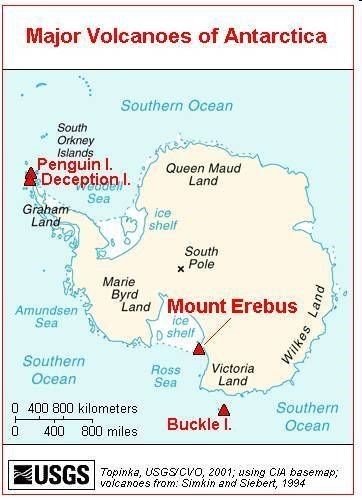
Mount Erebus is a stratovolcano situated on the western half of Ross Island in the Ross Sea, Antarctica. It is the southernmost active volcano on Earth and the second-highest volcano in Antarctica, rising to 3,794 metres (12,448 feet) above sea level after Mount Sidley.
Unlike volcanoes located along plate boundaries, Mount Erebus is an intraplate volcano belonging to the McMurdo Volcanic Group. It is situated within the Terror Rift, a part of the West Antarctic Rift System. Although Antarctica itself is not a major tectonic plate boundary, the volcano is associated with the broader tectonic processes linked to the Pacific Ring of Fire.
One of the most remarkable features of Mount Erebus is its persistent lava lake, which has remained continuously active since at least 1972. Such permanent lava lakes are extremely rare, making Erebus one of only a handful of volcanoes worldwide with this phenomenon. Most of its eruptions are Strombolian in nature, characterised by relatively mild but frequent explosive bursts that eject incandescent volcanic bombs and lava fragments around the crater.
Unique Feature
Mount Erebus is the only known volcano in the world that naturally releases microscopic crystals of pure gold into the atmosphere. These tiny gold particles, carried by volcanic gases, are dispersed over considerable distances by prevailing winds, making the volcano geologically unique.
Mount Erebus
- 10 Mar 2025
In News:
- Volcanic ice caves beneath Mount Erebus host thriving microbial life, offering insights into extremophile survival and potential life on alien planets.
About Mount Erebus:
- Location: Ross Island, Antarctica, in the Ross Sea.
- Type:Glaciated intraplate stratovolcano; part of the Pacific Ring of Fire.
- Altitude:3,794 meters (12,448 feet) above sea level.
- Rank:Second tallest volcano in Antarctica (after Mount Sidley).
- Discovered: In 1841 by British explorer Sir James Clark Ross.
- Name Origin: Named after Ross’s ship, HMS Erebus.
Volcanic Activity:
- Southernmost active volcano on Earth.
- Continuously active since 1972.
- Eruptions are Strombolian in nature — small, explosive, with lava bombs ejected onto crater rim.
- Contains a persistent lava lake with alkalic lava, typical of rift volcanoes.
Proximity to Human Activity:
- Near McMurdo Station, the largest Antarctic research base, just ~40 km away.
Scientific Significance:
- The microbial ecosystems in volcanic ice caves could help understand:
- Life in extreme environments
- Astrobiological prospects on Mars or Europa