
Maharishi Sushruta
- 27 Jun 2026
In News:
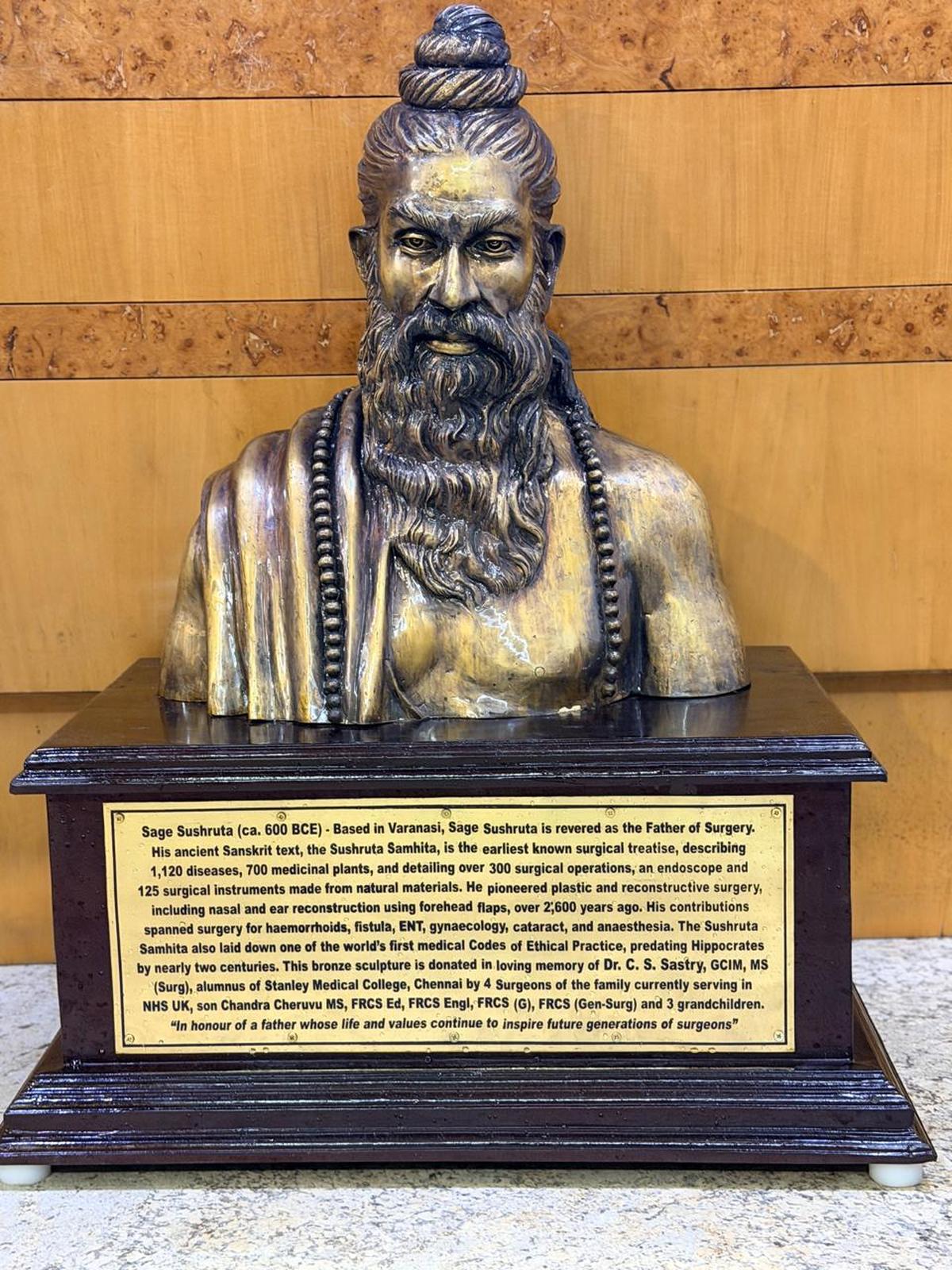
A bronze statue of Maharishi Sushruta, widely revered as the Father of Surgery, was recently unveiled at the Royal College of Surgeons of Edinburgh, United Kingdom, recognising his pioneering contributions to the development of surgery and medical science.
About Maharishi Sushruta
Maharishi Sushruta is regarded as one of the greatest physicians and surgeons of ancient India. Revered as the "Father of Surgery" and often referred to as the "Father of Indian Medicine," he made pioneering contributions to the fields of surgery, anatomy, and Ayurveda. His systematic approach to surgical practice laid the foundation for many principles that continue to influence modern medicine.
Although scholars differ regarding the exact period in which he lived, Sushruta is generally believed to have practised between 600 BCE and 1000 BCE. According to Ayurvedic tradition, he was a disciple of Lord Dhanvantari, the divine physician and the deity associated with Ayurveda. He is believed to have taught and practised medicine in Varanasi (Kashi), an important centre of learning in ancient India.
Sushruta Samhita
Sushruta's most celebrated contribution is the Sushruta Samhita, one of the foundational texts of Ayurveda and among the earliest comprehensive treatises on surgery in the world.
Composed over 2,500 years ago, the text contains 184 chapters covering various branches of medicine and surgery. It describes:
- More than 300 surgical procedures.
- Over 120 surgical instruments.
- Different types of wounds, fractures, dislocations, and their treatment.
- Detailed knowledge of toxicology, paediatrics, pharmacology, and general medicine.
- More than 100 medicinal plants, including their therapeutic properties and medicinal uses.
The text remains one of the most significant contributions to the history of medicine and Ayurveda.
Contributions to Surgery
Sushruta introduced a scientific and systematic approach to Shalya Tantra (Surgical Science), considering surgery an integral part of medical treatment.
His major contributions include:
- Development of rhinoplasty (nasal reconstruction), regarded as one of the earliest forms of plastic surgery.
- Surgical removal of bladder stones (lithotomy).
- Procedures for the removal of a dead foetus.
- Advanced methods for treating fractures, wounds, and dislocations.
- Design and use of specialised surgical instruments.
- Emphasis on cadaver dissection for understanding human anatomy.
- Use of herbal anaesthetics and systematic post-operative care.
His insistence on practical training, observation, and meticulous documentation established principles that continue to underpin surgical education.
Legacy
The influence of Maharishi Sushruta extended well beyond ancient India. His surgical techniques and medical knowledge were transmitted to other regions through translations and scholarly exchanges, contributing to the development of plastic surgery, orthopaedics, ophthalmology, and reconstructive surgery across the world.
His emphasis on scientific observation, ethical medical practice, and evidence-based treatment makes him one of the earliest pioneers of modern surgical science.