
LineShine Supercomputer
- 30 Jun 2026
In News:
China's LineShine supercomputer has topped the latest TOP500 rankings, replacing the United States' El Capitan as the world's fastest publicly ranked supercomputer. The achievement marks China's growing leadership in high-performance computing despite restrictions on advanced semiconductor technologies.
What is the TOP500 List?
The TOP500 is the globally accepted ranking of the world's most powerful supercomputers. Published twice every year since 1993, it evaluates supercomputers using the High Performance LINPACK (HPL) benchmark, which measures a system's ability to solve large-scale mathematical computations at high speed.
The ranking serves as the global benchmark for assessing advances in High-Performance Computing (HPC) and is widely used by governments, research institutions, and industry.
About LineShine
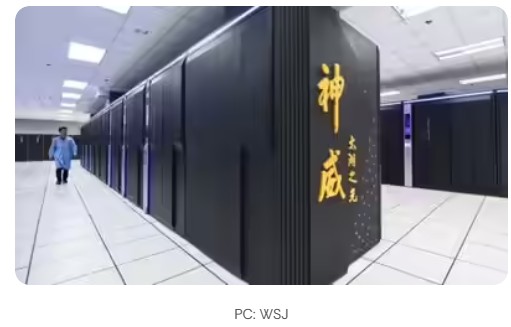
LineShine is located at the National Supercomputing Center, Shenzhen (China) and has achieved a computing performance of approximately 2.19 exaflops, enabling it to perform more than two quintillion (2 × 10¹?) calculations per second.
Its entry into the TOP500 expands the number of exascale supercomputers worldwide from four to five. It is also the first time that Asia, North America, and Europe simultaneously host publicly ranked exascale computing systems.
Key Features
One of LineShine's most distinctive features is that it operates entirely on general-purpose Central Processing Units (CPUs) without relying on Graphics Processing Units (GPUs). It is the first CPU-only supercomputer to exceed the two-exaflop performance mark, demonstrating the continued potential of CPU-based architectures for scientific computing.
The system also reflects the growing convergence of High-Performance Computing (HPC) and Artificial Intelligence (AI), enabling both traditional numerical simulations and AI-driven computational workloads on a single platform.
Applications
LineShine supports a wide range of advanced scientific and engineering applications, including:
- AI-assisted weather forecasting.
- Rainfall prediction across East Asia.
- Atomic-scale simulations of magnetic and advanced materials.
- Large-scale scientific modelling and engineering research.
- Artificial Intelligence and machine learning applications.