
Kudankulam Nuclear Power Project (KKNPP)
- 23 Jun 2026
In News:
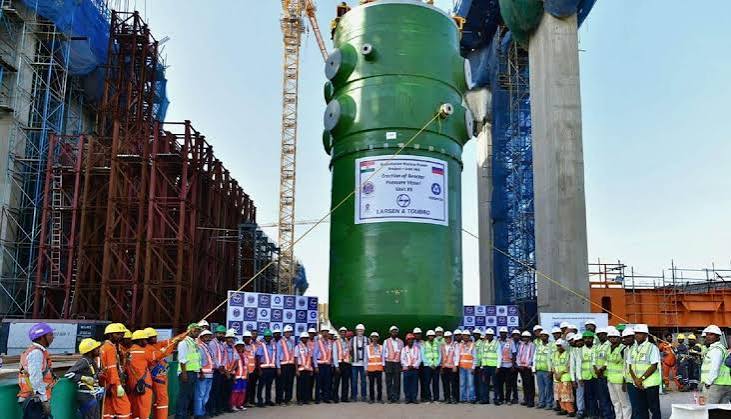
The Nuclear Power Corporation of India Limited (NPCIL) successfully installed the Reactor Pressure Vessel (RPV) at Unit-5 of the Kudankulam Nuclear Power Project (KKNPP) in Tamil Nadu, marking a major milestone in India's nuclear energy expansion. The installation followed clearance from the Atomic Energy Regulatory Board (AERB) and was carried out with technical support from Russia's Rosatom.
About Kudankulam Nuclear Power Project (KKNPP)
- The Kudankulam Nuclear Power Project (KKNPP) is India's largest nuclear power project, located in Tirunelveli district, Tamil Nadu.
- It is being developed by the Nuclear Power Corporation of India Limited (NPCIL) under a long-standing India–Russia Intergovernmental Agreement signed in 1988.
- The project is being constructed in phases with six units, each employing Russian-designed VVER-1000 (Water-Water Energetic Reactor) technology—a type of Pressurized Water Reactor (PWR) that uses light water as both coolant and neutron moderator.
Recent Development
- NPCIL completed the installation of the Reactor Pressure Vessel (RPV) at Unit-5, one of the most critical milestones in reactor construction.
- The installation was executed using the 'open-top' installation method, where heavy reactor equipment is lowered into the reactor building before the containment dome is installed.
- The activity was undertaken with technical assistance from Rosatom and its engineering arm Atomstroyexport (ASE) after obtaining the necessary approvals from the Atomic Energy Regulatory Board (AERB).
Reactor Pressure Vessel (RPV)
- The Reactor Pressure Vessel (RPV) is the core component of a nuclear reactor, often referred to as its "heart." It is a massive steel vessel weighing around 320 tonnes and houses the reactor core, where controlled nuclear fission takes place to generate heat for electricity production.
Significance
The operational Units 1 and 2 of Kudankulam have already generated over 127 billion kWh of electricity, avoiding more than 112 million tonnes of CO? emissions while reducing dependence on coal-based power generation.
Once all six units become operational, the project will achieve a total installed capacity of 6,000 MWe, making Kudankulam one of India's largest nuclear power hubs. The project will play a crucial role in enhancing energy security, expanding the share of clean baseload power, and supporting India's target of achieving 100 GW of nuclear power capacity by 2047 under the Nuclear Energy Mission for Viksit Bharat.
The project also exemplifies the strategic depth of India–Russia cooperation in the field of civilian nuclear energy.