
IMAT-05: Fifth Integrated Main Parachute Airdrop Test for Gaganyaan Mission
- 12 Jul 2026
In News:
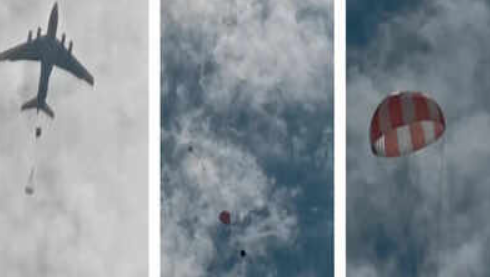
The Indian Space Research Organisation (ISRO) successfully conducted the fifth Integrated Main Parachute Airdrop Test (IMAT-05) for the Gaganyaan Mission at the Aerial Delivery Research and Development Establishment (ADRDE) drop zone in Sheopur, Madhya Pradesh. The test marks another significant milestone in validating the crew module's safe recovery system ahead of the upcoming uncrewed G1 mission.
What is IMAT-05?
The Integrated Main Parachute Airdrop Test (IMAT-05) is a high-altitude structural qualification test designed to validate the main parachute system of the Gaganyaan Crew Module under the most demanding re-entry conditions. It simulates the extreme aerodynamic forces experienced by the crew capsule during atmospheric re-entry before its splashdown in the sea.
The test was jointly planned and executed by the Indian Space Research Organisation (ISRO) and the Aerial Delivery Research and Development Establishment (ADRDE), a laboratory under the Defence Research and Development Organisation (DRDO).
Objective
The primary objective of IMAT-05 was to verify the structural integrity, deployment sequence, aerodynamic performance and safety margins of the main parachute system under maximum design loads expected during the Gaganyaan G1 uncrewed demonstration mission.
Key Features of the Test
The test involved dropping a dummy payload, equivalent in mass to the actual crew module, from an altitude of 2.5 km using an Indian Air Force IL-76 heavy transport aircraft.
The Gaganyaan Crew Module uses an integrated 10-parachute deceleration system, designed to gradually reduce the capsule's velocity before ocean landing.
The system comprises:
- 2 Apex Cover Separation Parachutes to jettison the protective cover over the parachute compartment.
- 2 Drogue Parachutes to stabilize the descending capsule and reduce its initial speed.
- 3 Pilot Parachutes to extract the main parachutes from the capsule.
- 3 Main Parachutes that sequentially deploy to reduce the crew module to a safe splashdown velocity.
A major highlight of IMAT-05 was the successful validation of the disreefing sequence, a controlled deployment mechanism in which the main parachutes inflate in stages rather than opening instantaneously. This significantly reduces structural stress on the parachute canopy and suspension lines under extreme aerodynamic loads.