
Hemis Festival
- 27 Jun 2026
In News:
The Hemis Festival 2026 commenced with great religious fervour at the historic Hemis Monastery in the Leh district of Ladakh, drawing devotees, monks, and tourists from across India and abroad.
About Hemis Festival
- The Hemis Festival, also known as Hemis Tsechu, is one of the most important Buddhist festivals of Ladakh.
- It is celebrated annually at the Hemis Monastery on the 10th day of the Tse-Chu month according to the Tibetan lunar calendar.
- The festival commemorates the birth anniversary of Guru Padmasambhava (Guru Rinpoche), who is revered in Tibetan Buddhism as the Second Buddha for spreading Vajrayana Buddhism across the Himalayan region and subduing evil forces.
- According to local tradition, Guru Padmasambhava visited Ladakh in the 8th century and is believed to have protected the region from negative forces, making the festival an important occasion of spiritual renewal and thanksgiving.
Religious and Cultural Significance
- The Hemis Festival is a vibrant expression of Tibetan Buddhist traditions, symbolising the victory of good over evil, spiritual purification, and compassion. Besides its religious importance, the festival plays a vital role in preserving Ladakh's rich cultural heritage and monastic traditions.
Major Attractions
- The celebrations are centred around the Hemis Monastery, one of the largest and wealthiest monasteries of the Drukpa Kagyu school of Tibetan Buddhism. The monastery is adorned with colourful decorations, prayer flags, and religious ornaments during the festival.
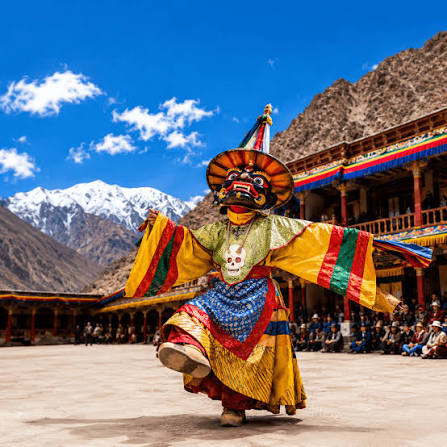
- The principal attraction is the Cham Dance, a sacred masked dance performed by monks and lamas in elaborate costumes. Accompanied by drums, cymbals, and long horns, the dance symbolises the triumph of virtue over evil and narrates important episodes from Buddhist teachings.
Important Rituals
A distinctive ritual of the festival is the ceremonial destruction of a dough sculpture representing evil forces. At the conclusion of the ritual, the sculpture is broken into pieces and scattered in the four cardinal directions, symbolising the elimination of negativity and the purification of the soul.
As part of the local tradition, Chhang, a traditional fermented barley beverage of Ladakh, is served during the festivities.
Thangka Display
One of the most significant features of the Hemis Festival is the display of a giant Thangka (sacred Buddhist scroll painting) depicting Guru Padmasambhava.
This rare display takes place once every 12 years, during the Tibetan Year of the Monkey. The Thangka is richly decorated with semi-precious stones, pearls, and intricate embroidery, attracting thousands of pilgrims and tourists.