
Great Nicobar Island Project
- 16 Jun 2026
In News:
The Andaman and Nicobar Islands Administration has notified the Rehabilitation and Resettlement (R&R) Census for families likely to be affected by the trunk infrastructure component of the Great Nicobar Island Project, marking the commencement of the project's implementation phase.
About the Great Nicobar Island Project
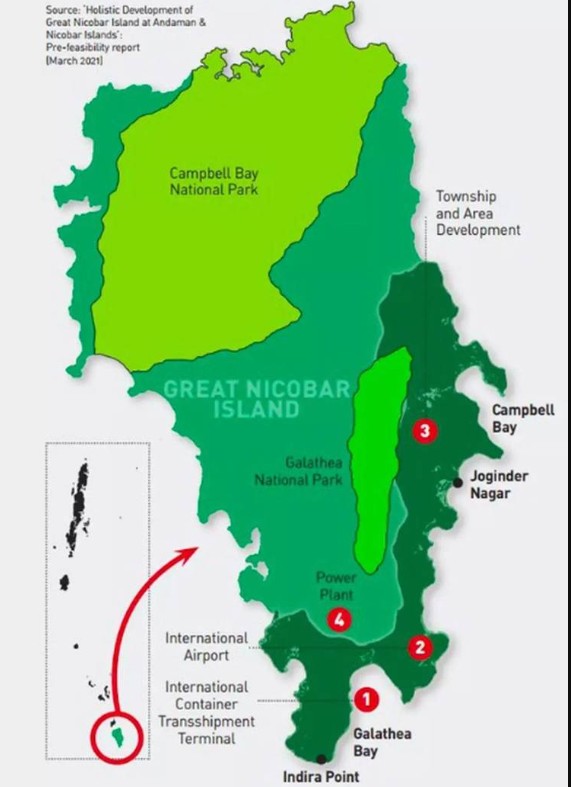
The Great Nicobar Island Project is a flagship infrastructure initiative aimed at transforming Great Nicobar Island into a strategic economic and maritime hub in the Bay of Bengal. Estimated at ?92,000 crore, the project has a long-term implementation timeline extending up to 2050. It seeks to combine economic development with enhanced maritime security and regional connectivity in the Indo-Pacific.
The trunk infrastructure, comprising the main road network and associated public utilities, constitutes the first phase of the project. The ongoing R&R Census aims to identify and verify families affected by this component to facilitate rehabilitation and resettlement in accordance with applicable laws.
Major Components
- International Container Transhipment Port
- Greenfield International Airport
- Power Generation Infrastructure
- Greenfield Township with tourism and urban infrastructure
- Defence and strategic infrastructure
Strategic Significance
The project is envisioned as a model of frontier infrastructure development in ecologically sensitive and strategically important regions. Located near the Malacca Strait, one of the world's busiest Sea Lines of Communication (SLOCs), Great Nicobar occupies a critical position in the Indo-Pacific. The project is expected to:
- Strengthen India's maritime security and naval logistics.
- Enhance India's role in regional transhipment and global supply chains.
- Boost connectivity under the SAGAR (Security and Growth for All in the Region) vision.
- Promote economic development and employment through tourism and port-led growth.
Concerns
Despite its strategic benefits, the project has generated significant environmental and social concerns:
- Potential displacement and livelihood impacts on the Nicobarese and the Shompen, particularly the vulnerable Shompen Tribal Reserve.
- Ecological risks to one of India's richest biodiversity hotspots, including tropical rainforests, mangroves, coral reefs and endemic species.
- Concerns regarding deforestation, habitat fragmentation and increased human intervention in a fragile island ecosystem.
- In 2024, the Public Investment Board (PIB) observed that the proposed transhipment port lacked clearly defined strategic objectives; however, the Ministry of Defence subsequently reaffirmed the project's strategic importance for national security and regional development.
Way Forward
The project's long-term success will depend on balancing strategic infrastructure development with ecological conservation and the constitutional rights of indigenous communities. Transparent rehabilitation, rigorous environmental safeguards, continuous stakeholder consultation, and sustainable development practices will be essential to ensure that national security objectives are achieved without compromising the island's unique ecological and cultural heritage.