
Giant’s Causeway
- 17 Jun 2026
In News:
A recent geochronological study has revealed that the Giant's Causeway in Northern Ireland was formed over about 5.5 million years, nearly 8 million years shorter than previous estimates. The findings improve scientific understanding of one of the world's most iconic volcanic landscapes.
About Giant's Causeway
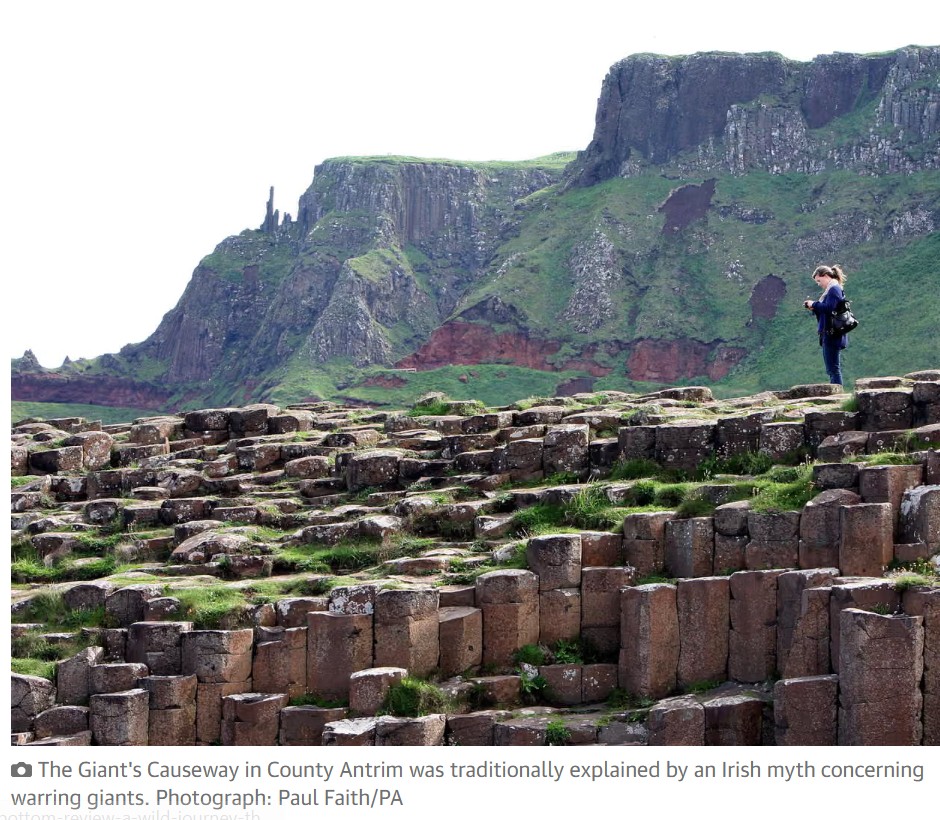
- The Giant's Causeway is a spectacular volcanic landform located along the Antrim Plateau on the northeastern coast of Northern Ireland. It comprises nearly 40,000 interlocking basalt columns extending over about 6 km of coastline. Most of the columns are hexagonal, though some have four, five, seven or eight sides. Their stair-like appearance gave rise to the name "Giant's Causeway."
- Recognised for its exceptional geological significance, it was designated a UNESCO World Heritage Site in 1986.
Formation of the Giant's Causeway
The basalt columns were formed during the Paleogene Period, around 50–60 million years ago, when intense volcanic activity affected the region.
The formation process involved:
- Extensive volcanic eruptions that produced large volumes of basaltic lava.
- The molten basalt rose through chalk beds, creating a vast volcanic plateau.
- As the lava cooled, it contracted, producing fractures known as columnar joints.
- Continued cooling caused the lava to shrink further, resulting in the development of tall, closely packed polygonal basalt columns.
- Rapid cooling led to greater contraction, producing the characteristic well-defined hexagonal columns visible today.
The latest research suggests that the volcanic processes responsible for this landscape occurred over approximately 5.5 million years, rather than the previously estimated 13.5 million years, indicating a much shorter but geologically significant volcanic episode.
Geological Significance
The Giant's Causeway is one of the world's finest examples of columnar jointing, demonstrating how cooling and contraction of basaltic lava produce regular polygonal rock columns. It provides valuable evidence for understanding igneous processes, volcanic evolution, and the geological history of the North Atlantic Igneous Province