
IMAT-05: Fifth Integrated Main Parachute Airdrop Test for Gaganyaan Mission
- 12 Jul 2026
In News:
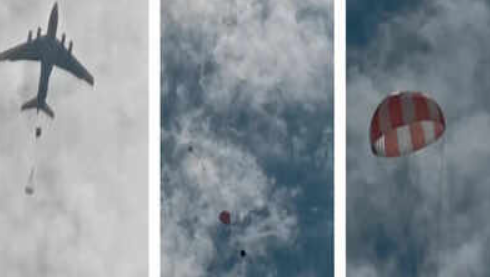
The Indian Space Research Organisation (ISRO) successfully conducted the fifth Integrated Main Parachute Airdrop Test (IMAT-05) for the Gaganyaan Mission at the Aerial Delivery Research and Development Establishment (ADRDE) drop zone in Sheopur, Madhya Pradesh. The test marks another significant milestone in validating the crew module's safe recovery system ahead of the upcoming uncrewed G1 mission.
What is IMAT-05?
The Integrated Main Parachute Airdrop Test (IMAT-05) is a high-altitude structural qualification test designed to validate the main parachute system of the Gaganyaan Crew Module under the most demanding re-entry conditions. It simulates the extreme aerodynamic forces experienced by the crew capsule during atmospheric re-entry before its splashdown in the sea.
The test was jointly planned and executed by the Indian Space Research Organisation (ISRO) and the Aerial Delivery Research and Development Establishment (ADRDE), a laboratory under the Defence Research and Development Organisation (DRDO).
Objective
The primary objective of IMAT-05 was to verify the structural integrity, deployment sequence, aerodynamic performance and safety margins of the main parachute system under maximum design loads expected during the Gaganyaan G1 uncrewed demonstration mission.
Key Features of the Test
The test involved dropping a dummy payload, equivalent in mass to the actual crew module, from an altitude of 2.5 km using an Indian Air Force IL-76 heavy transport aircraft.
The Gaganyaan Crew Module uses an integrated 10-parachute deceleration system, designed to gradually reduce the capsule's velocity before ocean landing.
The system comprises:
- 2 Apex Cover Separation Parachutes to jettison the protective cover over the parachute compartment.
- 2 Drogue Parachutes to stabilize the descending capsule and reduce its initial speed.
- 3 Pilot Parachutes to extract the main parachutes from the capsule.
- 3 Main Parachutes that sequentially deploy to reduce the crew module to a safe splashdown velocity.
A major highlight of IMAT-05 was the successful validation of the disreefing sequence, a controlled deployment mechanism in which the main parachutes inflate in stages rather than opening instantaneously. This significantly reduces structural stress on the parachute canopy and suspension lines under extreme aerodynamic loads.
SAKHI App To Assist Gaganyaan Crew
- 19 Mar 2024
Why is it in the News?
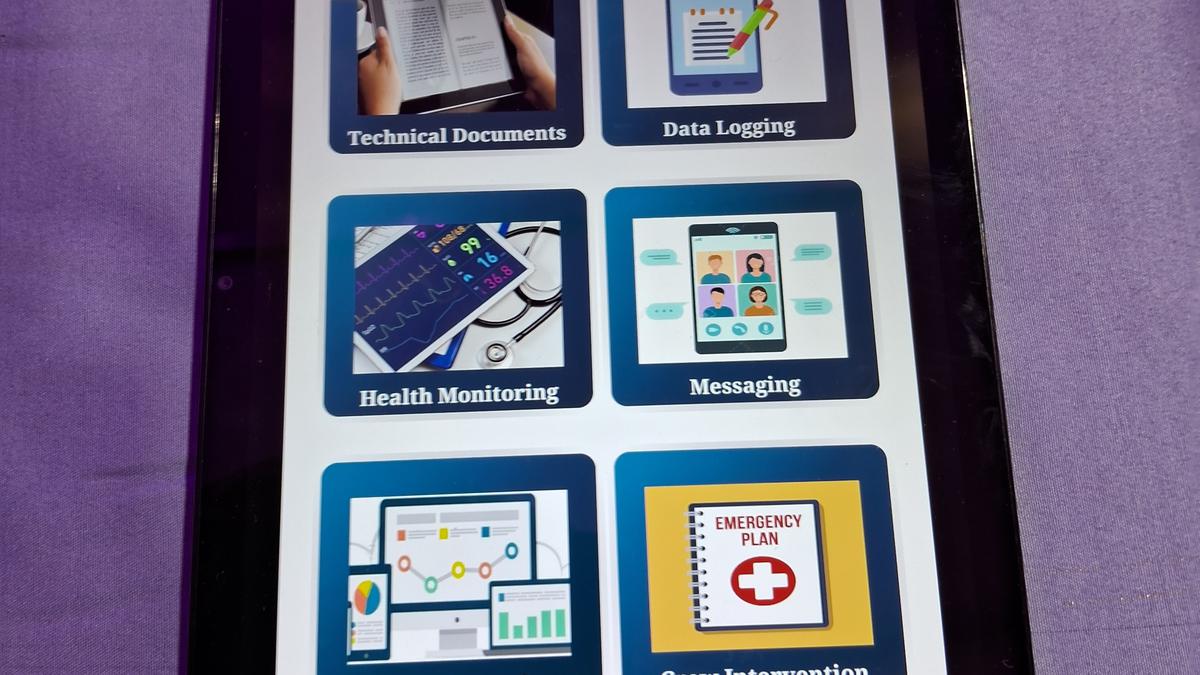
The Vikram Sarabhai Space Centre (VSSC), the Indian Space Research Organisation (ISRO) facility at Thumba in Thiruvananthapuram, has developed a multi-purpose app that will help astronauts on the Gaganyaan space flight mission carry out a range of tasks such as looking up vital technical information or communicating with one another.
About SAKHI App:
- The Vikram Sarabhai Space Centre (VSSC), an ISRO facility in Thumba, Thiruvananthapuram, has created the versatile 'SAKHI' app for astronauts on the Gaganyaan space flight mission.
- SAKHI stands for 'Space-borne Assistant and Knowledge Hub for Crew Interaction'.
Purpose:
- During the mission, the app will assist Gaganyaan crew members in various tasks such as accessing vital technical information and communicating with each other.
Utility:
- Health Monitoring: It will monitor key health parameters like blood pressure, heart rate, and oxygen saturation, providing crucial insights into the crew's physical condition during the mission.
- Additionally, it will remind them of hydration, dietary schedules, and sleep patterns.
- Connectivity:
- Astronauts can use the app to maintain mission logs in various formats, including voice recordings, texts, and images.
- It will ensure seamless communication between the crew, the onboard computer, and ground-based stations.
- Current Status: An engineering model of the custom-built hand-held smart device featuring SAKHI has been tested, with the development of a flight model underway.
About the Gaganyaan Mission:
- The primary objective of the mission is to demonstrate the capability to launch and safely return three crew members to low Earth orbit.
- The Launch Vehicle Mark-3 (LVM3) is designated as the launch vehicle for the Gaganyaan mission.
- Crew Escape System (CES): A vital component of the mission, CES is powered by quick-acting, high-burn rate solid motors.
- It ensures the safe evacuation of the Crew Module and crew in case of emergencies during launch or ascent.
- Orbital Module: Comprising the Crew Module (CM) and Service Module (SM), the Orbital Module orbits the Earth, providing safety and support throughout the mission phases.
- Crew Module (CM): Designed to offer a habitable space with Earth-like conditions for the crew during their time in space.
- Service Module (SM): This module supports the CM during orbit, containing essential systems such as thermal, propulsion, power, avionics, and deployment mechanisms.
- This will mark ISRO's inaugural manned spaceflight mission, joining the ranks of the US, Russia, and China, which have previously conducted human spaceflights.