
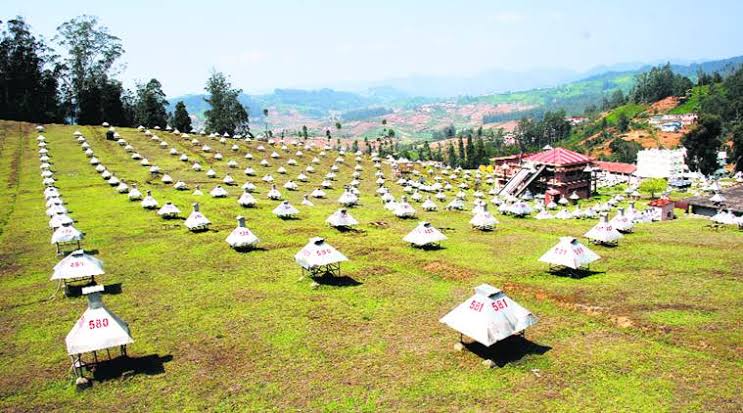
GRAPES-3 Telescope
- 18 Jun 2026
In News:
Researchers from Mumbai, Kochi, and Japan have used the GRAPES-3 Telescope to study how Earth's upper atmospheric temperature and the Sun's magnetic field influence cosmic ray muons—high-energy subatomic particles produced when cosmic rays interact with Earth's atmosphere. The findings improve understanding of space weather, atmospheric processes, and cosmic ray propagation.
What is GRAPES-3?
Gamma Ray Astronomy PeVEnergieS phase-3 (GRAPES-3) is a high-energy cosmic ray observatory designed to investigate the origin, acceleration, and propagation of cosmic rays by detecting Extensive Air Showers (EAS) produced when high-energy cosmic rays or gamma rays enter Earth's atmosphere.
Besides cosmic ray studies, the facility also investigates solar activity, space weather, and thunderstorm-related phenomena through the observation of cosmic ray muons.
Key Features of GRAPES-3
- Location: Ooty, Tamil Nadu.
- Operated by: Tata Institute of Fundamental Research (TIFR).
- Detects primary cosmic rays and gamma rays in the tera-electronvolt (TeV) to peta-electronvolt (PeV) energy range.
- Uses an array of plastic scintillator detectors and a large-area muon detector based on proportional counters.
- Measures Extensive Air Showers produced by high-energy particles entering Earth's atmosphere.
What are Cosmic Rays?
- Cosmic rays are high-energy charged particles originating from outer space that continuously bombard the Earth from all directions. They are among the most energetic particles in the Universe and were discovered over a century ago.
- When these primary cosmic rays collide with atmospheric molecules, they generate Extensive Air Showers, producing secondary particles such as:Muons, Electrons, Photons, Protons, and Neutrons
- These secondary particles travel towards Earth's surface at nearly the speed of light.
What are Muons?
Muons are unstable, charged elementary particles belonging to the lepton family, similar to electrons but approximately 200 times heavier. They are produced in large numbers during cosmic ray interactions with the atmosphere and can penetrate deep into matter, making them useful for studying atmospheric changes, solar activity, geological structures, and space weather.
Significance of the Study
The study demonstrates that variations in the Sun's magnetic field and the temperature of the upper atmosphere influence the number of muons reaching Earth. Continuous monitoring of these variations through GRAPES-3 enhances understanding of:
- Space weather and solar storms.
- Solar-terrestrial interactions.
- Atmospheric dynamics.
- Behaviour of high-energy cosmic particles.
- Potential impacts on satellite communication, navigation systems, and power infrastructure.