
Electrolyte Engineering for Advanced Aqueous Zinc-Ion Batteries (AZIBs)
- 29 Jun 2026
In News:
Scientists at the Institute of Nano Science and Technology (INST), Mohali, an autonomous institute under the Department of Science & Technology (DST), have developed a novel electrolyte additive (BDIM) that significantly improves the performance, safety and lifespan of Aqueous Zinc-Ion Batteries (AZIBs), offering a promising alternative to lithium-ion batteries.
About the Research
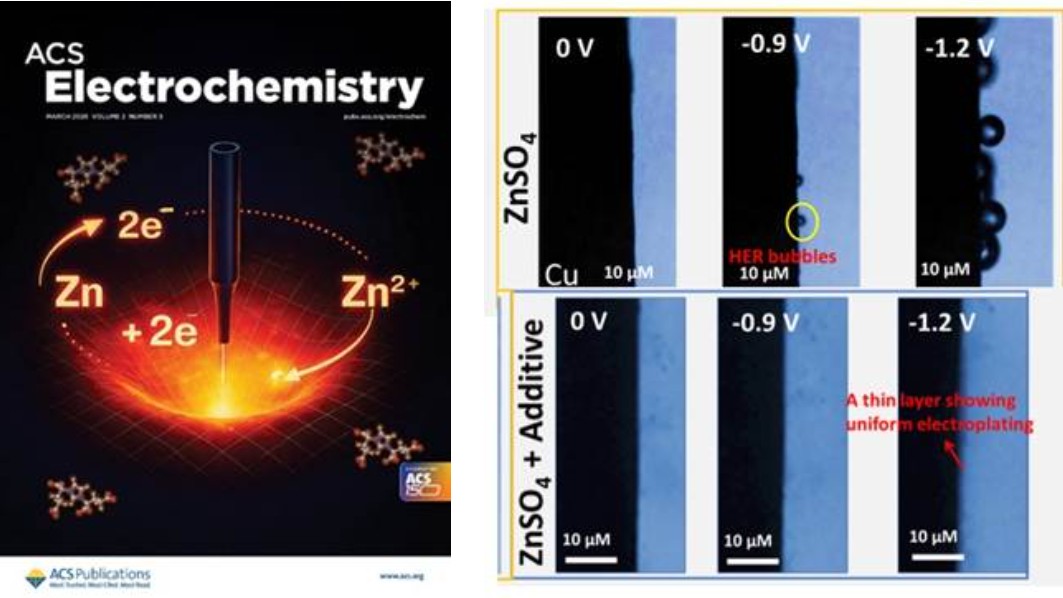
Researchers have developed a new electrolyte additive called 1,3-bis (1,3-dicarboxypropyl)-1H-imidazole-3-ium chloride (BDIM), which improves the stability of the zinc anode by regulating the Inner Helmholtz Plane (IHP)—the interfacial region where electrochemical reactions occur.
Unlike expensive battery redesigns, the innovation focuses on electrolyte interface engineering, making it a cost-effective and scalable solution for next-generation rechargeable batteries.
Why are Aqueous Zinc-Ion Batteries (AZIBs) Important?
AZIBs are emerging as a promising alternative to lithium-ion batteries because they are:
- Safer due to non-flammable water-based electrolytes.
- Low-cost owing to the abundance of zinc.
- Environment-friendly and sustainable.
- Suitable for grid-scale and renewable energy storage.
However, their commercialization has been limited due to:
- Zinc dendrite formation.
- Hydrogen Evolution Reaction (HER).
- Corrosion of the zinc anode.
- Poor cycling stability.
How Does BDIM Work?
The BDIM additive selectively adsorbs on the zinc surface and occupies the Inner Helmholtz Plane (IHP).
This prevents water molecules from directly interacting with the zinc surface, thereby:
- Suppressing Hydrogen Evolution Reaction (HER).
- Reducing corrosion.
- Preventing zinc dendrite formation.
- Improving battery stability and lifespan.
The researchers also employed Ultramicroelectrode (UME) and Fast-Scan Cyclic Voltammetry (FSCV) techniques to better understand zinc deposition and interfacial charge-transfer mechanisms.
Applications
The technology has significant potential in:
- Grid-scale energy storage.
- Renewable energy integration.
- Backup power systems.
- Long-duration stationary energy storage.
- Safer and affordable rechargeable batteries.
By increasing battery life and reducing degradation, it can lower maintenance costs and improve the reliability of clean energy infrastructure.