
Ease of Doing Business
- 11 Jun 2026
In News:
India has undertaken a comprehensive transformation of its business and regulatory framework over the last decade, shifting from a compliance-heavy administrative system to a digital, trust-based and facilitation-oriented governance model.
Led by the Department for Promotion of Industry and Internal Trade (DPIIT) and supported by multiple ministries, these reforms aim to reduce compliance burdens, improve investor confidence, encourage entrepreneurship and enhance India's global competitiveness.
The reforms form a critical component of India's broader vision of building a Viksit Bharat by 2047 through digital governance, streamlined regulations, transparent administration and efficient service delivery.
India's Progress in Global Competitiveness
The impact of these reforms is reflected in India's improved performance across various global governance and competitiveness indicators.
- India's rank in the World Bank's Ease of Doing Business Index improved dramatically from 142nd in 2014 to 63rd in 2019, one of the fastest improvements globally. Similarly, India's ranking in the IMD World Competitiveness Ranking improved from 43rd in 2021 to 41st in 2025.
- The country has also been placed in the top-tier Group A category of the World Bank's GovTech Maturity Index in 2020, 2022 and 2025, reflecting significant progress in digital governance. Furthermore, the UN E-Government Survey has recognized India's strong performance in online public services, telecommunications infrastructure and human capital.
Simplifying Business Entry and Formalisation
A major focus of reforms has been reducing barriers to starting and operating businesses.
Startup India
- The Startup India initiative has significantly expanded India's startup ecosystem. The number of recognized startups increased from 502 in 2016 to more than 2.23 lakh in 2026, generating over 23.3 lakh jobs.
- Notably, nearly 48% of recognized startups have at least one woman director or partner, highlighting increasing inclusivity.
SPICe and MCA21
- The SPICe (Simplified Proforma for Incorporating Company Electronically Plus) system integrated ten separate incorporation procedures into a single online application, significantly reducing the time and cost involved in starting a business.
- The MCA21 Version 3.0 platform processed 3.84 crore filings between 2021 and 2025, with most approvals granted through Straight Through Processing (STP), reducing human intervention and delays.
Udyam Registration Portal
- Launched in 2020, the Udyam Portal provides a free, paperless, self-declaration-based registration system for MSMEs.
- Monthly registrations increased from about 10,000 in 2020 to over 8.58 lakh in 2026, promoting formalisation and improving access to government support.
Land and Property Reforms
- Land administration has traditionally been one of the most challenging aspects of doing business in India. Significant reforms have therefore focused on digitisation and transparency.
Digital India Land Records Modernization Programme (DILRMP)
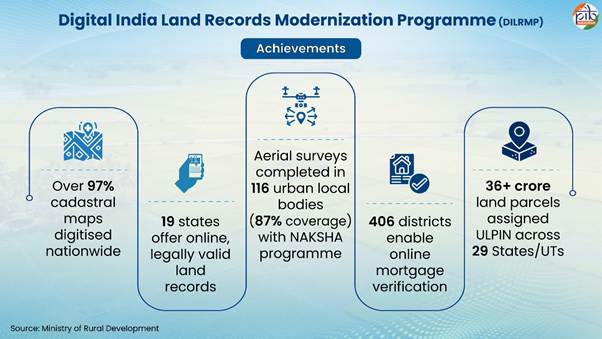
- The Digital India Land Records Modernization Programme (DILRMP) has digitized 97.37% of cadastral maps and assigned Unique Land Parcel Identification Numbers (ULPINs) to more than 36 crore land parcels.
- ULPIN is often referred to as the "Aadhaar for Land" because it provides a unique identity to each land parcel, reducing disputes and improving transparency.
National Generic Document Registration System (NGDRS)
- The NGDRS seeks to standardize and digitize property registration processes across states. However, implementation remains uneven and is currently limited to a relatively small number of States and Union Territories.
Single-Window Clearances and Regulatory Simplification
National Single Window System (NSWS)
The National Single Window System (NSWS) acts as a unified digital platform for investors by integrating approvals from:
- 32 Central Ministries and Departments
- 34 States and Union Territories
The system has facilitated more than 8.29 lakh approvals and clearances, significantly reducing procedural complexity.
PARIVESH 2.0
The PARIVESH platform has transformed environmental clearances through digital processing and monitoring. Clearance timelines have reportedly been reduced to approximately 64 days, improving project execution while maintaining environmental safeguards.
Strengthening Market Access and Logistics
Government e-Marketplace (GeM)
The Government e-Marketplace (GeM) has revolutionized public procurement by creating a transparent digital marketplace for government purchases.
Key achievements include:
- Cumulative procurement exceeding ?18.4 lakh crore
- Procurement worth nearly ?5 lakh crore in FY 2025–26
- Around 68% of orders sourced from Micro and Small Enterprises (MSEs)
PM Gati Shakti
- The PM Gati Shakti National Master Plan integrates planning across 58 ministries and all States and Union Territories through over 3,199 GIS layers.
- The platform has evaluated 352 infrastructure projects worth approximately ?16.1 lakh crore, promoting integrated infrastructure development and reducing logistics costs.
Logistics Performance
- India's rank in the World Bank Logistics Performance Index improved from 54th in 2014 to 38th in 2023.
- The Logistics Data Bank (LDB) 2.0 now tracks nearly 100% of EXIM containers, covering around 95 million container movements, thereby improving supply chain visibility and efficiency.
Expanding Credit Access and Digital Financial Infrastructure
Credit Support to MSMEs
- The Credit Guarantee Fund Trust for Micro and Small Enterprises (CGTMSE) has extended guarantees worth approximately ?9.34 lakh crore, supporting easier access to credit for MSMEs.
- Under the Pradhan Mantri Mudra Yojana (PMMY), more than 57 crore loans amounting to ?40.07 lakh crore have been sanctioned since 2015.
- Importantly, women account for nearly 60% of Mudra loan beneficiaries, highlighting the scheme's role in promoting financial inclusion.
UPI Revolution
- India's digital payments ecosystem has witnessed unprecedented growth through Unified Payments Interface (UPI).
- Transactions increased from around 2 crore in FY 2016–17 to over 24,162 crore transactions in FY 2025–26, with a transaction value exceeding ?314 lakh crore, making UPI the world's largest real-time payment system.
GST Reforms
The implementation of Goods and Services Tax (GST) has simplified indirect taxation by creating a unified national market.
Key indicators include:
- GST taxpayer base increasing from about 60 lakh to 1.64 crore
- Processing of ?107.64 lakh crore in tax payments
- Generation of 188.27 crore e-Way Bills in FY 2025–26
Emerging Reforms and Open Digital Commerce
India has also focused on reducing compliance burdens through trust-based governance.
Labour Reforms
The Labour Codes introduced:
- Risk-based inspections
- Randomized web-based allocation of inspections
- Transformation of inspectors into Inspector-cum-Facilitators
These measures seek to reduce discretionary powers and improve compliance support.
Consent to Operate Reforms
Revisions to industrial consent guidelines have made the Consent to Operate (CTO) valid until cancelled in many cases, eliminating the burden of repeated renewals.
Open Network for Digital Commerce (ONDC)
The Open Network for Digital Commerce (ONDC) is democratizing e-commerce by reducing platform monopolies.
The network has onboarded:
- Over 7.64 lakh sellers
- Across more than 616 cities
This has improved market access for small retailers and MSMEs.
Challenges Ahead
Despite substantial progress, several challenges remain:
- Uneven implementation of reforms across States and districts.
- Delays in insolvency resolution due to tribunal bottlenecks.
- Legacy land record discrepancies affecting property transactions.
- Digital literacy and language barriers for rural enterprises.
- Variations in local-level administrative capacity.
These issues continue to affect the uniform implementation of reforms across the country.
Way Forward
Further improvements can be achieved through:
- Faster disposal of insolvency cases under the Insolvency and Bankruptcy framework.
- Expansion of the District Business Reform Action Plan (D-BRAP).
- Wider adoption of Trade Receivables Discounting System (TReDS) to improve MSME liquidity.
- Continued decriminalization of minor business offences under the Jan Vishwas Act framework.
- Strengthening export promotion initiatives and integration into global value chains.