
Clouded Leopard
- 10 Aug 2025
In News:
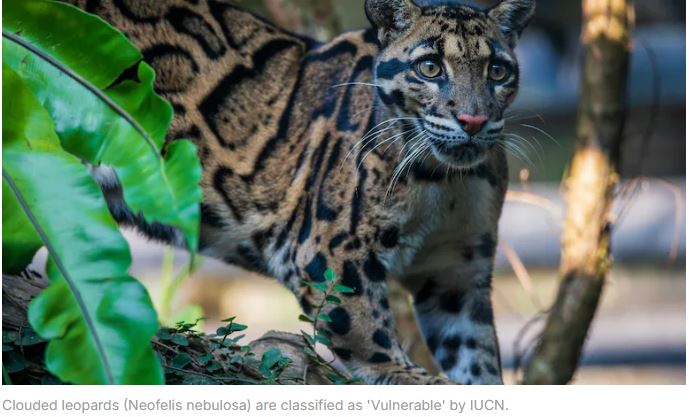
A rare video recently shared by Indian Forest Service officer Susanta Nanda offered a rare glimpse into the secretive life of the clouded leopard (Neofelisnebulosa), showcasing a mother with her cubs in the rainforests of Northeast India. The sighting highlights the critical conservation importance of this elusive and endangered species.
About the Clouded Leopard
- Scientific name:Neofelisnebulosa (mainland Asia); Neofelisdiardi (Sunda clouded leopard, Sumatra & Borneo).
- Classification: Among the most ancient cat species; neither a true “great cat” nor a small cat — cannot roar or purr.
- Size: Medium-sized (60–110 cm long; 11–20 kg); lifespan ~13–17 years.
- Distinctive features:
- Named for large “cloud-like” coat patterns (ellipses with dark edges).
- Exceptionally long tail (often body-length) for balance.
- Long canine teeth, proportionally the same size as those of a tiger.
- Broad paws and short legs, making it an agile climber; one of the only cats that can climb down trees headfirst, hang upside down, and hunt arboreally.
- Behaviour: Solitary, shy, and nocturnal.
Distribution and Habitat
- Found across Nepal, Bangladesh, India, Indochina, Sumatra, Borneo, and southern China (historically also Taiwan).
- In India: Present in Sikkim, northern West Bengal, Meghalaya, Tripura, Mizoram, Manipur, Assam, Nagaland, and Arunachal Pradesh.
- Declared the State Animal of Meghalaya.
- Habitat preference: Lowland tropical rainforests, but also found in dry woodlands, secondary forests, high altitudes in the Himalayas, and even mangrove swamps (Borneo).
Conservation Status
- IUCN Red List:Vulnerable.
- Global wild population:fewer than 10,000 individuals.
- Threats:
- Habitat loss (deforestation, infrastructure expansion).
- Poachingfor pelts and body parts.
- Human-wildlife conflict.
Conservation Significance
- Rare sightings, such as the video from Northeast India, underscore the species’ ecological and cultural importance.
- Conservationists stress the need for:
- Habitat protection through transboundary wildlife corridors.
- Strengthening protected areas across Northeast India.
- Community participation to reduce conflict and safeguard prey base.