
Citizenship in India and Proof of Citizenship
- 27 Jun 2026
In News:
The Ministry of External Affairs (MEA) recently clarified that an Indian passport is primarily a travel document and not conclusive proof of citizenship. The clarification has gained significance in the backdrop of the ongoing Special Intensive Revision (SIR) of electoral rolls and the broader debate on citizenship verification.
Citizenship under Indian Law
- Citizenship in India is governed by the Citizenship Act, 1955, which prescribes the legal framework for acquiring, determining, and terminating citizenship.
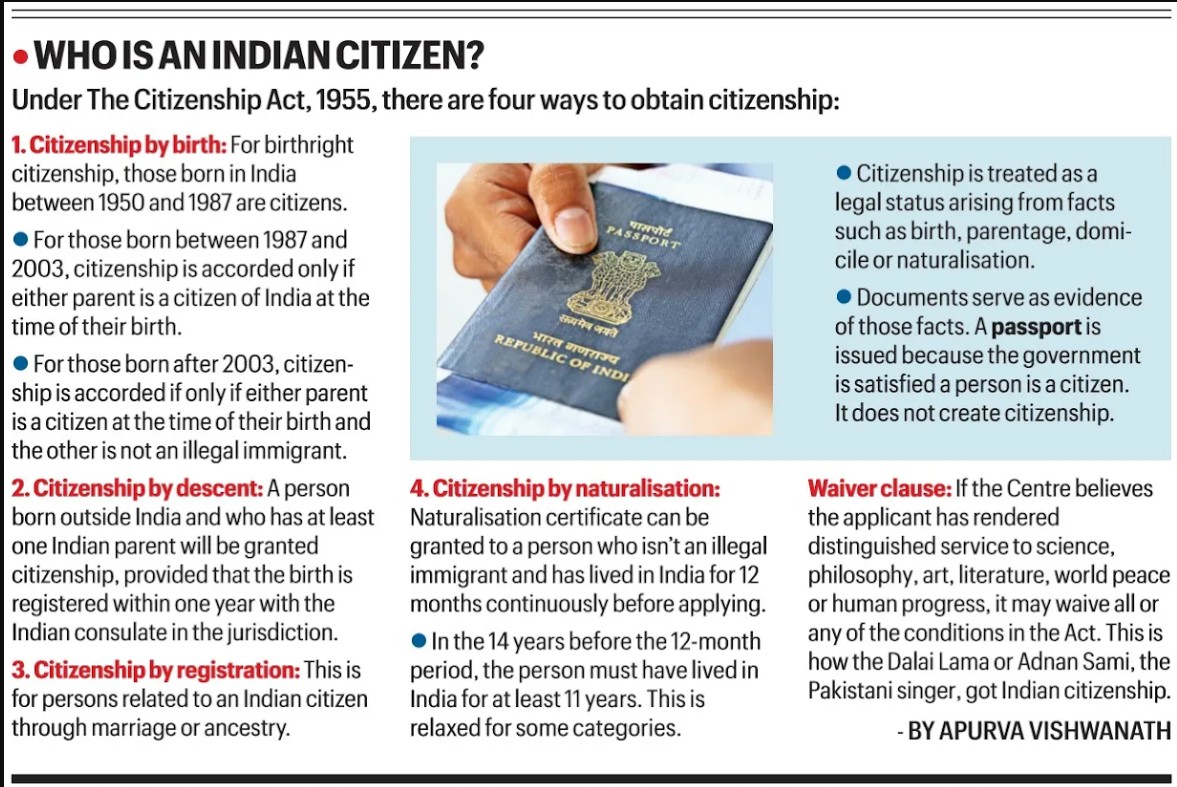
- Unlike several countries, India does not possess a single universal document that conclusively establishes citizenship. Instead, citizenship is determined through the provisions of the Citizenship Act and established using relevant documentary evidence relating to birth, parentage, descent, registration, or naturalisation.
- The Supreme Court, in Sarbananda Sonowal v. Union of India (2005), held that the burden of proving Indian citizenship lies on the individual claiming it.
Is a Passport Proof of Citizenship?
- The Passport Manual describes an Indian passport as strong evidence of nationality, a view also recognised by the Supreme Court in Maneka Gandhi v. Union of India (1978). However, it is not conclusive proof of citizenship in the event of a legal dispute.
- Further, Section 20 of the Passports Act, 1967 empowers the Central Government to issue passports to non-citizens in public interest under exceptional circumstances. This was reflected in the 2023 Madras High Court decision permitting a stateless Sri Lankan refugee to apply for an Indian passport.
Thus, while a passport generally indicates nationality for international travel, it does not by itself conclusively determine citizenship under Indian law.
Electoral Rolls and Citizenship
- The Supreme Court, in Lal Babu Hussein v. Electoral Registration Officer (1995), held that inclusion of a person's name in the electoral roll creates a presumption of citizenship, which can be displaced only through due legal process.
- More recently, in Association for Democratic Reforms & Others v. Election Commission of India (2026), the Supreme Court upheld the constitutional validity of the Special Intensive Revision (SIR) of electoral rolls conducted by the Election Commission of India (ECI) under Article 324 of the Constitution and Section 21(3) of the Representation of the People Act, 1950.
- The Court clarified that the ECI is empowered to undertake limited citizenship inquiries only for determining electoral eligibility. Importantly, deletion of a person's name from the electoral roll does not amount to loss of citizenship, as the authority to determine citizenship rests under the Citizenship Act, 1955, and not with the Election Commission. Suspected citizenship cases must be referred to the Ministry of Home Affairs (MHA) for adjudication before elections.
Modes of Acquiring Indian Citizenship
The Citizenship Act, 1955 provides five modes of acquiring citizenship:
- By Birth
- By Descent
- By Registration
- By Naturalisation
- By Incorporation of Territory
India initially followed the principle of Jus Soli (right by birth) but gradually shifted towards Jus Sanguinis (right by blood/descent) through successive amendments.
The conditions for citizenship by birth are:
- 26 January 1950 – 1 July 1987: Every person born in India became a citizen irrespective of parents' nationality.
- 1 July 1987 – 3 December 2004: At least one parent must be an Indian citizen.
- On or after 3 December 2004: One parent must be an Indian citizen and the other must not be an illegal migrant.
Citizenship by descent applies to persons born outside India to Indian parent(s), subject to mandatory consular registration for births after 3 December 2004.
Citizenship by registration and naturalisation is available to eligible Persons of Indian Origin (PIOs), spouses of Indian citizens, and foreign nationals fulfilling prescribed residency conditions, generally 12 years. India does not permit dual citizenship.
Important Amendments
- The Citizenship (Amendment) Act, 2003 introduced stricter provisions by denying citizenship by birth where one parent is an illegal migrant and strengthened provisions relating to illegal migration.
- The Citizenship (Amendment) Act (CAA), 2019 reduced the residency requirement for acquiring citizenship by naturalisation from 11 years to 5 years for Hindu, Sikh, Buddhist, Jain, Parsi, and Christian migrants from Pakistan, Bangladesh, and Afghanistan who entered India on or before 31 December 2014 after facing religious persecution.