
Ayushman Bharat Digital Mission (ABDM)
- 25 May 2026
In News:
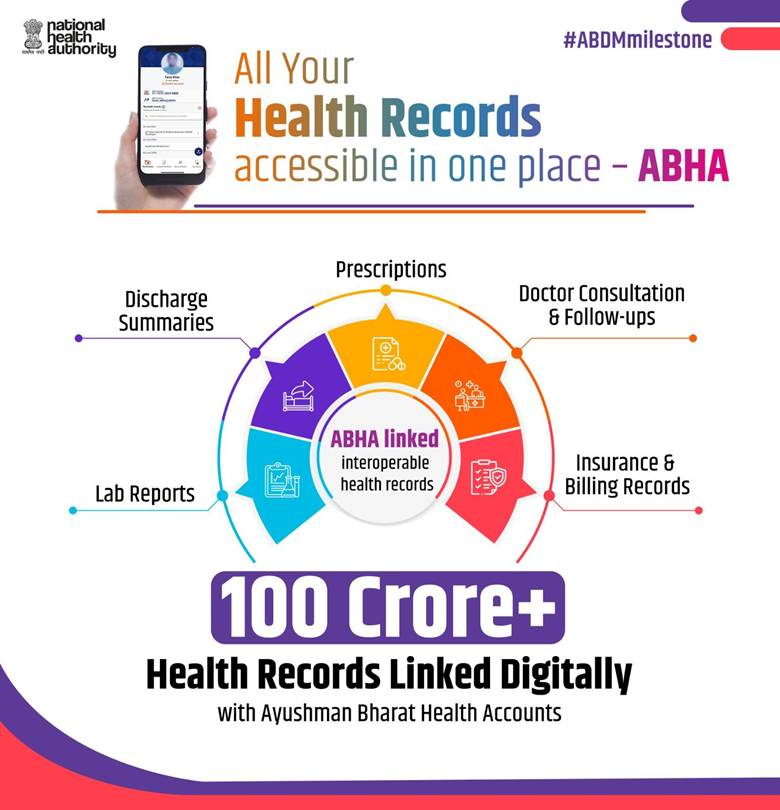
The Ayushman Bharat Digital Mission (ABDM), implemented by the National Health Authority (NHA) under the Ministry of Health and Family Welfare, has achieved a landmark milestone with over 100 crore health records successfully linked with Ayushman Bharat Health Accounts (ABHA). The achievement positions ABDM as one of the world's largest digital health ecosystems — a defining moment for India's Digital Public Infrastructure (DPI) in healthcare.
Scale and Speed of Achievement
ABDM doubled the number of linked health records from 50 crore in February 2025 to over 100 crore in just 15 months, with nearly 10 crore health records now being added every two to three months. From fewer than 1,000 linked records during its initial phase, the mission has evolved into a continental-scale digital health infrastructure.
More than 450 public and private health technology solutions have successfully integrated with the ABDM ecosystem, accelerating digitisation and seamless exchange of health records across healthcare facilities nationwide.
State-Wise Performance
Uttar Pradesh has emerged as the leading contributor with over 15.03 crore ABHA-linked health records, followed by Andhra Pradesh with over 11.95 crore. Bihar, Rajasthan, and Gujarat have linked over 7.37 crore, 6.32 crore, and 4.77 crore records respectively.
Key Government Platforms Contributing to the Milestone
Major contributing programmes and platforms include the NCD Programme and CoWIN (MoHFW), PM-JAY, UP's eKavach platform, AP's health programmes, the Reproductive and Child Health (RCH)programme, eHospital (NIC), eSushrut (C-DAC), Gujarat's TeCHO platform, and Rajasthan's iHMS platform.
Key Components of ABDM
The mission operates through six digital building blocks:
- ABHA (Ayushman Bharat Health Account): A 14-digit unique health ID enabling citizens to securely link and access health records across hospitals, clinics, labs, and pharmacies.
- Healthcare Professionals Registry (HPR): Comprehensive repository of all healthcare professionals across modern and traditional medicine systems.
- Health Facility Registry (HFR): Registry of all public and private health facilities — hospitals, clinics, diagnostic labs, pharmacies.
- HIE-CM (Health Information Exchange and Consent Manager): Enables consent-based, secure sharing of health records — placing data sovereignty with the citizen.
- Unified Health Interface (UHI): Open protocol enabling interoperability across digital health service applications.
- National Health Claims Exchange (NHCX):Standardises health claim information exchange between payers, providers, and beneficiaries — streamlining insurance claim processing.
Significance
ABDM represents a pivotal application of India's DPI model — the same stack of interoperable, consent-based, open-protocol infrastructure that powers UPI in payments and Aadhaar in identity — now applied to healthcare data. The milestone has several transformative implications:
- Continuity of Care: Longitudinal digital health records empower citizens with secure, consent-based access to their health information — enabling seamless record sharing across providers and eliminating dependence on physical documents.
- Insurance Efficiency: NHCX integration reduces claim processing delays and fraud — a critical reform for PM-JAY's effective implementation at scale.
- Public Health Surveillance: Aggregated, anonymised ABHA-linked data can power population-level disease surveillance, NCD monitoring, and health planning — aligning with India's One Health Mission and post-pandemic preparedness frameworks.
- Global DPI Leadership: India's ABDM model — open, interoperable, consent-driven, and rapidly scalable — is increasingly cited by the WHO and G20 as a replicable template for low- and middle-income countries building digital health infrastructure.
AYUSHMAN BHARAT DIGITAL MISSION (ABDM)

- 28 Sep 2024
In News:
Over 67 crore Ayushman Bharat Health Accounts (ABHA) have been created in the past three years under the Ayushman Bharat Digital Mission (ABDM). The digital healthcare mission marked its three-year anniversary.
Key Highlights:
- Launch Date: September 27, 2021.
- Vision: Establish a robust digital health infrastructure to enhance healthcare accessibility, efficiency, and transparency.
- Duration: A transformative three-year journey aimed at revolutionizing India’s digital healthcare ecosystem.
Objectives and Background
- Alignment with National Health Policy: The mission stems from the National Health Policy (2017), emphasizing accessibility and the integration of digital technologies.
- Building Blocks:
- National Health Stack (2018) introduced unique health identifiers and verified registries.
- National Digital Health Blueprint (2019) provided guidance for implementing ABDM.
Key Features of ABDM
- Unique Health Identifier (ABHA ID): Assigns a unique ID to every individual for managing health records.
- Healthcare Professionals Registry (HPR): Comprehensive database of healthcare professionals across all systems of medicine.
- Health Facility Registries (HFR): Repository of public and private health facilities, including hospitals, clinics, and pharmacies.
- Health Information Exchange and Consent Manager (HIE-CM): Allows secure access and sharing of health records based on informed consent.
- Unified Health Interface (UHI): Facilitates the discovery and delivery of health services.
- National Health Claims Exchange (HCX): Standardizes the insurance payment process for quicker claims.
- Data Privacy and Security: Ensures confidentiality and security of health-related information in compliance with the Digital Personal Data Protection Act, 2023.
- Interoperability: Enables seamless data exchange among stakeholders, supported by key gateways (HIE-CM, NHCX, UHI).
- Transparency: Offers individuals access to both public and private health services, ensuring transparent pricing and accountability.
Key Initiatives
- Scan and Share: QR-code based OPD registration reduces wait times and improves data accuracy.
- Digital Health Incentive Scheme (DHIS): Financial incentives to encourage participation in the ABDM ecosystem, launched on January 1, 2023.
- Microsites for Private Sector Adoption: Operationalized 106 microsites to facilitate ABDM adoption among private providers.
- End-to-End ABDM Adoption Pilot: Aimed at digitizing healthcare facilities across India, with 131 selected for participation.
Achievements
- Health Accounts Creation: Over 67 crore Ayushman Bharat Health Accounts (ABHA) established, linking 42 crore health records.
- Ecosystem Participation: Involvement of 236 private entities and leading public institutions, enhancing interoperability.
- Healthcare Facility Registration: 3.3 lakh health facilities and 4.7 lakh healthcare professionals registered.
Moving Towards Transformation
- Collaborations: Partnerships with IIT Kanpur and Maharashtra University of Health Sciences to drive digital health education and public goods development.
- Training Initiatives: Introduction of a WhatsApp Chatbot for stakeholder training on digital health practices.
- Digital Health Standards: Launched by the National Accreditation Board of Hospitals to promote digital health technology adoption.
- Integration of eSwasthya Dham Portal: Extends ABDM benefits to Char Dham Yatris.
Vision for the Future
ABDM aims to create a seamless digital health ecosystem, ensuring every Indian citizen has access to their health records through a unique ABHA ID. The initiative includes:
- Clinical Decision Support System (CDSS): Aids healthcare professionals in improving clinical decision-making and patient outcomes.