
Astra Mk 1 Missile
- 12 Jul 2026
In News:
During the India–Indonesia Bilateral Summit in Jakarta, the two countries signed a landmark defence agreement for the supply of the indigenously developed Astra Mk 1 Beyond-Visual-Range Air-to-Air Missile (BVRAAM). The deal marks a significant milestone in India's growing defence exports and strengthens strategic defence cooperation between the two countries.
What is the Astra Mk 1 Missile?
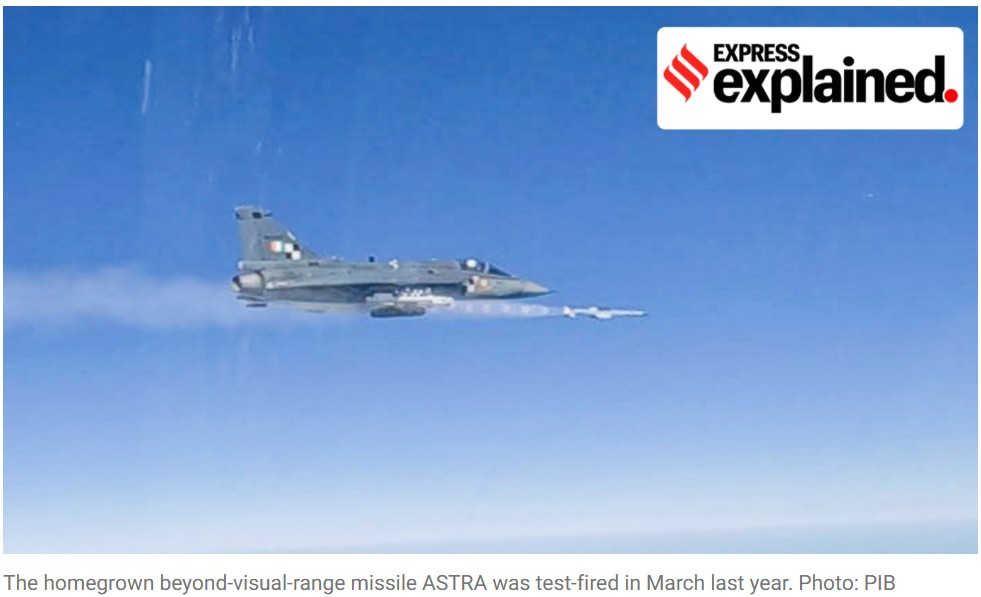
The Astra Mk 1 is India's first indigenously developed Beyond-Visual-Range Air-to-Air Missile (BVRAAM), designed to engage and destroy highly manoeuvrable enemy aircraft before they enter visual combat range. Developed by the Defence Research and Development Organisation (DRDO) in partnership with Bharat Dynamics Limited (BDL), the missile significantly enhances the long-range air combat capability of the Indian Air Force.
Its primary objective is to provide fighter aircraft with stand-off strike superiority, enabling pilots to neutralize hostile aerial targets from safe distances.
Key Features
- The Astra Mk 1 is an all-weather, supersonic missile capable of intercepting highly agile aircraft at speeds of up to Mach 4.5.
- It operates across a wide altitude envelope ranging from sea level to 20 km and has an effective engagement range of approximately 80–110 km, depending on launch conditions.
- The missile employs a three-stage guidance system for enhanced accuracy. During the initial phase, it navigates using an inertial navigation system. In the mid-course phase, it receives continuous radio frequency updates from the launch aircraft, enabling course corrections against manoeuvring targets. In the terminal phase, an Active Radio Frequency (RF) seeker autonomously locks onto the target, maintaining effectiveness even in electronic warfare environments.
- Powered by a single-pulse smokeless solid-fuel rocket motor, Astra leaves minimal visible smoke, thereby reducing the chances of revealing the launch aircraft's position.
Platform Integration
The Astra Mk 1 is fully operational on the Sukhoi Su-30 MKI fleet of the Indian Air Force. Integration is currently underway with India's indigenous LCA Tejas Mk 1A and the Rafale fighter aircraft, expanding its operational versatility across multiple combat platforms.
Evolution of the Astra Missile Family
Building upon the success of the Mk 1, DRDO is developing advanced variants to further strengthen India's aerial strike capability.
The Astra Mk 2 is expected to have an engagement range of around 200 km and will employ a dual-pulse solid rocket motor, enabling the missile to regain energy during the terminal phase and improve interception capability against highly manoeuvrable targets.
The Astra Mk 3, also known as Gandiva, is currently under development and will incorporate Solid Fuel Ducted Ramjet (SFDR) technology. This propulsion system will provide sustained thrust throughout flight, extending the missile's interception range to over 350 km, placing it among the world's longest-range air-to-air missiles.