
Ambubachi Mela
- 25 Jun 2026
In News:
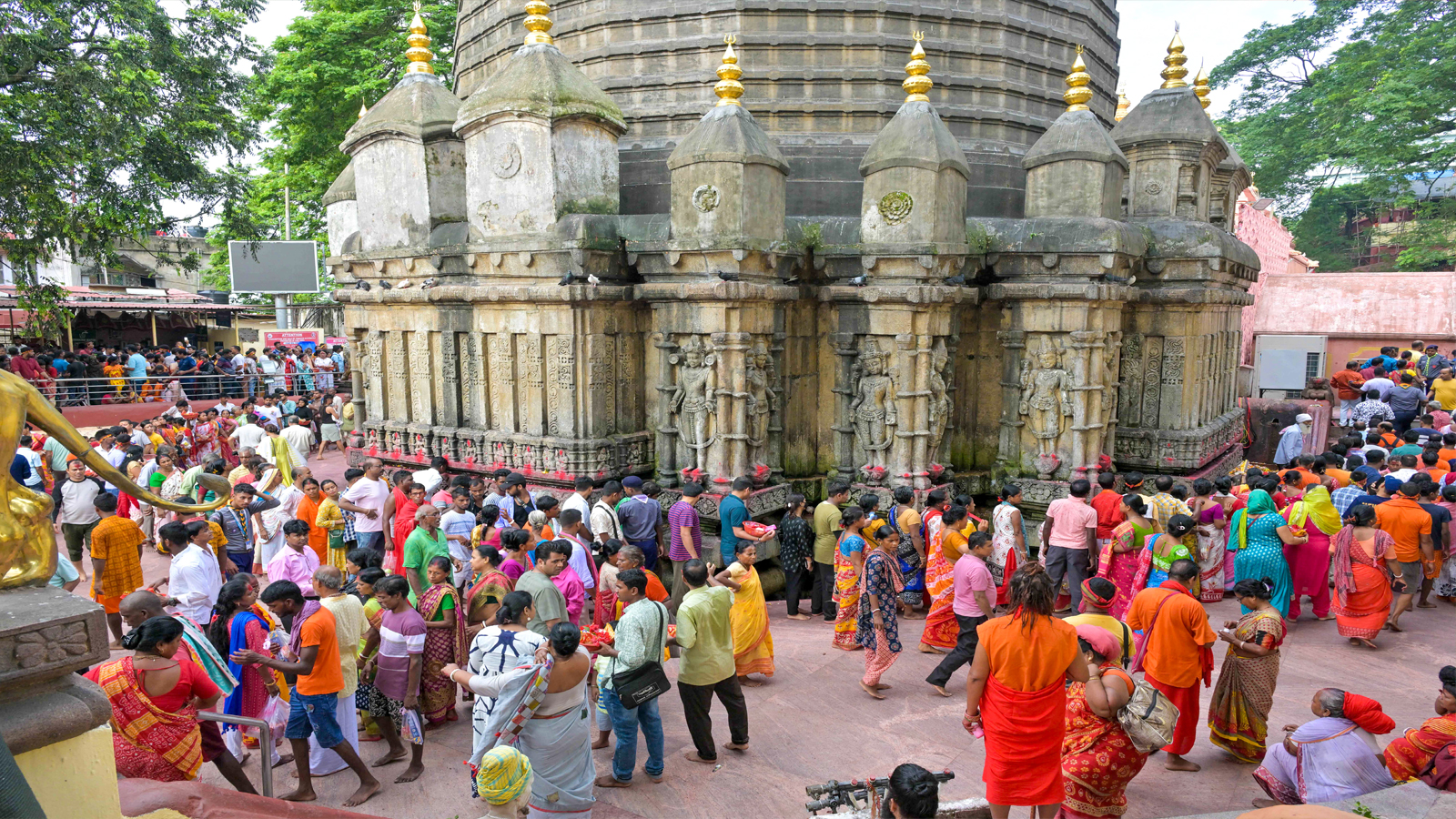
The annual Ambubachi Mela, one of the largest and most significant religious gatherings in eastern India, commenced at the revered Kamakhya Temple in Guwahati, Assam, attracting lakhs of devotees, ascetics, and Tantric practitioners from across India and abroad.
About Ambubachi Mela
Ambubachi Mela is an annual Hindu festival celebrated during the monsoon season, usually in June, at the Kamakhya Temple. The festival marks the annual menstruation of Goddess Kamakhya, symbolising the creative and regenerative powers of nature.
During this period, the temple remains closed for three days, as it is believed that the Goddess undergoes her annual menstrual cycle. The temple reopens on the fourth day after elaborate purification rituals, drawing large numbers of pilgrims seeking blessings.
The festival is deeply associated with fertility, womanhood, agricultural prosperity, and the onset of the monsoon. The word 'Ambubachi' literally means "water flowing,"symbolising both the rains and the fertility of the Earth.
Religious Significance
- Celebrates the divine feminine and the fertility of Mother Earth.
- Closely associated with the arrival of the southwest monsoon and the beginning of the agricultural season.
- Considered one of the most important festivals of Tantric Shaktism.
- Attracts Tantric practitioners, Aghori sadhus, ascetics, and devotees from across the country.
- Devotees receive the sacred Angodak (holy water) and Angabastra (cloth believed to have been sanctified during the Goddess's menstruation) as blessings after the temple reopens.
Kamakhya Temple
The Kamakhya Temple is one of the most revered shrines dedicated to Goddess Shakti and is regarded as one of the oldest and most sacred centres of Tantric worship in India.
It is believed to be one of the 51 Shakti Peethas, where the yoni (womb and generative organ) of Goddess Sati is said to have fallen according to Hindu mythology.
Location
- Situated atop Nilachal Hill in Guwahati, Assam.
- Overlooks the southern bank of the Brahmaputra River.
Key Features
- One of the foremost centres of Tantric Shaktism.
- Unlike many Hindu temples, the sanctum does not contain an idol; instead, worship is offered to a natural rock fissuresymbolising the divine feminine, continuously fed by an underground spring.
- Holds immense religious significance for both Shakta and Tantric traditions.
Temple Architecture
The Kamakhya Temple exhibits a distinctive architectural style known as the Nilachala Style, which blends:
- Traditional Nagara architecture.
- Saracenic (Mughal) architectural influences.
This unique fusion makes it one of the most distinctive temple structures in India.
Architectural Features
- The only temple in Assam with a fully developed ground plan.
- Comprises five principal chambers:
- Garbhagriha (sanctum sanctorum)
- Antarala (vestibule)
- Jagamohan (assembly hall)
- Bhogmandir (offering hall)
- Natmandir (dance and music hall)
- Each chamber possesses a distinct superstructure:
- The main shrine is crowned with a modified Saracenic dome.
- The Antarala features a two-tiered roof.
- The Bhogmandir has five domes resembling the main temple.
- The Natmandir has a shell-shaped roof with an apsidal end, resembling traditional Assamese Namghars (prayer halls).
Ambubachi Mela 2025
- 27 Jun 2025
In News:
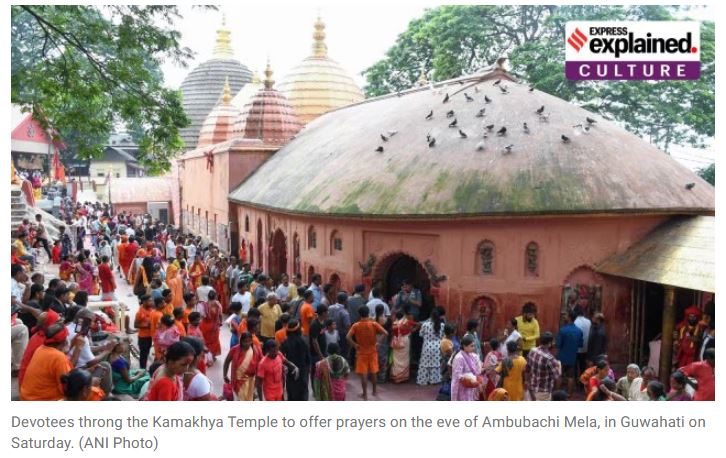
Thousands of devotees have congregated at the Kamakhya Temple in Guwahati, Assam, to participate in the annual Ambubachi Mela—one of the largest and most significant religious gatherings in Northeast India.
About Ambubachi Mela
- Timing: Celebrated annually during the monsoon season, typically in June.
- Location: Held at the Kamakhya Temple, situated atop Nilachal Hill in Guwahati, Assam.
- Religious Significance:
- Marks the menstrual cycle of Goddess Kamakhya, symbolising the fertility of Mother Earth.
- During this period, the sanctum sanctorum is closed for three days, after which it is ceremonially reopened for darshan.
- Cultural Symbolism:
- Reflects ancient beliefs that associate the Earth with feminine fertility.
- The word ‘Ambubachi’ translates to ‘water flowing’, indicative of both the monsoon rains and the goddess’s fertility.
Kamakhya Temple: Key Facts
- Spiritual Importance:
- Dedicated to Goddess Kamakhya, an incarnation of Shakti.
- Considered one of the most revered sites of Tantric Shaktism in India.
- Recognised as one of the 51 Shakti Peethas, where the yoni (womb) of Sati is believed to have fallen.
- Geographical Location:Located on Nilachal Hill, overlooking the southern bank of the Brahmaputra River.
Architectural Features of Kamakhya Temple
- Architectural Style:
- Combines traditional Nagara style with Saracenic (Mughal) architectural elements, known as the Nilachala Style of Architecture.
- Temple Layout:
- Only temple in Assam with a fully developed ground plan.
- Comprises five main sections:
- Garbhagriha (sanctum sanctorum)
- Antarala (vestibule)
- Jaganmohan (assembly hall)
- Bhogmandir (offering hall)
- Natmandir (performance hall)
- Distinctive Structural Elements:
- Main dome: Modified Saracenic style.
- Antarala: Features a two-roofed structure.
- Bhogmandir: Crowned with five domes, echoing the central shrine.
- Natmandir: Designed with a shell-shaped roof and apsidal end, similar to the namghars (prayer halls) of Assam.