
3D-Printed Artificial Reefs
- 01 Jul 2026
In News:
Tamil Nadu is set to deploy India's first 3D-printed artificial reef modules off the Ramanathapuram coast under the second phase of the Pradhan Mantri Matsya Sampada Yojana (PMMSY).
About India's First 3D-Printed Artificial Reefs
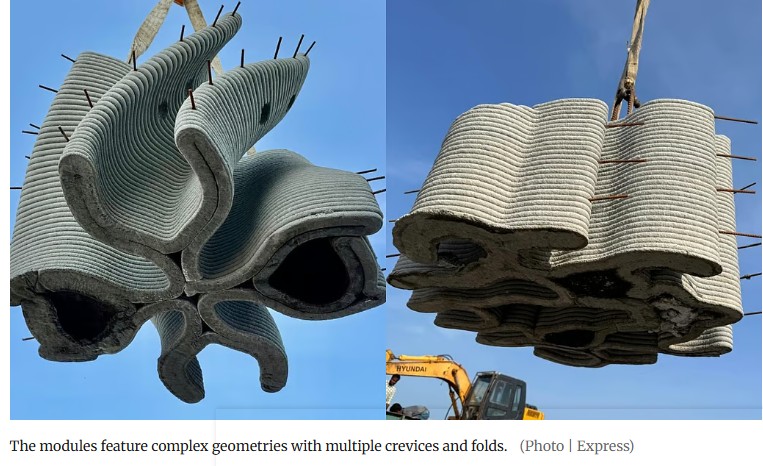
- The pilot project involves the deployment of six newly designed artificial reef modules in coastal waters to evaluate their structural durability and ecological performance under local marine conditions. Based on the results, the technology may be adopted for larger-scale reef restoration programmes.
- The project is being implemented by the Tamil Nadu Department of Fisheries in collaboration with the Visakhapatnam Regional Centre of the ICAR–Central Marine Fisheries Research Institute (CMFRI). The reef modules have been developed by Tvasta, an IIT Madras-incubated startup, with each module weighing approximately one tonne.
- Unlike conventional reinforced concrete reefs, the new modules are manufactured without iron reinforcement using advanced 3D-printing technology. Their intricate design incorporates numerous crevices, folds, cavities, and textured attachment surfaces, increasing porosity and providing ideal habitats for corals, sponges, algae, fish, and other reef-associated organisms.
- The initiative forms part of a broader artificial reef programme covering 213 sites across Tamil Nadu and is jointly funded by the Central and State Governments in a 60:40 ratio.
What are 3D-Printed Artificial Reefs?
- 3D-printed artificial reefs are specially designed underwater structures created to restore marine ecosystems where natural coral reefs have been damaged or degraded.
- They use additive manufacturing (3D printing) techniques to produce highly customised reef structures that closely resemble natural reef habitats.
- Compared to traditional artificial reefs, 3D printing allows greater flexibility in designing species-specific habitats with varying cavity sizes, complex surface textures, and intricate geometries that encourage the settlement and growth of diverse marine organisms.
Ecological Importance
These artificial reefs serve multiple ecological functions:
- Provide shelter, breeding grounds, and nursery habitats for marine organisms.
- Promote colonisation by corals, sponges, algae, crustaceans, molluscs, and reef fishes.
- Enhance marine biodiversity and restore degraded coastal ecosystems.
- Increase fish biomass, thereby supporting sustainable fisheries and improving the livelihoods of fishing communities.
- Reduce ecological pressure on natural coral reef ecosystems.
Challenges
Despite their potential, the long-term success of artificial reefs depends upon several factors, including:
- Structural durability in marine conditions.
- Use of environmentally safe and non-toxic construction materials.
- Appropriate site selection and deployment.
- Continuous ecological monitoring to assess biodiversity recovery and ecosystem functioning.
Artificial reefs may not always achieve the intended ecological outcomes if these factors are not carefully addressed.
Pradhan Mantri Matsya Sampada Yojana (PMMSY)
The Pradhan Mantri Matsya Sampada Yojana (PMMSY) was launched on 10 September 2020 to usher in a Blue Revolution by promoting sustainable, inclusive, and responsible development of India's fisheries sector.
The scheme seeks to increase fish production and productivity, modernise fisheries infrastructure, strengthen post-harvest management, improve quality standards, and enhance the incomes of fishers and fish farmers.
Initially approved with an outlay of ?20,050 crore for the period 2020–21 to 2024–25, the scheme has now been extended until 2025–26.
PMMSY comprises:
- Central Sector Scheme – fully funded by the Central Government.
- Centrally Sponsored Scheme – implemented by States with shared funding.
The programme supports fisheries infrastructure, climate-resilient coastal villages, women-led fisheries enterprises, biofloc technology, digital fisheries platforms, and sustainable aquaculture practices.
Achievements of PMMSY
Since its launch, PMMSY has significantly strengthened India's fisheries sector:
- Fish production increased to 195 lakh tonnes in 2024–25.
- Fisheries exports have expanded substantially.
- Approximately 58 lakh livelihoods have been generated.
- More than 99,000 women have been economically empowered through fisheries-related activities.