
16th India–Japan Annual Summit
- 04 Jul 2026
In News:
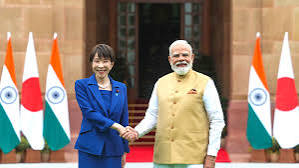
The 16th India–Japan Annual Summit was held in New Delhi, where both countries reviewed the progress of their Special Strategic and Global Partnership and announced several initiatives to deepen cooperation in defence, economic security, clean energy, artificial intelligence (AI), resilient supply chains, and the Indo-Pacific.
Key Outcomes of the Summit
A major highlight of the summit was the agreement in principle on the UNICORN (Unified Complex Radio Antenna) Mast, marking the first-ever India–Japan defence co-development project. Both sides also agreed to expand cooperation in defence equipment, maritime security, naval Maintenance, Repair and Overhaul (MRO), Maritime Domain Awareness (MDA), and joint military exercises, besides convening the 4th India–Japan 2 2 Ministerial Meeting later in 2026.
Economic security emerged as another key pillar of cooperation. Both countries adopted the India–Japan Joint Declaration on Economic Security Cooperation, focusing on semiconductors, critical minerals, ICT, pharmaceuticals, and clean energy while building resilient and diversified supply chains to reduce dependence on any single country. They also agreed to accelerate the review of the Comprehensive Economic Partnership Agreement (CEPA) and work towards achieving the target of ¥10 trillion in Japanese investments in India. A USD 10 billion investment package was also announced to strengthen industrial collaboration.
The summit witnessed significant progress in clean energy cooperation. The two countries adopted a Joint Statement on Energy Resilience, launched the India–Japan Cooperative Biogas for Growth (CBG) Initiative, and expanded collaboration in green hydrogen, clean ammonia, solar photovoltaic technologies and civil nuclear energy. Japan also reiterated its support for India's membership of the International Energy Agency (IEA). In the digital domain, the launch of the India–Japan AI Strategic Dialogue and the adoption of a Joint Statement on AI Cooperation marked the beginning of structured collaboration on trusted AI, resilient digital infrastructure and responsible AI governance.
Both countries reaffirmed their commitment to a Free and Open Indo-Pacific (FOIP) aligned with India's Indo-Pacific Oceans Initiative (IPOI) and MAHASAGAR vision. They pledged greater cooperation through the Quad, ASEAN and BIMSTEC, supported freedom of navigation under UNCLOS, backed UN Security Council reforms, and announced a new India–Japan–Philippines 1.5 Track Dialogue to strengthen maritime security cooperation.
India–Japan Relations
India and Japan share centuries-old civilisational ties rooted in Buddhism, while diplomatic relations were established in 1952. Bilateral ties have steadily evolved through the Global Partnership (2000), Annual Summit mechanism (2006), Comprehensive Economic Partnership Agreement (2011), and the Special Strategic and Global Partnership (2014). Today, cooperation spans defence, trade, infrastructure, technology, connectivity and people-to-people exchanges. Japan is India's fifth-largest source of FDI and its largest bilateral development partner through Official Development Assistance (ODA), supporting projects such as the Mumbai–Ahmedabad High-Speed Rail, Delhi Metro and North-East connectivity. The two countries also collaborate in emerging technologies, semiconductors, AI, and the ISRO–JAXA Lunar Polar Exploration (LUPEX) mission.
Challenges
Despite growing strategic convergence, bilateral trade remains below potential, infrastructure projects continue to face implementation delays, and Indian exports encounter non-tariff barriers in Japan. Differences over Russia, language barriers affecting skilled workforce mobility, and constraints on defence technology transfer have also limited the pace of cooperation.
Significance
The 16th India–Japan Annual Summit reflects the transformation of bilateral ties into a comprehensive strategic partnership anchored in defence cooperation, trusted technology, resilient supply chains, clean energy and Indo-Pacific security. As both countries seek to address emerging geopolitical and economic challenges, their partnership is poised to play an increasingly important role in promoting a free, open and rules-based Indo-Pacific, strengthening India's Atmanirbhar Bharat vision, and contributing to regional stability and sustainable economic growth.