
Pharmacogenomics: Towards Precision Medicine
- 24 Nov 2025
In News:
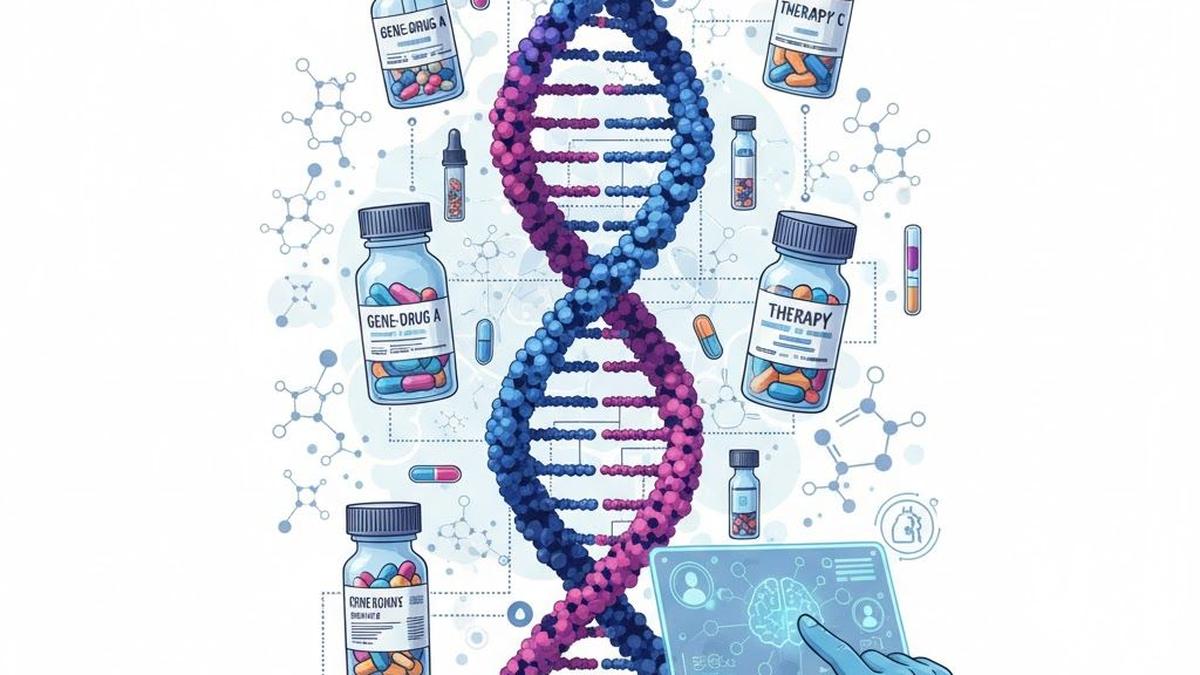
Pharmacogenomics is increasingly being highlighted as a transformative approach in healthcare, enabling personalised drug prescriptions based on an individual’s genetic makeup and moving away from the traditional “one-size-fits-all” model of treatment.
What is Pharmacogenomics?
Pharmacogenomics is the study of how genetic variations influence an individual’s response to medicines. It combines pharmacology (study of drugs) with genomics (study of genes) to determine whether a drug will be effective, ineffective, or potentially harmful for a specific person. This approach replaces trial-and-error prescribing with precision medication.
Scientific Basis
- Genetic differences, especially in drug-metabolising enzymes such as the cytochrome P450 (CYP) family, significantly affect drug absorption, metabolism, and clearance.
- Nearly 75% of commonly prescribed drugs are metabolised by CYP enzymes.
- Variations create different metaboliser types:
- Poor metabolisers → drug accumulation and toxicity
- Ultrarapidmetabolisers → reduced drug efficacy
- Studies show that ~90% of individuals carry at least one actionable pharmacogenetic variant, making this clinically relevant at the population level.
Clinical Applications
- Cardiovascular Medicine:
- Warfarin: Variants in CYP2C9 and VKORC1 explain ~50% of dose variability. Genotype-guided dosing reduces bleeding risk and stabilises therapy faster.
- Clopidogrel: Loss-of-function variants in CYP2C19 reduce drug activation, increasing risk of stent thrombosis; guidelines now recommend alternative drugs for poor metabolisers.
- Psychiatry:Antidepressants and antipsychotics metabolised by CYP2D6/CYP2C19 show improved outcomes and fewer side effects with genetic-guided prescribing.
- Oncology:Screening for DPYD variants before using 5-fluorouracil prevents severe, life-threatening toxicity.
- Immunology & Neurology:Testing for HLA-B*57:01 (Abacavir) and HLA-B*15:02 (Carbamazepine) prevents fatal drug reactions such as Stevens–Johnson syndrome.
Economic Relevance
- Cost of genetic testing has declined sharply to USD 200–500 per panel.
- Pharmacogenomics is most cost-effective in chronic diseases requiring long-term medication.
- Preventing even a single serious adverse drug reaction can offset testing costs for multiple patients.
- Pre-emptive panel testing offers lifetime utility, guiding prescriptions for dozens of drugs.
Key Challenges
- Knowledge Gaps: Limited pharmacogenomics training among doctors and pharmacists.
- Infrastructure: Lack of electronic health record–based decision-support systems.
- Regulatory & Reimbursement Issues: Inconsistent insurance coverage and evolving regulatory guidance.
- Research Complexity: Millions of SNPs must be linked accurately to drug response, and drug development for small genetic subgroups can be costly.
Way Forward
- Promote pre-emptive genetic testing integrated with electronic health records.
- Strengthen medical education and clinical guidelines on pharmacogenomics.
- Expand digital clinical decision-support systems.
- Encourage public–private investment to lower costs and widen access.
Precision Medicine, Biobanks, and Regulatory Challenges in India
- 26 Oct 2024
In News:
Precision medicine is bringing in a new era of personalised healthcare. The field began to take concrete shape when scientists were wrapping up the Human Genome Project.
Introduction to Precision Medicine:
- Precision Medicine is a novel approach to healthcare that tailors treatments and preventive strategies based on an individual’s genetics, environment, and lifestyle, instead of using a one-size-fits-all approach.
- It leverages technologies like genomics, gene editing (CRISPR), and mRNA therapeutics to address various diseases such as cancer, chronic diseases, and genetic disorders.
- Recent breakthroughs include gene therapy for restoring vision and stem cell transplants for reversing diabetes, demonstrating the transformative potential of precision medicine.
Role of Biobanks in Precision Medicine:
- Biobanks are repositories storing biological samples (blood, DNA, tissues) along with associated health data. These samples are crucial for research and development of personalized treatments.
- Large and diverse biobanks are essential for ensuring that precision medicine benefits a wide demographic, as data from homogenous groups could limit the applicability of findings.
- Recent studies using biobank data have led to breakthroughs, such as identifying rare genetic disorders and developing organoid models for high-throughput drug screening.
Precision Medicine and Biobanks in India:
- Market Growth: India’s precision medicine market is growing at a CAGR of 16%, expected to surpass USD 5 billion by 2030, contributing 36% to the national bioeconomy.
- Policy Framework: The government’s BioE3 policy aims to promote biomanufacturing, with a focus on precision therapeutics and related technologies like gene editing and cancer immunotherapy.
- Biobank Initiatives:
- Genome India Programme: Completed sequencing of 10,000 genomes from 99 ethnic groups, aimed at identifying treatments for rare genetic diseases.
- Phenome India Project: Focused on collecting 10,000 samples for improving prediction models for cardio-metabolic diseases.
- Paediatric Rare Genetic Disorders (PRaGeD) Mission: Aiming to identify genes that could help develop targeted therapies for genetic diseases in children.
Regulatory and Ethical Challenges in Biobanking:
- India’s biobanking regulations are inconsistent, hindering the full potential of precision medicine. Unlike countries like the U.K., U.S., and Japan, which have comprehensive laws addressing issues like informed consent, data protection, and privacy, India lacks a cohesive regulatory framework.
- Informed Consent Issues: In India, participants provide samples without full knowledge of how their data will be used, who will have access to it, and for how long it will be stored. This lack of transparency undermines public trust in biobank research.
- Ethical Concerns: Without a clear regulatory framework, there is a risk of misuse of biological samples, such as non-consensual data sharing and sample mishandling.
- International Implications: The absence of robust laws allows foreign pharmaceutical companies to access Indian biobank data and samples without ensuring that the Indian population benefits from the resulting research or profits.
Global Comparison of Biobank Regulations:
- International Standards: Countries like the U.K., U.S., and Japan have established comprehensive biobank regulations, addressing:
- Informed consent for sample collection and data usage.
- Privacy protection and secure storage of genetic information.
- Withdrawal rights for participants at any stage of research.
- India’s biobank regulations lack clear provisions for data protection and participant rights, limiting the effectiveness of research and undermining public confidence in biobanks.