
US–Saudi 123 Agreement
- 25 Jul 2026
In News:
The United States and Saudi Arabia have signed a landmark civilian nuclear cooperation agreement, commonly known as the 123 Agreement, along with a bilateral safeguards agreement to facilitate peaceful nuclear cooperation.
What is the US–Saudi 123 Agreement?
- The 123 Agreement is a bilateral civil nuclear cooperation framework established under Section 123 of the US Atomic Energy Act, 1954. It provides the legal basis for the United States to transfer nuclear technology, reactors, fuel, equipment, and technical expertise to another country for peaceful civilian purposes.
- The agreement was signed by US Energy Secretary Chris Wright and Saudi Energy Minister Prince Abdulaziz bin Salman.
Objective
- The agreement aims to support Saudi Arabia's civilian nuclear energy programme, enabling the country to diversify its energy mix beyond crude oil. Nuclear energy is expected to help meet rising domestic electricity demand while powering desalination plants, air-conditioning systems, and other energy-intensive sectors.
Background
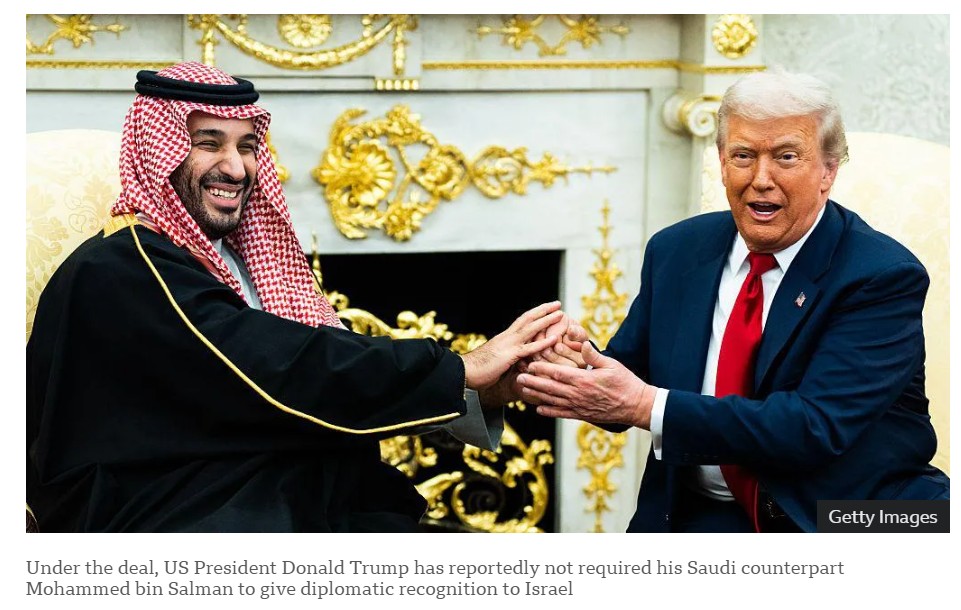
- Negotiations had remained stalled for years because the United States insisted that Saudi Arabia adopt the "Gold Standard", under which it would permanently forgo domestic uranium enrichment and spent fuel reprocessing, and also normalize diplomatic relations with Israel.
- The 2026 agreement marks a policy shift by removing the Israel normalization requirement and allowing greater flexibility regarding Saudi Arabia's domestic uranium enrichment programme under agreed safeguards.
Key Features
- The agreement allows US companies to supply civilian nuclear reactors, equipment, fuel-cycle technology, and technical expertise to Saudi Arabia.
- It permits Saudi Arabia to enrich uranium domestically in facilities developed with US cooperation, subject to mutually agreed safeguards.
- A bilateral safeguards mechanism has been incorporated to ensure that nuclear materials and technology are used exclusively for peaceful purposes and are not diverted for nuclear weapons development.
- Unlike several earlier US nuclear cooperation agreements, this pact does not require Saudi Arabia to adopt the International Atomic Energy Agency (IAEA) Additional Protocol, which provides for more intrusive international inspections.
- The agreement will also undergo a 90-legislative-day review by the US Congress before entering into force.