
US 28-Point Peace Proposal on the Russia–Ukraine War
- 26 Nov 2025
In News:
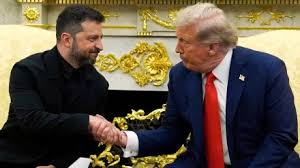
The United States has reportedly shared a 28-point draft peace proposal with Volodymyr Zelenskyy to explore a negotiated end to the Russia–Ukraine war. The draft is associated with the foreign-policy team of former US President Donald Trump and has been discussed in Geneva between US and Ukrainian officials. European partners are preparing a counter-proposal to safeguard Ukraine’s sovereignty.
What is the 28-Point Peace Plan?
- Nature: A US-drafted roadmap for a negotiated settlement of the Russia–Ukraine conflict.
- Objective:
- Freeze the conflict and prevent further territorial expansion.
- Rework European security arrangements by limiting NATO expansion.
- Enable Ukraine’s economic reconstruction via US–EU mechanisms.
Key Provisions
1) Security Architecture Reset
- Ukraine to forgo NATO membership and enshrine permanent neutrality in its Constitution.
- Restrictions on Ukraine’s military strength (reported cap ~600,000 troops).
- NATO to formally guarantee Ukraine’s non-admission and avoid stationing troops on Ukrainian soil.
2) Territorial & Political Elements
- Ukraine expected to make territorial concessions to Russia (details unspecified).
- Tripartite dialogue (Russia–Ukraine–Europe) to resolve long-standing disputes.
3) Economic Reconstruction
- Ukraine Development Fund for technology, energy, AI, urban rebuilding, and resources.
- Use of ~$100 billion frozen Russian assets for reconstruction under US management; profit-sharing reported (US share) with additional EU contributions.
4) Russia’s Global Re-engagement
- Phased sanctions relief.
- Invitation for Russia to rejoin the G8.
- Prospective US–Russia cooperation in energy, rare earths, AI, and Arctic projects.
Diplomatic Process & Reactions
- Geneva talks: US and Ukraine termed discussions “productive,” aiming to align positions and refine the draft.
- Process concerns: Reports suggest Ukraine and some US officials were initially excluded from drafting; European allies seek safeguards.
- Ukraine’s stance: Any final deal must respect sovereignty and ensure durable security; Kyiv prefers territorial talks after stabilisation on current lines.
- Next steps: Continued US–Ukraine engagement; any agreement requires approval by Ukraine, the US, and Russia.
Significance
- Most detailed US-linked proposal since the war began.
- Potential to reshape NATO–Russia–Ukraine security dynamics.
- Controversial: Criticised as Russia-leaning and constraining Ukraine’s sovereignty.
Army Tactical Missile Systems (ATACMS)
- 26 Apr 2024
Why is it in the News?
The United States has confirmed providing long-range Army Tactical Missile Systems (ATACMS) to Ukraine to aid its war effort against Russia.
What is the ATACMS System?
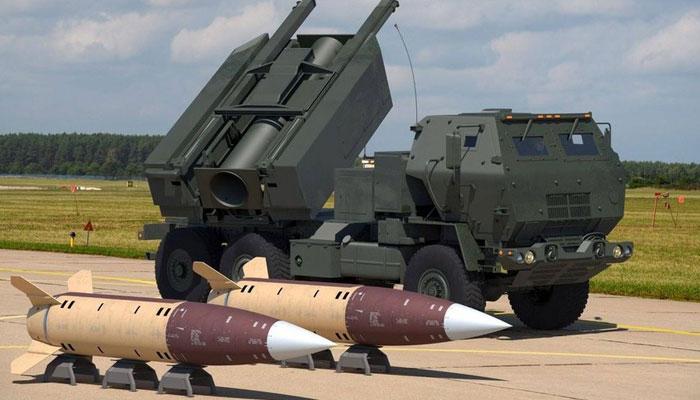
- The Army Tactical Missile Systems (ATACMS) is one of the most potent missile systems built by US-based arms manufacturer Lockheed Martin.
- This is a surface-to-surface artillery weapon system.
- Its biggest strengths are the long-range of attack, the ability to fire cluster munitions, and the weapon system’s mobility.
- Range: There is a mid-range version of the ATACMS, called Block 1, and a long-range version, Block 1A.
- ATACMS Block 1 has a range of 165 kilometres. Ukraine was provided these systems last year and used them to attack targets in October.
- ATACMS Block 1A, on the other hand, has a maximum range of 300 km. However, this depends on the kind of munition the missile carries.
- With such a range, the long-range ATACMS Block 1A is capable of striking targets well beyond the range of existing Army cannons, rockets, and other missiles.
- Mobility: ATACMS missiles are fired from the High Mobility Artillery Rocket System (HIMARS) and M270 Multiple Launch Rocket System (MLRS) platforms. Both of these launching systems are highly mobile automatic systems.
Why Ukraine can’t use ATACMS to Target Russian Territories?
- Despite territories deep inside Russia now being within the range of the ATACMS, Ukraine cannot use it to hit targets in these locations.
- Ukraine has committed to only use the weapons inside Ukraine, not in Russia.
- The US administration has made it clear that the weapons cannot be used to hit targets inside Russia.
- The Biden administration is concerned that if Ukraine strikes deep into Russian territory, it will anger Moscow and escalate the conflict.
World Cybercrime Index

- 12 Apr 2024
Why is it in the News?
A new World Cybercrime Index developed by researchers shows that a majority of cybercriminals come from just a few countries.
About World Cybercrime Index:
- The World Cybercrime Index is a collaborative effort between the University of Oxford and UNSW Canberra that identifies global cybercrime hotspots by ranking countries based on their contribution to cybercrime.
- Data is collected from a survey of 92 cybercrime experts involved in intelligence gathering and investigations.
- The index ranks around 100 countries and identifies key hotspots for various cybercrime categories, such as ransomware, credit card theft, and scams.
Key Findings:
- Russia tops the list, followed by Ukraine, China, the USA, Nigeria, and Romania.
- India ranks 10th in the index, with a balanced distribution of cybercrime types but a notable specialization in scams.
- Certain countries were associated with specific types of cybercrime, like data and identity theft in the United States and technical products or services-related crimes in China.
- These insights highlight the need for international cooperation in addressing cybercrime and its various manifestations across different countries.
According to the Oxford University, the five major categories of cybercrime assessed by the study were:
-
- Technical products/services (e.g. malware coding, botnet access, access to compromised systems, tool production).
- Attacks and extortion (e.g. denial-of-service attacks, ransomware).
- Data/identity theft (e.g. hacking, phishing, account compromises, credit card comprises).
- Scams (e.g. advance fee fraud, business email compromise, online auction fraud).
- Cashing out/money laundering (e.g. credit card fraud, money mules, illicit virtual currency platforms).