
Hayli Gubbi Volcano
- 27 Nov 2025
In News:
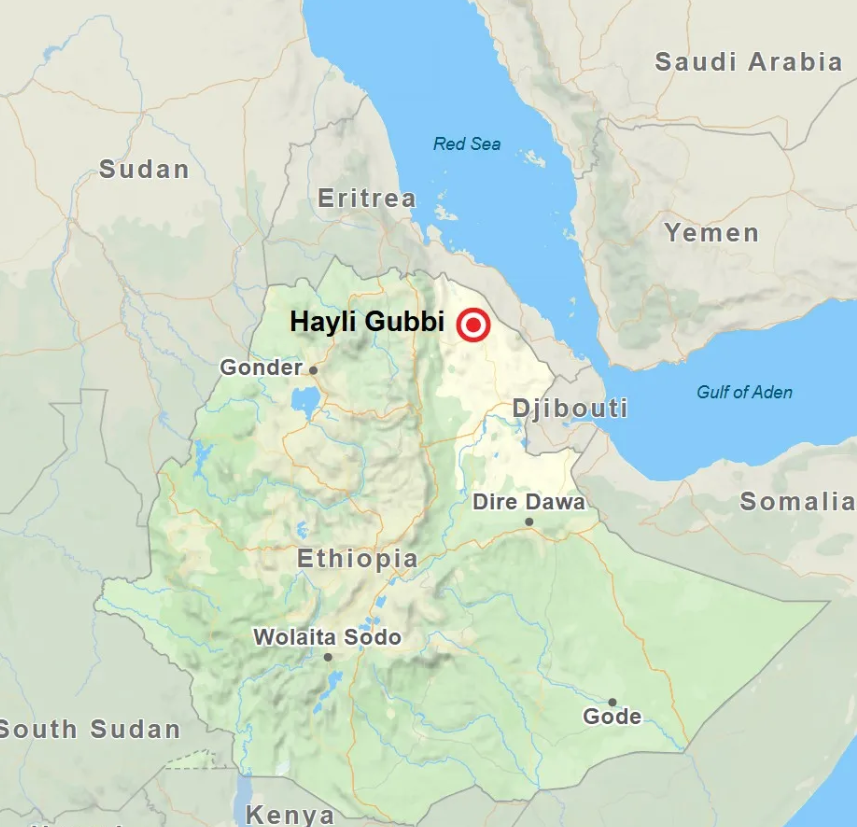
A long-dormant volcano, Hayli Gubbi, in Ethiopia erupted after nearly 12,000 years, releasing massive ash plumes that travelled across the Red Sea towards Yemen, Oman, and even parts of South Asia, including India. The ash cloud led to airspace disruptions and flight diversions, highlighting the transboundary impact of large volcanic eruptions.
Geographical & Tectonic Setting
- Location: Hayli Gubbi volcano lies in Ethiopia’s Afar region, about 800 km northeast of Addis Ababa.
- It is part of the Afar Depression (Danakil Depression), one of the most geologically active regions on Earth.
- The region marks the triple junction of three tectonic plates:
- African (Nubian) Plate
- Somalian Plate
- Arabian Plate
- It forms a critical segment of the East African Rift System (EARS), where the African Plate is splitting into the Nubian (western) and Somalian (eastern) plates.
Volcanism
- Volcanism refers to the process by which magma, gases, and ash escape from Earth’s interior through vents or fissures.
Process of Eruption:
- The asthenosphere (a weak, semi-molten layer in the upper mantle) allows magma to accumulate.
- Buoyant magma rises through cracks in the lithosphere.
- As pressure decreases near the surface, dissolved gases (water vapour, CO?, sulphur gases) expand violently, triggering eruptions.
- When magma reaches the surface, it is called lava (basaltic, andesitic, or rhyolitic depending on composition).
Eruption Products:
- Lava
- Ash and dust
- Pyroclastic debris and volcanic bombs
- Gases (sulphur compounds, nitrogen compounds, CO?, etc.)