
Durand Line
- 03 Dec 2025
In News:
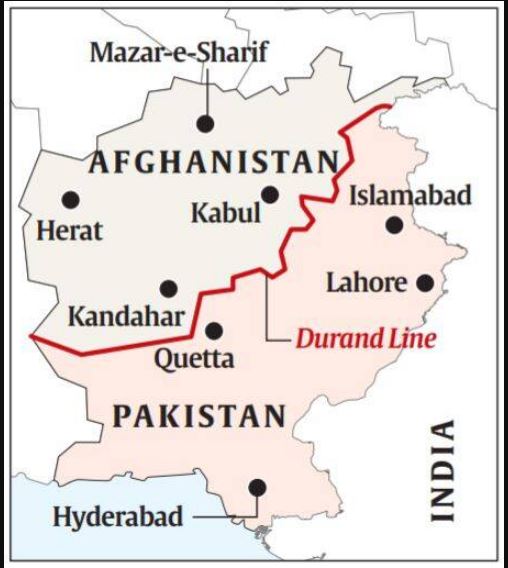
The Durand Line is the 2,600-km boundary separating Pakistan and Afghanistan, running from the Iran border in the west to China’s border in the east, traversing rugged terrain including the Karakoram range and the Registan desert. It remains one of South Asia’s most disputed international borders and a recurring flashpoint in regional geopolitics.
Historical Background
1. The Great Game Context
- During the 19th century, Afghanistan became strategically crucial in the rivalry between the British Empire and Tsarist Russia, known as the Great Game.
- Britain sought to create Afghanistan as a buffer state to protect British India from Russian expansion.
2. Anglo-Afghan Wars
|
War |
Period |
Outcome |
|
First Anglo-Afghan War |
1839–42 |
British forces retreated after strong Afghan resistance |
|
Second Anglo-Afghan War |
1878–80 |
British victory; led to the Treaty of Gandamak (1879) giving Britain control over Afghan foreign policy |
|
Third Anglo-Afghan War |
1919 |
Ended with the Treaty of Rawalpindi, restoring Afghanistan’s foreign policy independence |
Creation of the Durand Line (1893)
- Negotiated between Sir Henry Mortimer Durand, Foreign Secretary of British India, and Emir Abdur Rahman Khan of Afghanistan.
- Formally demarcated between 1894 and 1896 by joint commissions.
- Key consequences:
- Divided Pashtun tribal territories between Afghanistan and British India
- Brought Balochistan under British India
- Recognised the Wakhan Corridor as a buffer between Russian and British spheres of influence
Post-Independence Dispute
Pakistan’s Position
- After Partition in 1947, Pakistan inherited the Durand Line as its western international boundary.
- Pakistan treats it as a legally valid international border under the principle of state succession.
Afghanistan’s Position
- Afghanistan has never formally recognised the Durand Line as an international border.
- It argues that the agreement was:
- A colonial imposition
- Signed under unequal conditions
- Successive Afghan governments including the Taliban regime have maintained this position.
Pashtunistan Issue
- The Durand Line splits the Pashtun ethnic homeland.
- Post-1947, demands emerged for an independent “Pashtunistan”, straining Pakistan–Afghanistan relations.
- Afghanistan was the only country to oppose Pakistan’s admission to the UN (1947), partly over this issue.
Security and Contemporary Relevance
- The border region has long been marked by:
- Militant safe havens
- Cross-border insurgency
- Smuggling and illegal movement
- Pakistan began fencing the border in 2017, which Afghanistan opposed, leading to clashes.
- Recent tensions include allegations of cross-border air strikes and skirmishes, highlighting the border’s volatility.
- The dispute complicates counter-terror cooperation, refugee management, and regional connectivity.
Why the Durand Line Matters for India & the Region
- Affects regional stability in South Asia and Central Asia
- Impacts terror networks operating in the Af-Pak region
- Influences geopolitical alignments involving Pakistan, Afghanistan, China, and the US
- Important for understanding ethnic geopolitics and colonial legacy borders