
CJI Calls for National Judicial Policy
- 28 Nov 2025
In News:
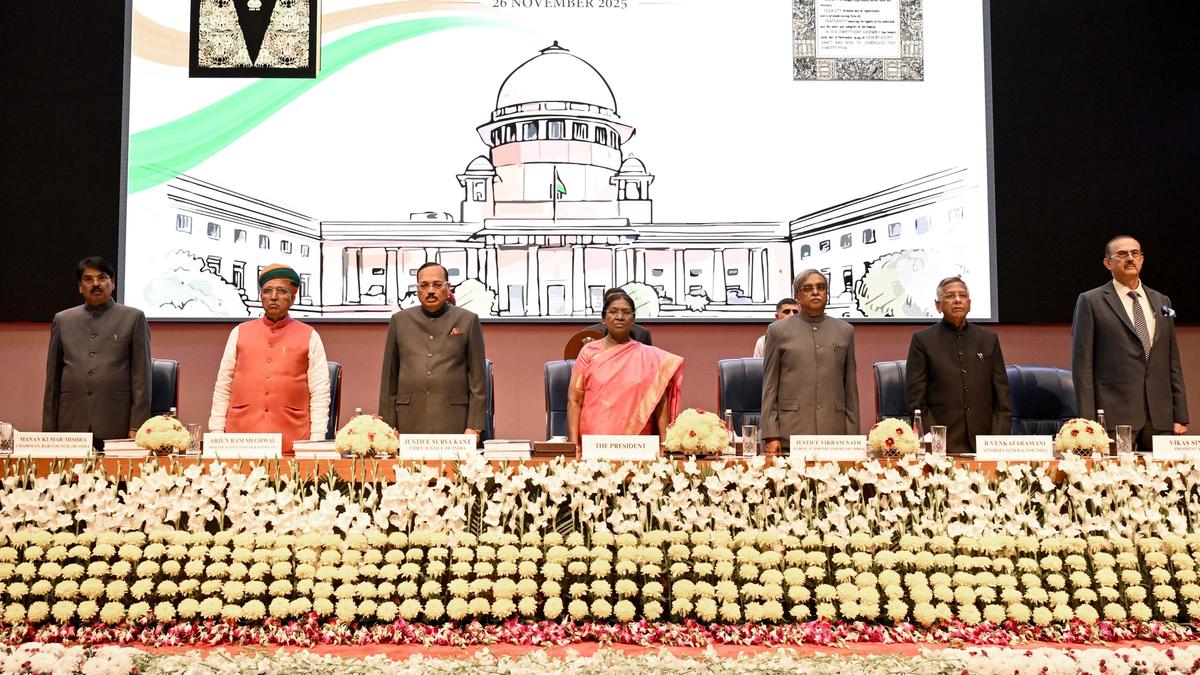
The Chief Justice of India Surya Kant has advocated the formulation of a National Judicial Policy to address growing concerns over divergent judicial interpretations across High Courts and different Benches of the Supreme Court of India. The proposal is aimed at ensuring greater consistency, predictability, and coherence in judicial outcomes across the country.
What is a National Judicial Policy?
A National Judicial Policy would function as a common guiding framework for courts at all levels, laying down uniform standards of interpretation, procedure, and case management. It seeks to ensure that courts across India “speak in one rhythm” on major constitutional and legal questions, without compromising their adjudicatory independence.
Why is such a policy needed?
India’s judicial system faces frequent conflicting rulings by different High Courts on similar legal issues, creating uncertainty for citizens, governments, and institutions. Even within the Supreme Court, multiple Benches sometimes issue inconsistent orders, affecting policy implementation. With nearly 5.4 crore pending cases, the absence of standardised timelines and procedures aggravates delays. Additionally, uneven infrastructure, language barriers, high litigation costs, and geographical distance restrict access to justice, particularly for marginalised groups.
Existing and Supporting Reforms
The judiciary has already initiated several measures aligned with the spirit of a national policy. These include promotion of mediation and alternative dispute resolution, expansion of digital justice tools such as e-filing and virtual hearings, strengthening of arbitration mechanisms, and efforts toward modernising court infrastructure. International judicial cooperation and training exchanges are also being used to adopt global best practices.
Key Challenges
Implementing a national framework faces structural hurdles. India’s federal diversity, reflected in varying state laws and languages, complicates uniformity. There are also concerns that such a policy could dilute judicial independence, especially the constitutional autonomy of High Courts under Articles 225 and 226. Persistent infrastructure gaps, large judicial vacancies, resistance to procedural change, and the digital divide further constrain uniform implementation.
Way Forward
A workable National Judicial Policy must be jointly drafted by the Supreme Court, High Courts, and the Law Ministry, ensuring a balance between uniform standards and constitutional autonomy. Harmonising court procedures, strengthening the lower judiciary, expanding inclusive digital access, scaling up pre-litigation mediation, and improving coordination through regular judicial conferences are essential steps.