
White-bellied Heron
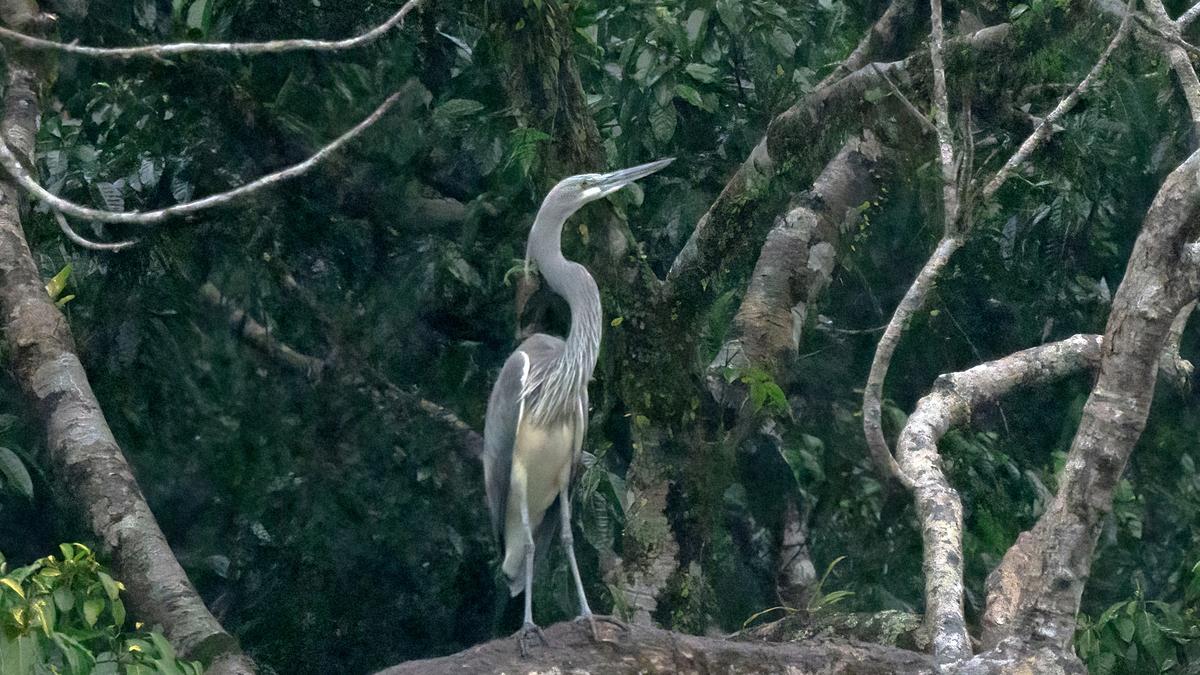
- 24 Jul 2026
In News:
The proposed 1,200 MW hydropower project on the Lohit River in Arunachal Pradesh has raised concerns over its potential impact on the White-bellied Heron, one of the world's rarest and most threatened bird species.
About White-bellied Heron
- The White-bellied Heron (Ardea insignis), also known as the Imperial Heron, belongs to the family Ardeidae.
- It is the second-largest heron species in the world and among the most elusive birds globally.
- The species is strictly dependent on free-flowing, fast-flowing Himalayan rivers bordered by mature riparian forests with minimal human disturbance.
- It primarily feeds on fish in shallow river rapids, making it extremely vulnerable to hydropower dams, altered river flows, increased water turbidity, and habitat fragmentation.
- It inhabits eastern Himalayan river systems up to an elevation of about 1,500 metres above sea level.
Key Features
The White-bellied Heron possesses a long flexible neck, a sharp serrated bill for catching fish, compact body, shorter legs, and extended toes that help it maintain stability on slippery rocks in fast-flowing rivers.
Standing nearly four feet tall, it follows a distinctive hunting strategy by remaining motionless before rapidly striking at nearby fish.
Distribution
- Globally, the species occurs across the Himalayan freshwater ecosystems of Bhutan, India, Myanmar, China, and Bangladesh, covering nearly 165,000 sq. km.
- Fewer than 60 individuals survive in the wild today. Bhutan supports about 45% of the global population and is regarded as the species' last major stronghold. The bird is considered extinct in Nepal and possibly Bangladesh.
- In India, the White-bellied Heron is found only in Arunachal Pradesh, particularly in the Lohit, Anjaw, and Changlang districts, including areas around Namdapha Tiger Reserve and Kamlang Tiger Reserve.
- India has an estimated 6–9 individuals, distributed across the Noa-Dehing, Lahm, and Lohit rivers. The Lahm River basin, a tributary of the Lohit, supports nearly 70% of India's population, while Walong Cantonment near the proposed dam site is an important breeding area.
Conservation Status
- IUCN Red List: Critically Endangered
- Wildlife (Protection) Act, 1972: Schedule I
Threats
The principal threats include:
- Hydropower projects and river regulation
- Habitat loss and fragmentation
- Hunting and human disturbance
- Extremely small population and restricted distribution