
Western Ghats Eco-Sensitive Area (ESA)
- 31 Jul 2026
In News:
The Ministry of Environment, Forest and Climate Change (MoEFCC) has reissued the 7th draft notification proposing an Eco-Sensitive Area (ESA) in the Western Ghats. The notification remains open for public objections for 60 days, while differences persist between the Centre and the six Western Ghats States over the extent of the notified area.
7th Draft Notification on Western Ghats ESA
- The proposed Eco-Sensitive Area (ESA) covers 56,825.7 sq. km across Gujarat, Maharashtra, Goa, Karnataka, Kerala, and Tamil Nadu, with Karnataka accounting for the largest share and Gujarat the smallest.
- The draft proposes a ban on commercial mining, quarrying, sand mining, new thermal power plants, red-category industries, and large-scale construction projects. Hydropower projects will be permitted only under strict regulation, while agriculture, plantation activities, and the livelihoods of local communities remain exempt.
- It also allows phased implementation of the ESA without waiting for consensus from all six states. The tenure of the Sanjay Kumar Committee (2022), constituted to examine state objections and boundary-related issues, has been extended until July 2027.
Evolution of the ESA Proposal
The proposal to notify the Western Ghats as an ESA has remained under consideration since 2011.
- The Gadgil Committee (Western Ghats Ecology Expert Panel, 2011) recommended declaring the entire Western Ghats as an Eco-Sensitive Area and dividing it into ESZ-I, ESZ-II and ESZ-III based on ecological sensitivity. However, states opposed the recommendations as being too restrictive.
- The Kasturirangan Committee (2013) adopted a more balanced approach by recommending that only about 37% of the Western Ghats (around 60,000 sq. km) be notified as an ESA while permitting sustainable development in other areas.
Challenges
The notification has remained pending due to disagreements between the Centre and States over balancing conservation with development.
Boundary demarcation disputes, disagreements over village inclusion, lack of adequate financial incentives for conservation, and repeated draft notifications without finalisation have created regulatory uncertainty, allowing environmentally damaging activities in ecologically fragile regions.
Western Ghats
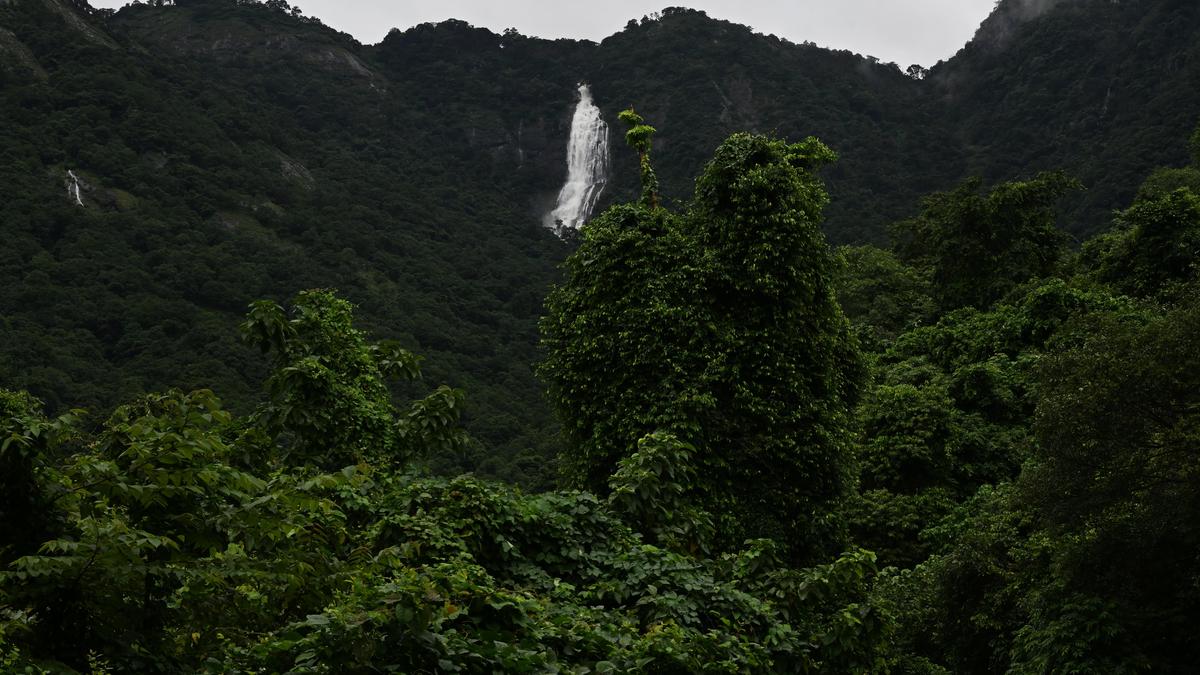
- The Western Ghats (Sahyadris) extend for about 1,490 km from Gujarat to Kerala and Tamil Nadu, covering nearly 1.4 lakh sq. km across six states. They are older than the Himalayas, having formed from the faulted edge of the Deccan Plateau following the breakup of Gondwanaland.
- The mountain chain is interrupted by three important gaps—Goa Gap, Palghat Gap, and Shencottah Gap—which divide it into the Northern, Central, and Southern Western Ghats.
- The region was designated a UNESCO World Heritage Site (2012) as a serial property comprising 39 protected areas grouped into seven sub-clusters: Sahyadri, Kudremukh, Talacauvery, Nilgiri, Anamalai, Periyar, and Agasthyamalai.
- The Southern Western Ghats contain Anamudi (2,695 m), the highest peak of the Western Ghats and the highest mountain in India outside the Himalayas.
Ecological Importance
- The Western Ghats are one of the world's eight hottest biodiversity hotspots and function as the water tower of Peninsular India. They intercept the southwest monsoon, regulate regional climate, and give rise to major east- and west-flowing rivers.
- The region supports over 5,000 flowering plant species, with around 65% of amphibians and 53% of freshwater fishes being endemic. It is home to flagship species such as the Lion-tailed Macaque, Nilgiri Tahr, Nilgiri Langur, Tiger, Asian Elephant, and Gaur.
- Besides biodiversity conservation, the Western Ghats contribute significantly to carbon sequestration, provide valuable non-timber forest products, support agriculture and hydropower, and sustain the livelihoods of forest-dependent communities.