
Vehicle-to-Vehicle (V2V) Technology
- 07 Aug 2026
In News:
The Ministry of Road Transport and Highways (MoRTH) has issued a draft notification proposing amendments to the Central Motor Vehicles Rules, 1989, introducing Vehicle-to-Vehicle (V2V) communication standards (AIS-230) to enhance road safety.
About Vehicle-to-Vehicle (V2V) Technology
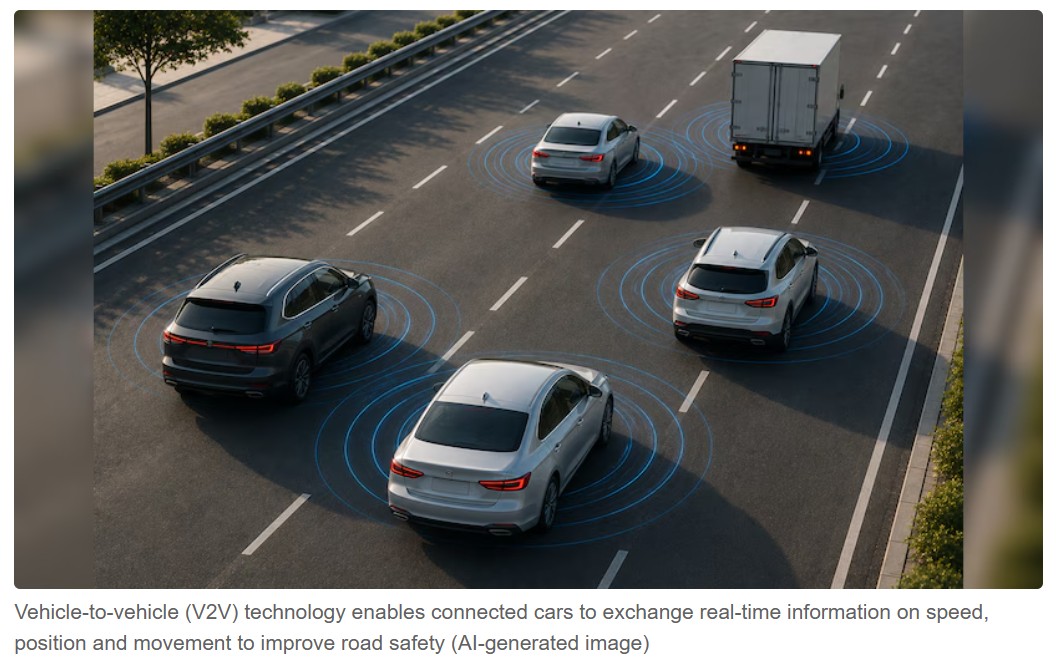
Vehicle-to-Vehicle (V2V) technology is a wireless communication system that enables vehicles to exchange real-time information such as speed, location, direction, acceleration, and braking status. By sharing this data directly with nearby vehicles, V2V helps drivers detect hazards even when they are not visible, thereby preventing collisions and improving overall road safety.
Key Features
- Operates using Cellular Vehicle-to-Everything (C-V2X) technology on the 5.875–5.925 GHz license-exempt spectrum.
- Functions through On-Board Units (OBUs) installed in vehicles that continuously exchange low-latency data.
- Supports 360-degree, non-line-of-sight communication, making it effective around blind curves, junctions, and adverse weather conditions.
- Incorporates encrypted communication protocols to safeguard against spoofing, message tampering, and cyberattacks.
Implementation Timeline
- AIS-230 will serve as the national technical standard.
- Voluntary compliance: From 1 October 2027.
- Mandatory implementation: For all newly manufactured L, M, and N category vehicles from 1 October 2028.
Applications
V2V technology supports several advanced safety functions, including:
- Emergency Electronic Brake Light (EEBL).
- Forward Collision Warning (FCW).
- Blind Spot and Lane Change Alerts.
- Wrong-Way Driving Detection.
- Emergency Vehicle Approaching Alerts.