
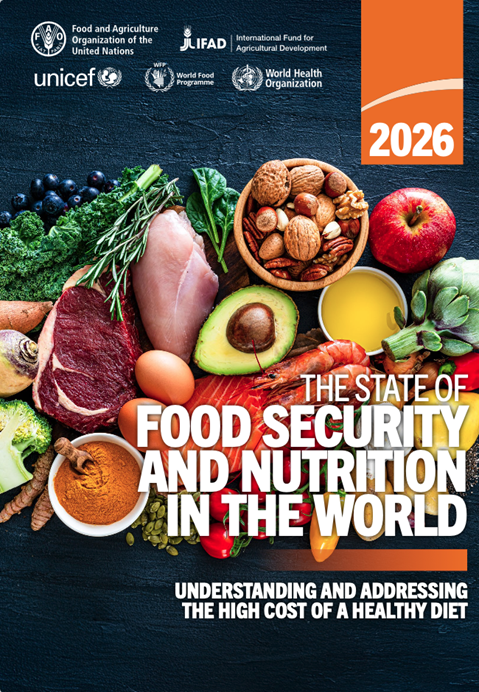
The State of Food Security and Nutrition in the World (SOFI) 2026
- 07 Aug 2026
In News:
The State of Food Security and Nutrition in the World (SOFI) 2026 report highlighted that global hunger declined for the third consecutive year, but 645 million people remain undernourished. For the first time, Africa surpassed Asia as the region with the highest number of people facing hunger.
About SOFI
The State of Food Security and Nutrition in the World (SOFI) is the annual flagship report jointly published by the FAO, IFAD, UNICEF, WFP, and WHO. It monitors global progress towards SDG 2 (Zero Hunger) by assessing food security, hunger, malnutrition, and the affordability of healthy diets.
Key Findings
- Global hunger declined to 7.8% in 2025, down from 8.6% in 2022, though 645 million people remain undernourished.
- Africa became the global hunger hotspot, with 309 million people (20% of its population) facing hunger, compared to 292 million (6%) in Asia.
- Around 2.1 billion people (25.8%) experienced moderate or severe food insecurity in 2025.
- The Cost of a Healthy Diet (CoHD) increased to 4.28 PPP dollars per person per day, leaving 2.69 billion people (32.7%) unable to afford a healthy diet.
- Progress towards SDG 2.2 (ending all forms of malnutrition) remains slow, with inadequate improvement in dietary diversity, child nutrition, and maternal health indicators.
India in SOFI 2026
India played a major role in improving food security in Southern Asia, with undernourishment declining from 13.9% in 2021 to 9.3% in 2025. The report also notes that India significantly improves the affordability of healthy diets in lower-middle-income countries. However, maternal anaemia and the rising cost of fruits and vegetables remain major concerns.
Cost of a Healthy Diet (CoHD)
The Cost of a Healthy Diet (CoHD) is an indicator developed by the FAO and World Bank that estimates the minimum daily cost of a nutritionally adequate diet. It is based on a basket of six food groups providing around 2,330 kcal per day and is calculated using Purchasing Power Parity (PPP) prices.
Significance
The report highlights that ensuring food availability alone is insufficient. Achieving Zero Hunger requires shifting from calorie-centric food systems to nutrition-sensitive agriculture, improving dietary diversity, strengthening value chains and post-harvest infrastructure, and making nutritious foods more affordable through targeted policy interventions.