
Cloudbursts in India
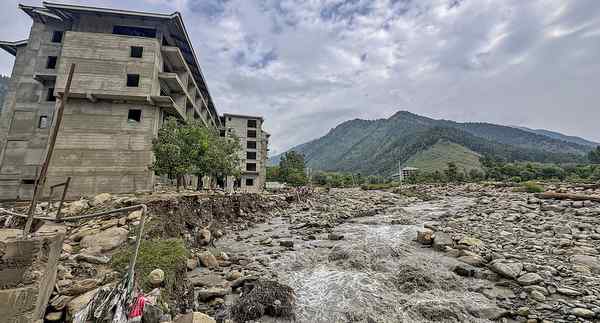
- 01 Aug 2026
In News:
Recent heavy monsoon rainfall across Uttarakhand, Himachal Pradesh, and Jammu & Kashmir has triggered flash floods and landslides, drawing attention to the increasing occurrence of cloudbursts in the Himalayan region.
What is a Cloudburst?
- According to the India Meteorological Department (IMD), a cloudburst is an extremely localized weather event in which 100 mm (10 cm) or more rainfall occurs within one hour over an area of about 20–30 sq. km. The sudden release of such a large volume of water overwhelms the land's infiltration capacity, resulting in flash floods, debris flows, and landslides.
- Some scientists also recognize a mini-cloudburst, where around 50 mm rainfall within an hour over a similar area can cause severe damage, particularly in mountainous terrain.
How Does a Cloudburst Occur?
Cloudbursts are primarily associated with orographic rainfall. Moisture-laden monsoon winds are forced to ascend steep mountain slopes, leading to rapid cooling and condensation.
Strong updrafts within towering cumulonimbus clouds keep water droplets suspended, allowing them to accumulate. Once these updrafts weaken or the water load becomes too heavy, the entire mass of water is released suddenly over a very small area, producing intense rainfall within a short duration.
Occurrence in India
Cloudbursts occur predominantly in the Himalayan region, especially in Uttarakhand, Himachal Pradesh, Jammu & Kashmir, and Ladakh, where rugged topography and steep mountain slopes favour their formation.
Although IMD records documented around 30 cloudburst events between 1970 and 2016, experts believe the actual number is much higher due to limited rain-gauge coverage and radar blind spots in remote mountainous regions.
Climate change is expected to increase the frequency and intensity of such localized extreme rainfall events as a warmer atmosphere can hold more moisture.
Major Recent Events
Recent incidents include cloudburst-induced flash floods in Pahalgam and Anantnag (Jammu & Kashmir, 2026), Dharali and Uttarkashi (Uttarakhand, 2025), Amarnath Cave (2022), and Lahaul-Spiti and Mandi (Himachal Pradesh, 2023), causing widespread destruction of roads, bridges, settlements, and loss of lives.
Impacts
Cloudbursts trigger flash floods, debris flows, landslides, and river blockages, leading to severe damage to infrastructure, agriculture, and human settlements.
The rapid movement of water, rocks, and sediment often destroys highways, bridges, hydropower infrastructure, and villages within minutes. Temporary blockage of rivers may also create artificial lakes, whose sudden breach can generate secondary floods downstream.
Experts also caution that attributing every disaster solely to cloudbursts may divert attention from human-induced factors such as deforestation, illegal construction, poor drainage, and encroachment of river channels.
NDMA Recommendations
The National Disaster Management Authority (NDMA) recommends identifying vulnerable micro-catchments through hazard mapping and restricting construction in flood-prone and unstable areas.
It also advocates expanding Doppler Weather Radar (DWR) and Automatic Weather Station (AWS) networks under Mission Mausam, strengthening short-term nowcasting and early warning systems, improving drainage infrastructure, promoting slope stabilization through bio-engineering, and establishing community-based disaster preparedness and evacuation systems.