
Blue Straggler Stars (BSS)
- 29 Jul 2026
In News:
Astronomers from the Indian Institute of Astrophysics (IIA), along with international collaborators, have reported the rare discovery of a Blue Straggler Star (BSS) actively forming in the binary star system TIC 327546480. The finding provides direct evidence of how these unusual stars are formed through mass transfer in binary systems.
What are Blue Straggler Stars (BSS)?
- Blue Straggler Stars (BSS) are hotter, brighter, bluer, and more massive stars found in old open and globular star clusters. Although all stars in a cluster are believed to have formed at the same time, Blue Stragglers appear much younger because they continue to shine like younger stars after gaining fresh hydrogen fuel.
- The term Blue Straggler was introduced after Allan Sandage first identified these stars in 1953 in the globular cluster M3.
How are Blue Straggler Stars Formed?
Blue Stragglers are believed to form through two main mechanisms:
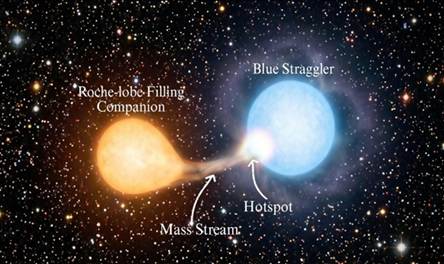
- Mass Transfer in Binary Systems: In a close binary system, an ageing star expands beyond its Roche lobe and transfers matter to its companion. The companion gains fresh hydrogen, becomes more massive, hotter, and brighter, effectively resetting its evolutionary clock.
- Stellar Collision or Merger: In dense star clusters, two stars may collide or merge, forming a single rejuvenated star with greater mass.
Key Features of the Newly Discovered System
- The newly discovered system TIC 327546480 is a semi-detached binary system in which the smaller companion star is continuously transferring matter to the Blue Straggler.
- The transferred gas also increases the star's angular momentum, causing it to rotate rapidly. The infalling material produces X-rays, providing direct observational evidence of active mass transfer.
- Researchers estimate that this rejuvenation process began around 5.46 billion years ago and is still continuing.
Significance of the Discovery
The discovery provides one of the clearest observational confirmations that mass transfer in binary systems can produce Blue Straggler Stars.
It improves scientific understanding of binary star evolution, stellar mass transfer, and the life cycle of stars, while helping astronomers refine models of stellar evolution across the universe.