
BitChat Repositories
- 28 Jul 2026
In News:
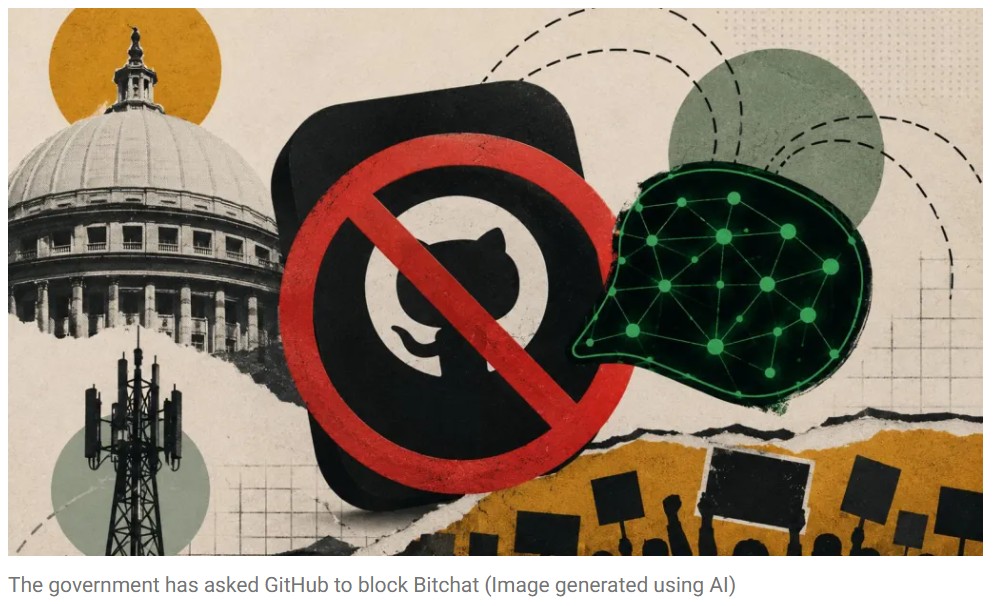
The Indian Cyber Crime Coordination Centre (I4C) under the Ministry of Home Affairs directed GitHub to remove three repositories hosting BitChat, citing concerns over law enforcement and cyber security.
About BitChat
- BitChat is an open-source, decentralized peer-to-peer (P2P) messaging application that enables communication without internet connectivity, mobile networks, or central servers.
- The project, conceived by Doris Lima and developed by Jack Dorsey, has its source code and Android installation files hosted on GitHub.
- Unlike conventional messaging platforms, BitChat uses Bluetooth Low Energy (BLE) to create a mesh network, allowing nearby devices to relay encrypted messages from one phone to another until they reach the intended recipient. When internet connectivity is available, it can also integrate with the decentralized Nostr protocol.
Key Features
BitChat operates without requiring phone numbers, email addresses, or user accounts, ensuring complete anonymity. It employs end-to-end encryption using the Noise Protocol Framework, preventing intermediary devices from accessing message content.
The application also supports ephemeral messaging, automatic deletion of chats, and a panic mode that enables rapid deletion of stored data. Since there are no central servers, it does not maintain centralized communication logs or subscriber databases.
Concerns
The absence of centralized infrastructure and user verification makes it difficult for law enforcement agencies to identify users or intercept communications during criminal investigations.
Authorities have also expressed concerns that such mesh-based communication platforms could be used to coordinate activities during internet shutdowns, bypass lawful surveillance, or evade public order restrictions.
Additionally, legal experts have raised concerns that the government's action under Section 79(3)(b) of the Information Technology Act, instead of Section 69A, may bypass procedural safeguards recognised in the Shreya Singhal and Anuradha Bhasin judgments.