
UN ESCAP Asia-Pacific Disaster Report 2025
- 29 Nov 2025
In News:
The UN Economic and Social Commission for Asia and the Pacific (ESCAP), in its Asia-Pacific Disaster Report 2025, has warned that Asian megacities such as Delhi, Karachi, Dhaka, Manila, Shanghai and Seoul face severe and potentially deadly heat stress due to the combined impact of global warming and the urban heat island (UHI) effect.
Urban Heat Island Effect and Temperature Rise
The report highlights that even if global warming is limited to 1.5–2°C, dense urban areas could experience an additional 2–7°C rise in local temperatures. This amplification is caused by concrete-dominated landscapes, limited green cover, waste heat from vehicles and air conditioners, and poor urban ventilation. As a result, cities heat up far beyond surrounding rural areas, pushing everyday temperatures into dangerous zones.
Heat Index and Measurement of Risk
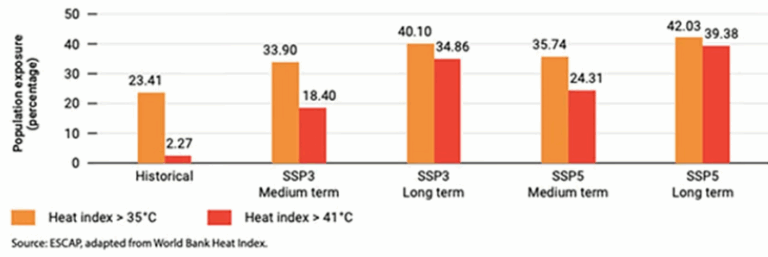
To assess extreme heat risk, ESCAP used the heat index, which combines air temperature and relative humidity to reflect “felt temperature.”
- 35°C and above: Severe heat stress
- 41°C and above: Extreme danger with high risk of heat stroke
The analysis used four thresholds-35°C, 37°C, 39°C and 41°C, corresponding to the World Bank’s heat risk index categories. South and Southwest Asia fall in the highest risk categories (3 and 4).
Regional Exposure Patterns
- India, Pakistan and Bangladesh may face over 300 days annually with heat index above 35°C, and more than 200 days above 41°C in several regions.
- Over 40% of South Asia’s population is projected to experience chronic exposure to extreme heat in both medium- and long-term scenarios, regardless of climate mitigation pathways.
- Southeast Asia could see nearly 30% of its population exposed to extreme heat under business-as-usual scenarios.
Extreme Heat: Fastest Growing Climate Hazard
The report identifies extreme heat as the fastest-growing climate-related hazard in Asia-Pacific.
- 2024 was the hottest year on record globally.
- The Bangladesh heatwave (April–May 2024) affected ~33 million people, the largest single disaster by population impacted.
- In India, prolonged heatwaves caused around 700 deaths, making it the second deadliest event in the region that year.
According to EM-DAT, over 180 natural and climate-induced disasters were recorded in Asia-Pacific in 2024.
Health, Inequality and Air Pollution Linkages
Extreme heat overwhelms the body’s thermoregulation, increasing risks of cardiovascular, respiratory and kidney disorders, as well as heatstroke. Urban poor communities are disproportionately affected due to crowded housing, lack of cooling, water stress and limited healthcare access. Heat also worsens air pollution, as droughts and wildfires increase PM10, PM2.5, VOCs and nitrogen oxides, creating a dangerous heat–pollution feedback loop.
Economic and Livelihood Impacts
Heat stress severely affects productivity in labour-intensive sectors such as agriculture, construction and industry. Across Asia-Pacific, working hours lost to heat stress are projected to more than double—from 3.75 million to over 8.1 million full-time job equivalents by 2030.
Using probabilistic risk modelling, ESCAP estimates average annual disaster losses could rise from $418 billion currently to $498 billion under high-emission scenarios, reflecting rising exposure and insufficient adaptation.
Way Forward Highlighted by the Report
The report stresses the need to place extreme heat at the centre of multi-hazard planning, including:
- Heat–health early warning systems with last-mile communication
- Heat-sensitive urban design (cool roofs, urban forests, shaded corridors)
- Legal protection for outdoor workers
- Strengthened health systems and cooling shelters
- Inclusive adaptation policies targeting vulnerable populations