
Sujalam Bharat Summit 2025
- 30 Nov 2025
In News:
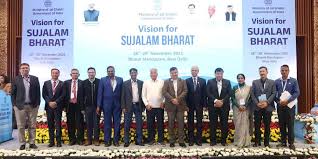
The Ministry of Jal Shakti will host the Vision for Sujalam Bharat Summit 2025 at Bharat Mandapam, New Delhi, marking a major national initiative to build a coherent, practical and cooperative water security framework for India. The Summit forms part of NITI Aayog’s six thematic Departmental Summits, envisaged by the Prime Minister to bring together Central and State governments along with junior and field-level cadres for solution-oriented governance.
Objectives and Approach
The Summit aims to accelerate water sustainability through:
- Evidence-based policymaking
- Sectoral reforms
- Cooperative federalism in water governance
It adopts a whole-of-government approach, bridging the gap between policy formulation and on-ground implementation, and aligning national priorities with State- and community-level action.
Thematic Areas Covered
The Vision for Sujalam Bharat process encompasses six critical thematic areas:
- Rejuvenation of Rivers and Springs: Focus on Aviral (continuous) and Nirmal (clean) Dhara through spring-shed management, catchment protection, wetland restoration, riverfront development, and community-led river stewardship.
- Greywater Management and Reuse: Promotion of circular water use via pricing and financing models, nature-based solutions, septage management, and reuse in domestic, industrial and urban sectors.
- Technology-driven Water Management: Deployment of AI-based monitoring, micro-irrigation, leak detection, loss reduction, and precision agriculture to enhance demand-side efficiency.
- Water Conservation and Groundwater Recharge: Managed aquifer recharge, revival of traditional water systems, community-led groundwater governance, and behavioural change aligned with the LiFE (Lifestyle for Environment) initiative.
- Sustainable Drinking Water Supply: Emphasis on source sustainability planning, climate-resilient infrastructure, community-based operations and maintenance (O&M), and digital governance tools.
- Community & Institutional Engagement: Empowerment of Panchayati Raj Institutions (PRIs), Self-Help Groups (SHGs), frontline workers, and local bodies, alongside stronger inter-departmental convergence.
Consultative Process and Key Outcomes
Between September and October 2025, the Ministry conducted six thematic workshops, engaging over 2,800 participants from across States/UTs, Central ministries, technical institutions, PRIs, NGOs, SHGs and field-level officials.
Based on these consultations, five national priorities were identified:
- Strengthening source sustainability
- Scaling groundwater recharge
- Expanding modern and nature-based solutions
- Revitalising community institutions
- Enhancing inter-departmental convergence
Significance
- Provides a national roadmap for water-secure and climate-resilient India
- Integrates rural–urban water management, sanitation, irrigation efficiency and drinking water security
- Encourages community ownership of water assets for long-term sustainability
- Strengthens alignment between strategy and execution through cooperative federalism