
Indian names approved for Martian Landforms
- 30 Nov 2025
In News:
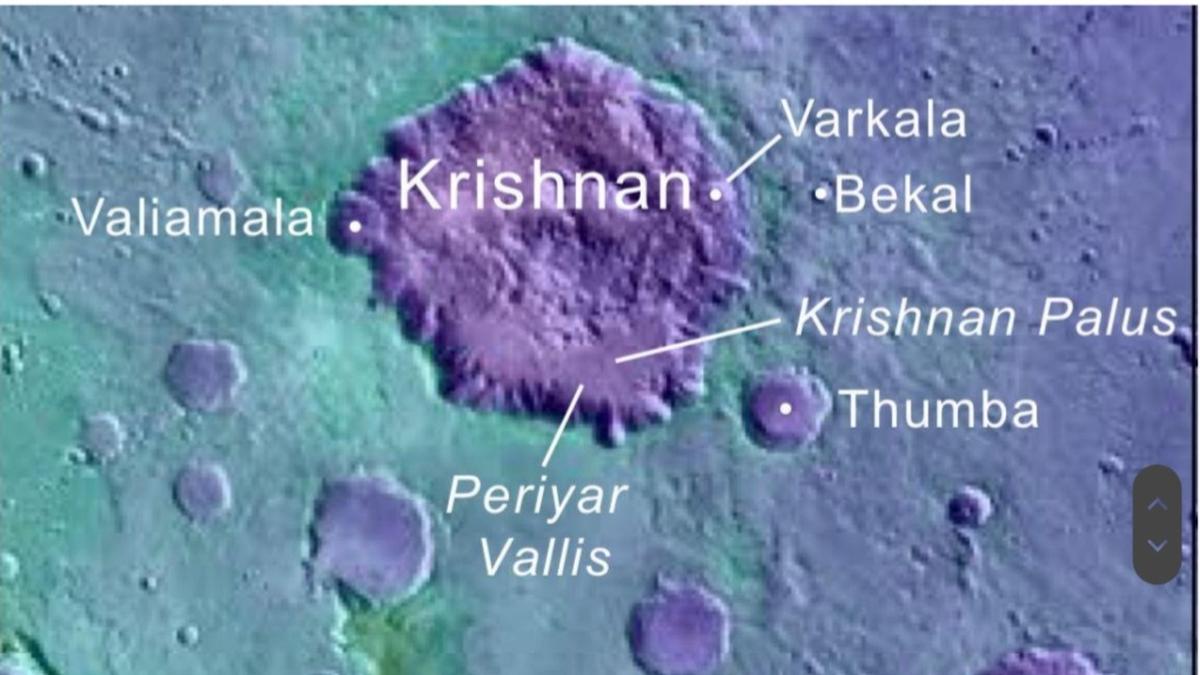
The International Astronomical Union (IAU) has approved seven new Indian names proposed by Kerala-based researchers for geological features on Mars, marking a significant recognition of India’s scientific and cultural contributions in planetary science. These names include Martian craters, valleys and plains inspired by Indian geographers, scientists and locations with geological or space-science relevance.
Martian Landforms named after Indian Places and Personalities
Among the newly approved names, several are inspired by Kerala’s geography and India’s space and scientific legacy:
- Periyar Vallis: A Martian valley named after the Periyar River, Kerala’s longest river, highlighting similarities between fluvial landforms on Earth and Mars.
- Varkala Crater: Named after Varkala beach, known for its laterite cliffs rich in jarosite, a mineral also detected on Mars, making it a key terrestrial analogue site.
- Bekal Crater: Named after Bekal Fort in Kasaragod, a historic coastal fort associated with the Keladi Nayaka dynasty, Mysore rulers and the British.
- Thumba Crater: Named after Thumba, the birthplace of India’s space programme and home to the Thumba Equatorial Rocket Launching Centre (1962), where Indian Space Research Organisation (ISRO) began its early rocket launches.
- Valiamala Crater: Named after Valiamala, which hosts the Indian Institute of Space Science and Technology (IIST), India’s premier space education institution.
- Krishnan Crater: Named in honour of M. S. Krishnan, India’s pioneering geologist and first Indian Director of the Geological Survey of India (GSI). Located in the Xanthe Terra region, the crater is about 3.5 billion years old and preserves evidence of ancient glacial and fluvial activity.
- Krishnan Planus: A plain southeast of the Krishnan Crater, also named after M. S. Krishnan and geologically associated with the crater system.
Note: In 2024, the IAU had approved three Indian-proposed names from Ahmedabad-based Physical Research Laboratory (PRL), including Lal Crater (after geophysicist Devendra Lal) and Mursan and Hilsa craters (named after towns in Uttar Pradesh and Bihar).
How are Martian surface features named?
The IAU is the global authority responsible for naming celestial bodies and planetary features. Proposals are evaluated by its Working Group for Planetary System Nomenclature (WGPSN).
Key guidelines include:
- Large craters (>50 km): Named after deceased scientists with foundational contributions.
- Small craters: Named after towns or villages with populations below 100,000.
- Names must be unique, culturally relevant, non-political, non-offensive, and easy to pronounce.
- Each proposal must include the name’s origin, coordinates, imagery, feature type and scientific justification.