
Red Sanders
- 23 Feb 2026
In News:
Busy Tirupati pilgrimage route makes Red Sanders smuggling easy in south Andhra Pradesh.
About Red Sanders
- Scientific Name: Pterocarpus santalinus
- Common Name: Red Sandalwood
- Type: Tropical dry deciduous tree
- Endemic to: Southern Andhra Pradesh
Geographic Distribution
- Restricted to three districts: Chittoor, Nellore, and YSR Kadapa
- Largest reserve located in the Seshachalam Biosphere Reserve, part of the Eastern Ghats
- Spread over 4,755 sq km
- Located about 35 km from Tirupati temple town
Ecological Characteristics
- Grows in rocky, degraded and red soil areas
- Requires hot and dry climate
- Fire-hardy and drought-resistant
- Slow-growing: 25–40 years to reach maturity
- Wood is relatively brittle compared to teak
Economic Importance
- Contains ‘Santalin’, a natural red dye
- Used in:
- Pharmaceutical preparations
- Textile and leather industries
- Food colouring
- Perfume and medicinal products
- Gained global attention in the 1960s when Japanese instrument makers used it for crafting the traditional shamisen due to superior tonal quality
Conservation Status
- IUCN Red List: Endangered
- CITES: Appendix II (International trade strictly regulated)
- Wildlife (Protection) Act, 1972: Schedule IV
Harvesting and felling inside reserve forests is prohibited. Legal trade permitted only under regulated plantation and CITES-controlled export mechanisms.
Red Sanders Smuggling: Key Issues
Role of Tirupati Pilgrimage Route
The proximity of the Tirupati pilgrimage corridor to Seshachalam forests facilitates smuggling due to:
- Heavy traffic movement
- Limited vehicle checking
- Multiple forest entry points
- Inter-state border with Tamil Nadu
Smugglers often:
- Enter from Tamil Nadu
- Disguise themselves as labourers or pilgrims
- Use small vehicles for transport
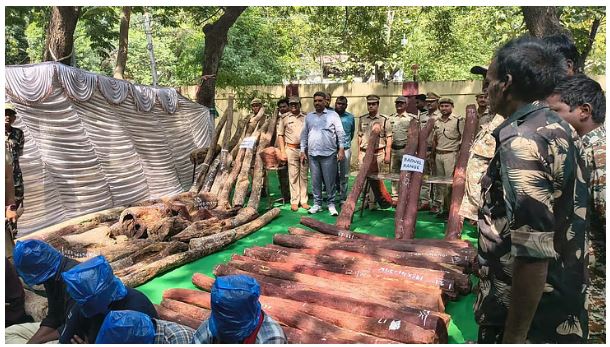
- Hide timber in containers or dump logs inside forests/water temporarily
- Use sea routes for international export
Organised Timber Mafia
- Operates in coordinated teams (felling transport units)
- Several trees cut within short duration
- Cross-firing incidents reported
- Forest officials issued arms after killings of personnel
- Andhra Pradesh Police–Forest Department task force formed in 2014
Recent Enforcement Action
- January 9, 2026: 75 Red Sanders logs seized in Kadapa division
Broader Issue: Illegal Timber and Deforestation
- India among top 10 forest-rich nations (area-wise)
- Since 1980, 1.5 million hectares of forest land diverted for development
- Majority diversion after 2000
- India is also one of the largest timber importers
- Illegal logging contributes to:
- Deforestation
- Carbon emissions
- Biodiversity loss
- Forest conflicts
Inter-state borders often act as transit hubs (e.g., timber movement in central India).
Conservation Efforts
- National Biodiversity Authority sanctioned ?82 lakh
- Andhra Pradesh State Biodiversity Board initiative
- Target: Raise 1 lakh (100,000) saplings
- Distribution to farmers for conservation and regulated cultivation
Red Sanders
- 04 Oct 2025
In News:
- Recently, the National Biodiversity Authority (NBA) sanctioned ?82 lakh to the Andhra Pradesh Biodiversity Board for the conservation of Red Sanders (Pterocarpus santalinus), an endemic and endangered tree species of India.
- The initiative, undertaken under the Access and Benefit Sharing (ABS) mechanism of the Biological Diversity Act, 2002 (amended in 2023), marks a crucial step towards community-based biodiversity conservation.
About Red Sanders
- Red Sanders, also known as Red Sandalwood, is native to the Southern Eastern Ghats, particularly in the Anantapur, Chittoor, Kadapa, and Kurnool districts of Andhra Pradesh.
- The species thrives in rocky, red soil regions with a hot and dry climate, often in degraded or fallow lands.
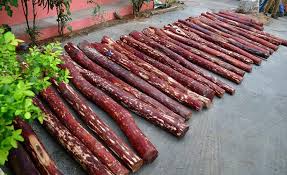
- Renowned for its deep red wood, which commands high demand in international markets for musical instruments, furniture, and medicinal purposes, Red Sanders faces serious threats from illegal felling and smuggling. Due to its restricted distribution and exploitation, it is listed as:
- IUCN: Endangered
- CITES: Appendix II (regulated international trade)
- Wildlife (Protection) Act, 1972: Schedule IV
Conservation Initiative
- The ?82 lakh grant aims to raise one lakh saplings of Red Sanders, which will be distributed among farmers under the Trees Outside Forests (ToF)programme. This aligns with India’s broader goal of enhancing green cover beyond traditional forest areas.
- The funds are sourced from benefit-sharing amounts collected from users of Red Sanders, ensuring that economic benefits are returned to local stakeholders such as farmers, tribal communities, and Biodiversity Management Committees (BMCs). The initiative exemplifies how the Access and Benefit Sharing mechanism promotes equitable sharing of biological resources and converts conservation into a community-driven effort.
- In addition, the NBA has previously released ?31.55 crore to the Andhra Pradesh Forest Department for similar conservation and protection activities related to Red Sanders. The present funding will further strengthen grassroots conservation, generating local employment, fostering skill development, and enhancing community stewardship of biodiversity resources.
National Biodiversity Authority (NBA)
The National Biodiversity Authority, headquartered in Chennai, is a statutory body established under the Biological Diversity Act, 2002, and became operational in 2003. It works in coordination with:
- State Biodiversity Boards (SBBs): Regulate access to biological resources at the state level.
- Biodiversity Management Committees (BMCs): Function at the local level to document and conserve biodiversity through People’s Biodiversity Registers (PBRs).
Composition:
- Chairperson: An eminent expert in biodiversity conservation and sustainable resource use.
- 10 Ex-officio Members: Senior representatives from various ministries.
- 5 Non-official Members: Experts from relevant fields of biodiversity management.